

UltraAvidin™ — DyLight® 488


Data
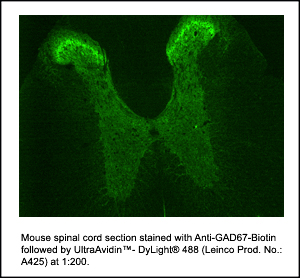
- -
- -
BackgroundUltraAvidin is Leinco Technologies' trademark for a uniquely modified form of avidin which is isolated from chicken egg whites. With a molecular weight of 60,000 there are four identical subunits each capable of binding one molecule of biotin. UltraAvidin from Leinco Technologies has been de-glycosylated to prevent carbohydrate moieties from adhering to lectin-like receptors on the surface of cells, thus eliminating the possibility of false positives. Unlike native avidin, UltraAvidin has a near neutral pI which prevents electrostatic interactions with negatively charged serum or membrane proteins. Protein DetailsFormat DyLight® 488 Product Concentration 0.2 mg/ml Formulation This DyLight® 488 conjugate is formulated in 0.01 M phosphate buffered saline (150 mM NaCl) PBS pH 7.4, 1% BSA and 0.09% sodium azide as a preservative. Working Concentration Western blotting: 1:5,000 - 1:10,000
ELISA: 1:5,000 - 1:20,000
Immunohistochemistry: 1:100 - 1:1,000
Western blotting and ELISA Chemiluminescent: 1:20,000 - 1:100,000
However, each investigator should determine their own optimal working dilution for each specific research application. Storage and Stability Stable when stored at 2 - 8°C. Do not freeze Country of Origin USA Shipping Next Day 2-8°C References & Citations1. Wilchek, M. et al.(1990) Biochem Biophys Res Commun. 1990 170(3):1236-41. 2. Sullivan, W. et al. (1996) Genetics. 143(4):1629-42. Certificate of AnalysisIMPORTANT Use lot specific datasheet for all technical information pertaining to this recombinant protein. |
Related Products
- -
- -
Prod No. | Description |
|---|---|
H1665 | |
M1386 | |
R1329 | |
R1340 | |
R1351 | |
H264 | |
M1185 | |
M111 | |
R115 | |
H215 | |
R113 | |
R114 | |
M113 | |
M114 | |
R102 | |
M102 | |
H217 | |
M1259 | |
R117 | |
R119 |
 Products are for research use only. Not for use in diagnostic or therapeutic procedures.
