Recombinant Human/Mouse/Rat BMP-2

Recombinant Human/Mouse/Rat BMP-2

Product No.: B388

[product_table name="All Top" skus="B388"]

- -
- -
Alternate Names
BMP-2A, OP-1
Product Type
Recombinant Protein
Expression Host
E. coli Cells
Species
Human
Mouse
Rat

- -
- -
Select Product Size

Data

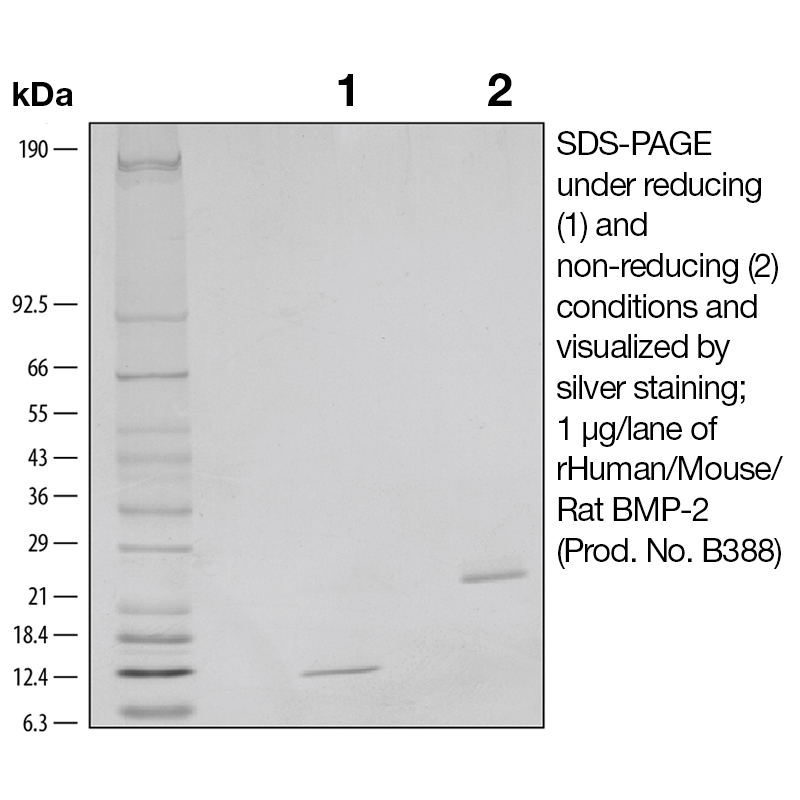
Human BMP-2 SDS-PAGE
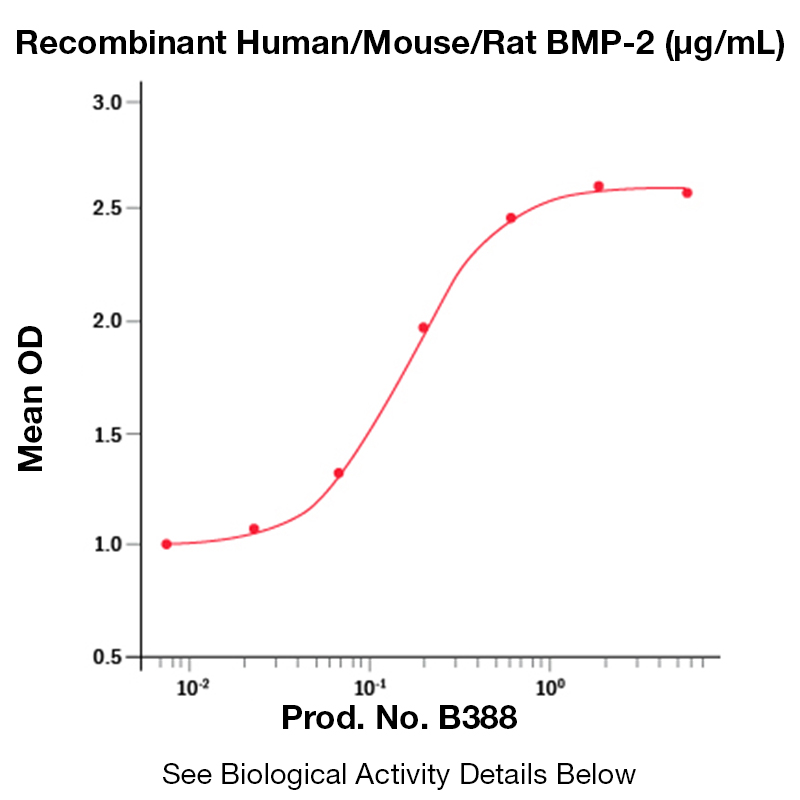
Human BMP-2 Bioactivity Data
- -
- -

Background

BMPs (Bone Morphogenetic Proteins) belong to the TGF-beta superfamily of structurally related signaling proteins. BMP-2 is a potent osteoinductive cytokine, capable of inducing bone and cartilage formation in association with osteoconductive carriers such as collagen and synthetic hydroxyapatite. In addition to its osteogenic activity, BMP-2 plays an important role in cardiac morphogenesis. The functional form of BMP-2 is a 26 kDa protein composed of two identical 114 amino acid polypeptide chains linked by a single disulfide bond. Each BMP-2 monomer is expressed as the C-terminal part of a precursor polypeptide, which also contains a 23 amino acid signal sequence for secretion, and a 259 amino acid propeptide. After dimerization of this precursor, the covalent bonds between the propeptide (which is also a disulfide-linked homodimer) and the mature BMP-2 ligand are cleaved by a furin-type protease.

Human and mouse BMP-2 and BMP-7 are 100% and 98% identical, respectively, at the amino acid level. Human BMP-2 shares 85% aa sequence identity with human BMP-4 and less than 51% aa sequence identity with other BMPs. Human BMP-7 shares approximately 60% - 70% aa sequence identity with BMP-5, -6, and -8, and less than 50% aa sequence identity with other BMPs. BMP-2 and BMP-7 are co-expressed in some embryonic tissues 6,7 and associate into a functional 38 kDa osteogenic dimer.8 In in vitro osteoblast differentiation assays and in vivo bone formation models, a BMP-2/BMP-7 heterodimer is significantly more potent than either homodimer.

Bone morphogenetic protein 2 is shown to stimulate the production of bone and recombinant human protein (rhBMP-2) and is currently available for orthopaedic usage in the United States. Implantation of BMP-2 in a collagen sponge induces new bone formation and can be used for the treatment of bony defects, delayed union, and non-union. Bone morphogenetic protein 2 has also found its way into the field of Dentistry. Oral Surgery and Implant Dentistry in particular have benefited dramatically from commercially available BMP-2.

Protein Details

Purity
>95% by SDS-PAGE and analyzed by silver stain.
Endotoxin Level
<0.01 EU/µg as determined by the LAL method
Biological Activity
The biological activity of Human BMP-2 was determined by its ability to induce alkaline phosphatase production by ATDC5 mouse chondrogenic cells. Nakamura, K. et al. (1999) Exp. Cell Res. 250:351. The expected ED<sub>50</sub>= 0.3-1 μg/ml.
Amino Acid Sequence
akhkqrk rlkssckrhp lyvdfsdvgw ndwivappgy hafychgecp fpladhlnst nhaivqtlvn svnskipkac cvptelsais mlyldenekv vlknyqdmvv egcgcr
State of Matter
Lyophilized
Predicted Molecular Mass
The predicted molecular weight of Recombinant Human BMP-2 is Mr 12.8 kDa. However, the actual molecular weight as observed by migration on SDS-PAGE is 12 kDa (reducing conditions) and 24 kDa (non-reducing conditions).
Predicted Molecular Mass
12.8
Formulation
This recombinant protein was lyophilized from a 0.2 μm filtered solution in 35% acetonitrile (CH3CN) and 0.1% trifluoroacetic acid (TFA).
Storage and Stability
This lyophilized protein is stable for six to twelve months when stored desiccated at -20°C to -70°C. After aseptic reconstitution, this protein may be stored at 2°C to 8°C for one month or at -20°C to -70°C in a manual defrost freezer. Avoid Repeated Freeze Thaw Cycles. See Product Insert for exact lot specific storage instructions.
Country of Origin
USA
Shipping
Next Day Ambient
NCBI Gene Bank

Leinco Protein Advisor

Powered by AI: AI is experimental and still learning how to provide the best assistance. It may occasionally generate incorrect or incomplete responses. Please do not rely solely on its recommendations when making purchasing decisions or designing experiments.

Recombinant Human/Mouse/Rat BMP-2 is widely used in research applications because it is a potent inducer of osteogenic and chondrogenic differentiation, making it essential for studies involving bone and cartilage formation, repair, and regeneration. It is also critical for investigating embryonic development, organogenesis, and tissue engineering.

Key scientific applications and rationale:

  • Bone and Cartilage Formation: BMP-2 stimulates the proliferation and differentiation of mesenchymal stem cells into osteoblasts and chondrocytes, promoting endochondral bone formation and cartilage repair. This makes it invaluable for research on skeletal development, fracture healing, and bone tissue engineering.

  • Enhanced Bone Healing: Recombinant BMP-2 has been shown to significantly improve bone regeneration and graft substitution in both preclinical and clinical models, outperforming traditional bone grafts in fusion rates and bone density. It is used to study accelerated healing in trauma, spinal fusion, and defect models.

  • Mechanistic Studies: BMP-2 signals through specific serine/threonine kinase receptors, activating canonical Smad pathways and other kinases (e.g., p38, JNK), allowing researchers to dissect molecular mechanisms of osteogenesis, chondrogenesis, and epithelial-to-mesenchymal transition.

  • Embryogenesis and Organogenesis: BMP-2 is indispensable for embryonic skeletal development and organ morphogenesis. BMP-2-deficient models exhibit severe developmental defects, making recombinant BMP-2 crucial for developmental biology studies.

  • Bioassays and Cell Differentiation: BMP-2 is routinely used in bioassays to induce alkaline phosphatase activity in chondrogenic cell lines (e.g., ATDC5), serving as a functional readout for osteogenic differentiation.

  • Versatility Across Species: Recombinant BMP-2 from human, mouse, or rat sources allows for cross-species studies, facilitating translational research and comparative biology.

Best practices:

  • Use carrier-free, sterile-filtered recombinant BMP-2 to ensure reproducibility and minimize endotoxin contamination.
  • Avoid repeated freeze/thaw cycles to preserve bioactivity.
  • Optimize concentration and delivery method for your specific cell type or animal model, as BMP-2 activity is dose-dependent.

Summary of scientific value:Using recombinant BMP-2 enables precise control over experimental conditions, reproducible induction of bone and cartilage formation, and mechanistic insights into skeletal biology and regenerative medicine. It is a gold standard for studies requiring robust osteoinductive and chondrogenic signals.

Recombinant Human/Mouse/Rat BMP-2 can be used as a standard for quantification or calibration in ELISA assays, provided it is compatible with your assay system and matches the form of BMP-2 detected by your ELISA antibodies.

Key considerations and supporting details:

  • Intended Use: Recombinant BMP-2 proteins are commonly used as standards in ELISA assays for quantification, as long as the recombinant protein is of the same species and form (e.g., glycosylation state, dimerization) as the analyte detected by the assay.
  • Assay Compatibility: Some ELISA kits are validated to detect both natural and recombinant BMP-2, while others may only recognize specific forms. For example, certain kits do not detect E. coli-expressed BMP-2 due to differences in folding or post-translational modifications. Always check the specificity section of your ELISA kit documentation to ensure compatibility.
  • Standard Curve Preparation: The recombinant BMP-2 standard should be prepared and diluted according to the ELISA kit instructions to generate a standard curve for quantification.
  • Matrix Effects: For accurate quantification, the recombinant standard and the sample should behave similarly in the assay matrix. Differences in aggregation, folding, or buffer composition can affect quantification accuracy.
  • Carrier Proteins: Recombinant BMP-2 is available with or without carrier proteins (e.g., BSA). For ELISA standards, the BSA-containing formulation is often recommended to improve stability and reduce adsorption to plasticware, unless BSA interferes with your assay.
  • Species Cross-Reactivity: Human, mouse, and rat BMP-2 share 100% sequence identity in the mature region, so cross-species standards are generally acceptable for assays targeting the conserved region.

Best Practices:

  • Confirm that your ELISA kit detects the recombinant BMP-2 standard you plan to use by reviewing the kit’s specificity and validation data.
  • Prepare the standard curve fresh for each assay, following the recommended dilution scheme.
  • If using a recombinant standard from a different expression system (e.g., mammalian vs. E. coli), verify that the antibodies in your ELISA recognize the recombinant form.
  • Ensure that the recombinant BMP-2 is molecularly dispersed and free of aggregates, as aggregation can affect quantification.

Summary Table:

RequirementRecommendation/Note
Protein form (species, expression)Must match ELISA kit specificity
Carrier protein (BSA)Use BSA-containing standard unless BSA interferes
Standard curve preparationFollow ELISA kit protocol
Matrix compatibilityEnsure similar behavior of standard and sample
Cross-reactivityHuman/mouse/rat BMP-2 mature regions are identical

In conclusion: You can use recombinant Human/Mouse/Rat BMP-2 as a standard for ELISA quantification if it is validated for your assay and matches the form detected by your antibodies. Always consult your ELISA kit documentation for compatibility and follow best practices for standard preparation and assay setup.

Recombinant Human/Mouse/Rat BMP-2 has been validated for a wide range of applications in published research, including:

  • Functional Assay: Used to assess the biological activity of BMP-2, such as induction of alkaline phosphatase production in cell lines (e.g., ATDC5 mouse chondrogenic cells).
  • ELISA: Employed as a standard or detection reagent in enzyme-linked immunosorbent assays.
  • Western Blot: Utilized for detection and quantification of BMP-2 protein expression.
  • Blocking Assay: Applied to study the inhibition of BMP-2 signaling pathways.
  • Immunohistochemistry: Used for localization of BMP-2 in tissue sections.
  • Bioassay: Employed in various cell-based assays to evaluate BMP-2 activity, such as osteogenic differentiation, cell proliferation, and signaling pathway activation.
  • Binding Assay/Protein-Protein Interaction: Used to study interactions between BMP-2 and its receptors or other proteins.
  • BMP-2 Delivery System: Investigated in studies focusing on novel delivery strategies for BMP-2, including spatiotemporal and controlled release systems.
  • Cell Proliferation: Assessed for its effects on cell growth and proliferation in different cell types.
  • Enzymatic Assay: Used in studies involving enzymatic activity related to BMP-2 signaling.

These applications highlight the versatility of recombinant BMP-2 in both basic research and clinical studies, particularly in the fields of bone biology, tissue engineering, and regenerative medicine.

To reconstitute and prepare Recombinant Human/Mouse/Rat BMP-2 protein for cell culture experiments, dissolve the lyophilized protein at a concentration of 100–200 μg/mL in sterile 4 mM HCl containing at least 0.1% human or bovine serum albumin (BSA) as a carrier protein. This protocol helps maintain protein stability and bioactivity for downstream cell culture applications.

Step-by-step protocol:

  • Centrifuge the vial briefly before opening to ensure all contents are at the bottom.
  • Add sterile 4 mM HCl to the vial to achieve a final concentration of 100–200 μg/mL BMP-2.
  • Include 0.1%–1% carrier protein (human or bovine serum albumin, preferably endotoxin-free) in the reconstitution buffer to prevent adsorption and loss of protein activity.
  • Gently swirl or tap the vial to mix. Avoid vortexing, which may denature the protein.
  • Aliquot the reconstituted solution to minimize freeze-thaw cycles, which can degrade BMP-2.
  • Store aliquots at ≤–20°C for long-term storage. For short-term use, aliquots can be kept at 2–8°C for up to one week.

Additional notes:

  • If a carrier-free formulation is used, reconstitute in sterile 4 mM HCl without albumin, but adding a carrier protein is recommended for most cell culture applications to stabilize BMP-2.
  • Some protocols allow reconstitution in sterile water or 20 mM acetic acid, but 4 mM HCl with albumin is preferred for optimal solubility and stability.
  • After reconstitution, further dilute BMP-2 into cell culture medium or assay buffer as needed, ensuring the final working concentration matches your experimental requirements (e.g., 40–200 ng/mL for alkaline phosphatase induction in ATDC5 cells).

Best practices:

  • Always use sterile technique to avoid contamination.
  • Avoid repeated freeze-thaw cycles by aliquoting.
  • Confirm protein concentration and activity before use in sensitive bioassays.

This protocol ensures BMP-2 remains stable and bioactive for cell culture experiments, supporting reliable and reproducible results.

Certificate of Analysis

IMPORTANT Use lot specific datasheet for all technical information pertaining to this recombinant protein.
- -
- -
Disclaimer AlertProducts are for research use only. Not for use in diagnostic or therapeutic procedures.