Chemokine (C-X-C motif) ligand 2 (CXCL2) is an inducible murine chemokine involved in attraction of polymorphonuclear granulocytes to sites of infection.1 This chemokine is secreted by monocytes and macrophages and is chemotactic for hematopoietic stem cells.2,3,4
Protein Details
Purity
>97% by SDS-PAGE and analyzed by silver stain.
Endotoxin Level
<0.01EU/µg as determined by the LAL method
Biological Activity
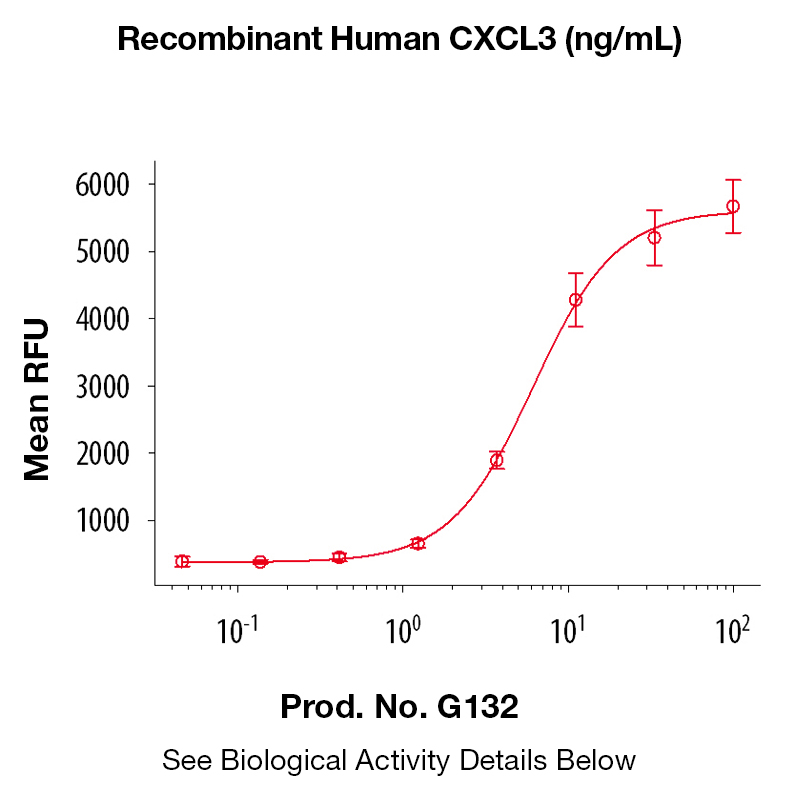
The biological activity of Human GRO-gamma was determined by its ability to induce myeloperoxidase release from cytochalasin B treated neutrophils (Shröeder, J. et al., 1987, J. Immunol. 139:3474) or chemotaxis of BaF/3 hCXCR-2 transfected cells. The expected ED50 for these effects are typically 0.1 - 0.3 μg/ml or 2 - 10 ng/ml, respectively.
The predicted molecular weight of Recombinant Human CXCL3 is Mr 8 kDa.
Predicted Molecular Mass
8
Formulation
This recombinant protein was lyophilized from a 0.2 μm filtered solution in 35% acetonitrile (CH3CN) and 0.1% trifluoroacetic acid (TFA).
Storage and Stability
This lyophilized protein is stable for six to twelve months when stored desiccated at -20°C to -70°C. After aseptic reconstitution, this protein may be stored at 2°C to 8°C for one month or at -20°C to -70°C in a manual defrost freezer. Avoid Repeated Freeze Thaw Cycles. See Product Insert for exact lot specific storage instructions.
Powered by AI: AI is experimental and still learning how to provide the best assistance. It may occasionally generate incorrect or incomplete responses. Please do not rely solely on its recommendations when making purchasing decisions or designing experiments.
Recombinant Human CXCL3 is used in research applications to study its roles in inflammation, immune cell recruitment, angiogenesis, and tumor biology, as well as to dissect its signaling mechanisms in vitro and in vivo.
Key reasons to use recombinant human CXCL3 in research include:
Modeling Tumor Progression and Metastasis: CXCL3 is implicated in promoting tumor cell proliferation, migration, and invasion in various cancers, including head and neck squamous cell carcinoma (HNSCC). Exogenous recombinant CXCL3 enhances malignant behaviors in cancer cell lines, making it valuable for studying mechanisms of tumor progression and for screening potential anti-cancer therapies.
Investigating Inflammatory Responses: CXCL3 is a potent chemokine that recruits neutrophils and other immune cells to sites of inflammation by binding to CXCR2. In neuroinflammation models, recombinant CXCL3 induces M1 polarization of microglia and upregulates pro-inflammatory cytokines, providing a tool to study neuroimmune interactions and inflammatory signaling pathways.
Angiogenesis and Endothelial Cell Function: CXCL3 promotes blood vessel formation (angiogenesis), which is critical in both cancer and wound healing research. Recombinant CXCL3 can be used to assess its effects on endothelial cell proliferation, migration, and tube formation in vitro.
Dissecting Chemokine Signaling Pathways: Recombinant CXCL3 allows precise control over concentration and timing in cell-based assays, enabling detailed analysis of downstream signaling events (e.g., ERK1/2, STAT3, NF-κB activation) and gene expression changes.
Standardization and Reproducibility: Using recombinant protein ensures batch-to-batch consistency and eliminates variability inherent to biological samples, which is essential for quantitative assays such as ELISA, chemotaxis, and cell proliferation assays.
Therapeutic Target Validation: CXCL3 is a potential therapeutic target in cancer and inflammatory diseases. Recombinant CXCL3 is used to validate its role and to test inhibitors or neutralizing antibodies in preclinical models.
Typical applications include:
Cell migration and invasion assays
Proliferation and clonogenicity assays
Chemotaxis and immune cell recruitment studies
Angiogenesis assays
ELISA standards and positive controls
In vivo models of inflammation or tumorigenesis
In summary, recombinant human CXCL3 is a versatile tool for elucidating its biological functions, signaling mechanisms, and therapeutic potential in cancer, immunology, and inflammation research.
Yes, recombinant human CXCL3 can be used as a standard for quantification or calibration in ELISA assays, provided it is of high purity and properly validated for your specific assay system. This is a common practice in quantitative ELISA protocols for chemokines and cytokines.
Supporting details:
ELISA kits for human CXCL3 routinely use recombinant human CXCL3 as the standard to generate calibration curves for quantification of CXCL3 in biological samples. The standard curve is essential for interpolating the concentration of CXCL3 in unknown samples.
Kit documentation confirms that both natural and recombinant CXCL3 are recognized by the antibodies used in these assays, and recombinant CXCL3 is specifically mentioned as suitable for use as a standard.
Purity and validation: The recombinant protein should be of high purity (typically >95% by SDS-PAGE) and ideally carrier-free if you want to avoid interference from stabilizers or other proteins. It is important to confirm that the recombinant CXCL3 you use is compatible with your assay's antibodies and detection system.
Matrix effects: Some ELISA kits validate recovery and linearity using recombinant CXCL3 spiked into relevant biological matrices (e.g., serum), demonstrating that recombinant protein behaves similarly to native CXCL3 in the assay context.
Best practices: Always prepare a fresh standard curve with each assay run, using serial dilutions of the recombinant CXCL3 standard in the same buffer or matrix as your samples, to ensure accurate quantification.
Additional considerations:
Check your ELISA kit’s instructions: Some kits are validated only for certain sample types (e.g., serum, not plasma or cell culture supernatant), and the standard curve range may vary.
Carrier proteins: If your recombinant CXCL3 contains carrier proteins (e.g., BSA), ensure this does not interfere with your assay or sample matrix.
Reactivity: Confirm that the recombinant CXCL3 matches the sequence and post-translational modifications (if relevant) of the native protein detected by your assay antibodies.
In summary: Recombinant human CXCL3 is widely used and accepted as a standard for ELISA quantification, provided it is appropriately validated and matched to your assay system.
Recombinant Human CXCL3 has been validated for several key applications in published research, primarily focusing on its biological and functional roles in cancer and inflammation. The main applications supported by published studies include:
Cell Proliferation Assays:
Exogenous recombinant CXCL3 has been used to stimulate proliferation of various cancer cell lines, including head and neck squamous cell carcinoma (HNSCC) cells (HSC4, KB, CAL27) and colon cancer cells (HT-29, SW480).
Studies have shown that treatment with recombinant CXCL3 at concentrations ranging from 5–30 ng/mL significantly enhances cell proliferation compared to untreated controls.
Migration and Invasion Assays:
Recombinant CXCL3 has been validated in Transwell and wound healing assays to assess its effect on cell migration and invasion.
Treatment with CXCL3 increases the migration and invasive potential of HNSCC and colon cancer cells, with effects observed at concentrations as low as 2–20 ng/mL.
Clonogenic Assays:
CXCL3 overexpression or exogenous administration has been shown to promote colony formation in cancer cell lines, indicating its role in supporting malignant transformation and survival.
Mechanistic Studies (Signaling Pathways):
Recombinant CXCL3 has been used to investigate downstream signaling pathways, such as ERK1/2 activation, in cancer cells.
Inhibition of ERK signaling (e.g., using PD98059) has been shown to block CXCL3-induced proliferation and migration, confirming its role in ERK-dependent mechanisms.
Gene Expression and Functional Network Analysis:
Recombinant CXCL3 has been used in studies to analyze transcriptomic changes, including gene set enrichment analysis (GSEA), to identify pathways such as cytokine–cytokine receptor interaction, TNF signaling, cell cycle, and DNA replication.
Chemotaxis Assays:
Recombinant CXCL3 has been validated for its ability to chemoattract CXCR2-expressing cells, such as neutrophils and endothelial cells, with effective concentrations typically in the range of 0.4–10 ng/mL.
Bioinformatics and Clinical Correlation Studies:
Recombinant CXCL3 has been used in conjunction with bioinformatics tools to correlate CXCL3 expression with clinical features, survival outcomes, and genomic alterations in cancer tissues.
In summary, recombinant Human CXCL3 has been validated for use in cell proliferation, migration, invasion, clonogenic, chemotaxis, and mechanistic signaling assays, as well as in bioinformatics and clinical correlation studies, primarily in the context of cancer biology and inflammation.
To reconstitute and prepare Recombinant Human CXCL3 protein for cell culture experiments, dissolve the lyophilized protein in sterile water or buffer to a concentration between 0.1–1.0 mg/mL, with a minimum recommended concentration of 100 μg/mL. After reconstitution, incubate the solution for at least 20 minutes at room temperature to ensure complete dissolution.
Step-by-step protocol:
Centrifuge the vial briefly (e.g., 3000 rpm for 5 minutes) before opening to ensure all powder is at the bottom.
Add sterile distilled water or PBS (pH 7.4) to achieve the desired concentration (e.g., 0.1–1.0 mg/mL; do not use less than 100 μg/mL for stability).
Gently mix by pipetting or inversion; avoid vigorous vortexing to prevent protein denaturation.
Incubate at room temperature for 20 minutes to ensure full dissolution.
Aliquot the reconstituted protein to avoid repeated freeze-thaw cycles, which can reduce activity.
Store aliquots at −20°C or −80°C for long-term use; use within one month after reconstitution for best activity.
Additional recommendations for cell culture:
If using for sensitive cell types, consider further diluting the stock in cell culture medium or buffer containing 0.1% BSA to minimize adsorption and loss.
Confirm the final working concentration based on your experimental design and published ED50 values (e.g., for chemotaxis, ED50 is typically <2 ng/mL).
Always use sterile technique to prevent contamination.
Summary Table:
Step
Details
Centrifuge vial
3000 rpm, 5 min
Reconstitution
Sterile H₂O or PBS, 0.1–1.0 mg/mL (≥100 μg/mL)
Mixing
Gentle pipetting/inversion
Incubation
20 min at room temperature
Aliquoting
To avoid freeze-thaw cycles
Storage
−20°C or −80°C, use within 1 month
Working dilution
Dilute in cell culture medium or buffer with 0.1% BSA if needed
These steps will ensure high activity and stability of recombinant CXCL3 for cell culture assays.
References & Citations
1. Beuscher, HU. et al. (2004) International Immunol.16: 1675
2. Cerami, A. et al. (1989) Proc Nat Acad Sci.86: 612
3. Grotendorst, GR. et al. (1990) Mol Cell Biol.10: 5596
4. Fukuda, S. et al. (2006) Exp Hematol.34: 1010




 Products are for research use only. Not for use in diagnostic or therapeutic procedures.
