Fibroblast growth factor 21 (FGF-21), is a secreted member of the fibroblast growth factor (FGF) family. FGF family members possess broad mitogenic and cell survival activities and are involved in a variety of biological processes including embryonic development, cell growth, morphogenesis, tissue repair, tumor growth and invasion (1). FGF-21 mRNA is most abundant in the liver. It is induced by a nuclear receptor heterodimer that includes RXR and utilizes Klotho family members for signal transduction. FGF-21 signals through the FGFR1c and FGFR4 receptors and stimulates insulin independent glucose uptake by adipocytes (2). It shows poor binding to the ECM and limited binding to heparin. FGF-21 decreases the expression of IGF-1, induces hepatic expression of IGFBP1 and blunts growth hormone signaling (3). Thus, FGF-21 may play a central role in inhibiting growth as part of its broader role in inducing the adaptive response to starvation. FGF21 has the potential to become a powerful therapeutic to treat hepatic steatosis, obesity and type 2 diabetes (4).
Protein Details
Purity
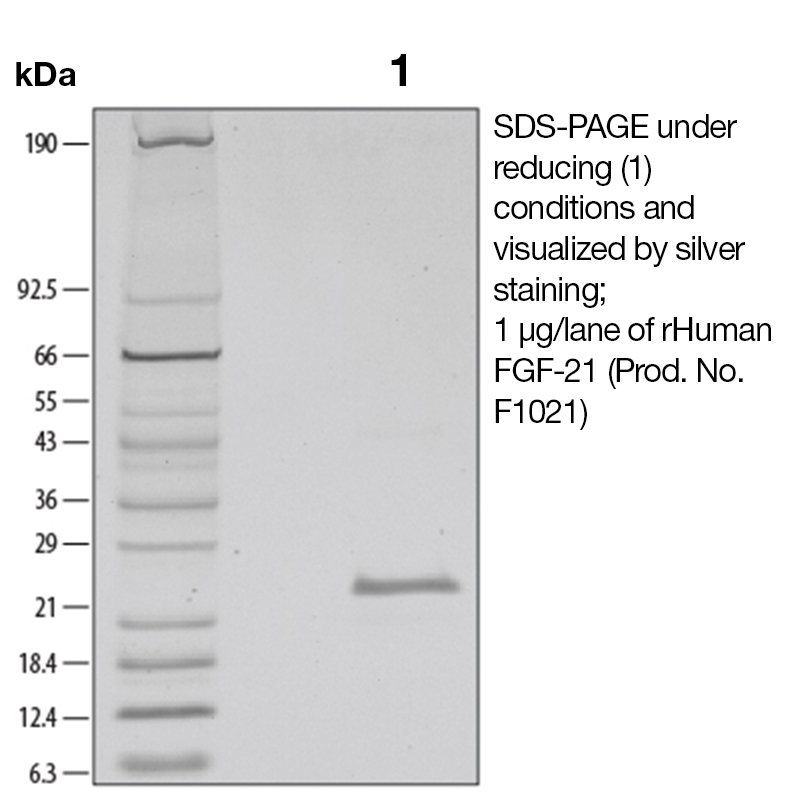
>97% by SDS-PAGE and analyzed by silver stain.
Endotoxin Level
<0.01EU/µg as determined by the LAL method
Biological Activity
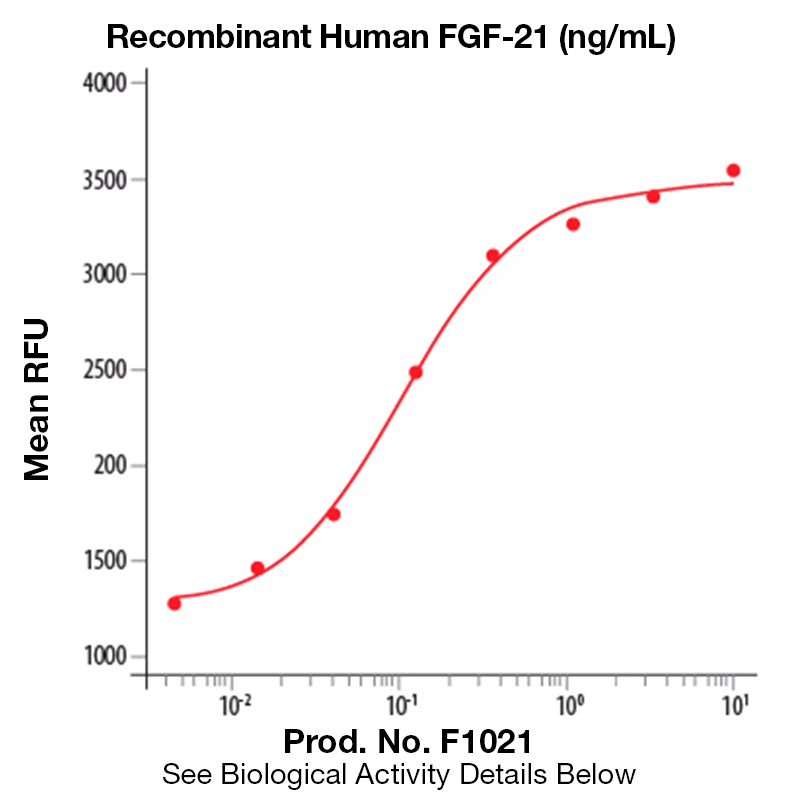
The biological activity of Human FGF-21 was determined by a cell proliferation assay using human FGF RIIIc transfected BaF3 mouse proB
cells. The expected ED<sub>50</sub> is 0.06 - 0.4 μg/ml in the presence of rmKlotho β and Heparin.
The predicted molecular weight of Recombinant Human FGF-21 is Mr 20.2 kDa. However, the actual molecular weight as observed by migration on SDS-PAGE is Mr 24 kDa (reducing conditions).
Predicted Molecular Mass
20.2
Formulation
This recombinant protein was lyophilized from a 0.2 μm filtered solution in MES, sodium sulphate (Na2SO4), ethylenediaminetetraacetic acid (EDTA), and dithiothreitol (DTT).
Storage and Stability
This lyophilized protein is stable for six to twelve months when stored desiccated at -20°C to -70°C. After aseptic reconstitution, this protein may be stored at 2°C to 8°C for one month or at -20°C to -70°C in a manual defrost freezer. Avoid Repeated Freeze Thaw Cycles. See Product Insert for exact lot specific storage instructions.
Powered by AI: AI is experimental and still learning how to provide the best assistance. It may occasionally generate incorrect or incomplete responses. Please do not rely solely on its recommendations when making purchasing decisions or designing experiments.
Recombinant Human FGF-21 is widely used in research due to its potent regulatory effects on metabolism, its therapeutic potential in metabolic diseases, and its well-characterized activity in both in vitro and in vivo models.
Key reasons to use recombinant human FGF-21 in research applications include:
Metabolic Regulation: FGF-21 is a hormone-like protein that plays a central role in regulating glucose and lipid metabolism. It activates key signaling pathways such as AMPK, SIRT1, and ERK, leading to improved insulin sensitivity, reduced blood glucose and lipid levels, and enhanced energy expenditure.
Therapeutic Potential: Recombinant FGF-21 and its analogs have demonstrated efficacy in preclinical models for treating obesity, type 2 diabetes, nonalcoholic fatty liver disease (NAFLD), and nonalcoholic steatohepatitis (NASH). These effects include reducing hepatic steatosis, inflammation, and fibrosis, as well as improving liver function and preventing further disease progression.
Anti-inflammatory and Cytoprotective Effects: FGF-21 has been shown to attenuate inflammation and apoptosis in metabolic tissues, protect against liver injury, and modulate immune cell infiltration, making it valuable for studying mechanisms of tissue repair and metabolic disease pathogenesis.
Biomarker and Diagnostic Utility: FGF-21 is being explored as a biomarker for metabolic disorders, including NAFLD and insulin resistance, due to its altered serum levels in these conditions.
Experimental Versatility: Recombinant human FGF-21 is suitable for a range of applications, including:
In vitro studies of glucose uptake and adipocyte biology.
In vivo studies in rodent and primate models to assess metabolic, hepatic, and cardiovascular outcomes.
Mechanistic studies on signaling pathways involved in energy homeostasis and lipid metabolism.
Improved Protein Quality: Recombinant production allows for high purity and batch-to-batch consistency, which is critical for reproducible experimental results.
Emerging Clinical Relevance: FGF-21 analogs are under clinical investigation, and recombinant FGF-21 is partially used in clinical practice, supporting its translational relevance for drug development and biomarker discovery.
In summary, recombinant human FGF-21 is a valuable tool for investigating metabolic regulation, disease mechanisms, and therapeutic interventions in metabolic and inflammatory disorders, with robust evidence supporting its use in both basic and translational research.
Recombinant human FGF-21 can be used as a standard for quantification or calibration in ELISA assays, provided it is compatible with your assay system and matches the native protein recognized by your antibodies. Several commercial ELISA kits use recombinant human FGF-21 as their standard, and this is a common practice in quantitative immunoassays.
Key considerations and supporting details:
Assay Compatibility: Many validated ELISA kits for FGF-21 quantification use recombinant human FGF-21 (often E. coli-expressed) as the standard, demonstrating that recombinant protein is suitable for generating standard curves. For example, one kit states: "It contains E. coli-expressed recombinant human FGF-21 and has been shown to accurately quantitate the recombinant factor". Another protocol specifies, "The recombinant protein is used as a Standard in this assay".
Parallelism: It is important that the standard curve generated with recombinant FGF-21 is parallel to the response obtained with native FGF-21 in your samples. Some kits have validated that curves for recombinant and native FGF-21 are parallel, indicating equivalent immunoreactivity in the assay system.
Protein Form: Ensure the recombinant FGF-21 you use matches the sequence and post-translational modifications (if any) of the native protein recognized by your ELISA antibodies. Most commercial standards are full-length, E. coli-expressed proteins, which may lack glycosylation but are generally accepted for calibration if the antibodies target linear epitopes.
Reconstitution and Handling: Follow best practices for reconstitution and dilution of the recombinant standard, as described in ELISA kit protocols, to ensure accuracy and reproducibility.
Documentation: If you are using a custom or non-kit recombinant FGF-21, document its source, sequence, and any modifications, and validate its performance in your specific ELISA system.
Summary Table: Use of Recombinant FGF-21 as ELISA Standard
Aspect
Details/Requirements
Protein Source
Recombinant human FGF-21 (commonly E. coli-expressed)
Assay Compatibility
Must be recognized by capture/detection antibodies in your ELISA
Validation
Standard curve should be parallel to native FGF-21 response in your samples
Documentation
Record sequence, expression system, and any modifications
Handling
Reconstitute and dilute according to ELISA protocol
In summary: You can use recombinant human FGF-21 as a standard for ELISA quantification, as long as it is compatible with your assay and validated for parallelism with native FGF-21. Always confirm compatibility with your specific ELISA system and document all relevant details for reproducibility.
Recombinant Human FGF-21 has been validated for a range of applications in published research, primarily in the context of metabolic regulation, wound healing, and cellular assays.
Key validated applications include:
Metabolic Disease Models: Recombinant FGF-21 and its analogs have been used in preclinical and clinical studies for the treatment of nonalcoholic steatohepatitis (NASH), non-alcoholic fatty liver disease (NAFLD), type 2 diabetes, and severe hypertriglyceridemia. These studies demonstrate effects such as improved glucose and lipid metabolism, reduced hepatic fat accumulation, and improved liver histology in both animal models and human patients.
Cellular Bioassays: FGF-21 has been validated in cell proliferation assays (e.g., BaF3 mouse pro-B cell line transfected with human FGFRIIIc), adipocyte differentiation assays, and signaling pathway activation (e.g., phosphorylation of Erk1/2 in 3T3-L1 adipocytes).
Wound Healing and Angiogenesis: Recombinant FGF-21 has been shown to promote wound healing in diabetic models by restoring endothelial cell proliferation, migration, tube formation, and reducing inflammation under hyperglycemic conditions. Both in vitro and in vivo studies confirm its role in stimulating angiogenesis and anti-inflammatory responses, with efficacy comparable to VEGF in diabetic wound models.
In Vivo Animal Studies: Applications include in vivo efficacy studies in mouse models of obesity, diabetes, and liver disease, where FGF-21 administration leads to improved metabolic parameters and tissue histology.
ELISA and Immunoassays: Recombinant FGF-21 has been used as a capture antigen in ELISA for quantifying FGF-21 levels in biological samples.
Western Blot and Molecular Biology: It is used as a positive control or for stimulating signaling pathways in Western blot and qRT-PCR analyses to assess downstream gene expression and protein phosphorylation.
Transdermal Delivery and Fusion Protein Studies: Novel recombinant FGF-21 constructs, including those fused with cell-penetrating peptides, have been validated for transdermal drug delivery systems (TDDS) and show enhanced skin penetration and pharmacological activity in wound healing models.
Biomarker Research: Circulating FGF-21 levels are investigated as biomarkers for metabolic diseases, including diabetes progression and diabetic kidney disease.
Endothelial cell assays, diabetic wound models (in vitro/in vivo)
In vivo efficacy
Obesity, diabetes, liver disease mouse models
ELISA/immunoassays
Capture antigen for quantification
Western blot/qRT-PCR
Signaling pathway activation, gene expression
Transdermal delivery research
CPP-fusion constructs, TDDS models
Biomarker studies
Circulating FGF-21 as disease marker
These applications are supported by both mechanistic studies and translational research, highlighting the versatility of recombinant human FGF-21 in metabolic, cellular, and regenerative medicine contexts.
To reconstitute and prepare Recombinant Human FGF-21 protein for cell culture experiments, add sterile water or sterile PBS to the lyophilized protein to achieve a concentration of 0.1–1.0 mg/mL, with 100 μg/mL being a common working concentration. For optimal stability and activity, include a carrier protein such as 0.1–1% BSA or HSA in your buffer.
Step-by-step protocol:
Centrifuge the vial briefly to collect all lyophilized material at the bottom before opening.
Add sterile water or PBS:
For most applications, reconstitute at 100 μg/mL in sterile PBS or sterile water.
If using PBS, ensure pH is 7.2–7.4.
Add carrier protein:
For cell culture, add 0.1–1% BSA or HSA to minimize adsorption and stabilize the protein.
Mix gently: Allow the solution to sit at room temperature for several minutes, then gently vortex or pipette to fully dissolve the protein.
Aliquot: Divide into single-use aliquots to avoid repeated freeze-thaw cycles.
Storage:
Short-term: 2–8°C for up to 1 week.
Long-term: –20°C to –80°C for several months.
Avoid repeated freeze-thaw cycles to preserve bioactivity.
Dilution for cell culture:
Dilute the reconstituted stock to your desired working concentration in cell culture medium immediately before use.
If possible, filter-sterilize the final working solution using a 0.2 μm filter.
Notes:
Always consult the specific product datasheet for any unique formulation or reconstitution instructions, as excipients and recommended buffers may vary.
For bioassays, ensure the protein is carrier-free if required, as BSA or HSA may interfere with certain applications.
Summary of key points:
Reconstitute at 100 μg/mL in sterile PBS or water, with 0.1–1% BSA/HSA.
Aliquot and store at –20°C to –80°C.
Avoid repeated freeze-thaw cycles.
Dilute to working concentration in cell culture medium just before use.
These steps will ensure that recombinant FGF-21 is optimally prepared for reliable and reproducible cell culture experiments.
References & Citations
1. Itoh, N. et al. (2000) Biochim. Biophys. 1492:203
2. Shanafelt, AB. et al. (2005) J. Clin. Invest. 115:162
3. Inagaki, T. et al. (2008) Cell Metab. 8:77
4. Véniant, MM. et al. (2009) Diabetes 58:250




 Products are for research use only. Not for use in diagnostic or therapeutic procedures.
