Bone morphogenetic protein 4 (BMP4) belongs to the TGF-β superfamily of proteins. Like other bone morphogenetic proteins, it is involved in bone and cartilage development. It is mainly involved in tooth and limb development, fracture repair, muscle development, bone mineralization, and uteric bud development. BMP4 has also been implicated in Fibrodysplasia Ossificans Progressiva in which it is underexpressed. In human embryonic development, BMP4 is a critical signaling molecule required for the early differentiation of the embryo and establishing of a dorsal-ventral axis. BMP4 is secreted from the dorsal portion of the notochord, and it acts in concert with sonic hedgehog (released from the ventral portion of the notochord) to establish a dorsal-ventral axis for the differentiation of later structures. BMP4 stimulates differentiation of overlying ectodermal tissue. Inhibition of the BMP4 signal (by chordin, noggin, or follistatin) causes the ectoderm to differentiate into the neural plate. If these cells also receive signals from FGF, they will differentiate into the spinal cord; in the absence of FGF the cells become brain tissue. Recombinant human BMP-4, expressed in HeLa cells, is a 31-36 kDa homodimeric glycoprotein. BMP-4 and BMP-7 are each 98% conserved between human and mouse. Human BMP-4 shares 85% aa sequence identity with human BMP-2 and less than 50% aa sequence identity with other BMPs. Human BMP-7 shares approximately 60 - 70% aa sequence identity with BMP-5, -6, and -8 and less than 50% aa sequence identity with other BMPs.
Protein Details
Purity
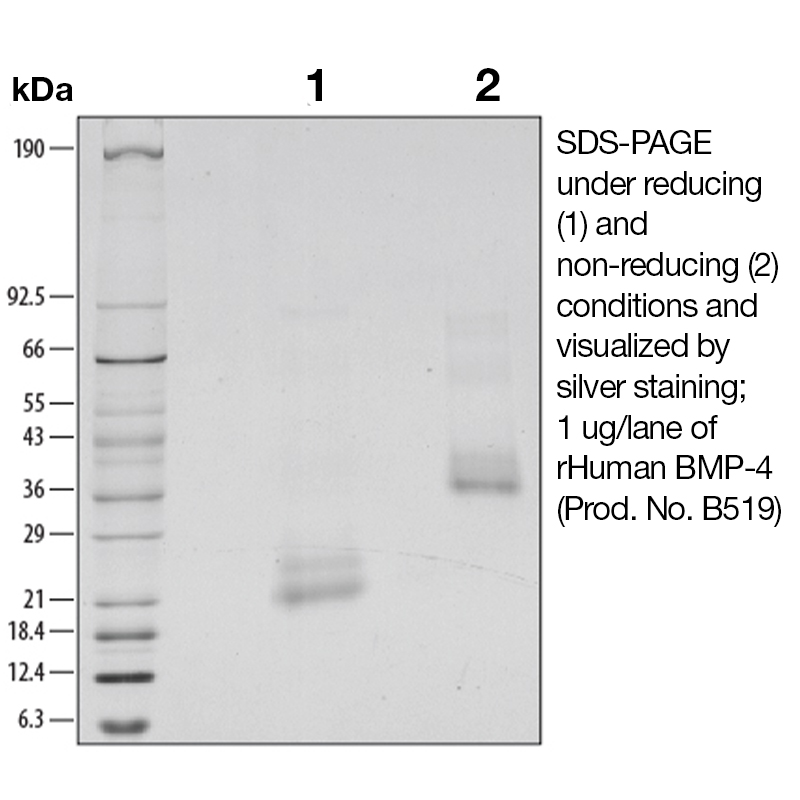
>95% by SDS-PAGE and analyzed by silver stain.
Endotoxin Level
<0.01EU/µg as determined by the LAL method
Biological Activity
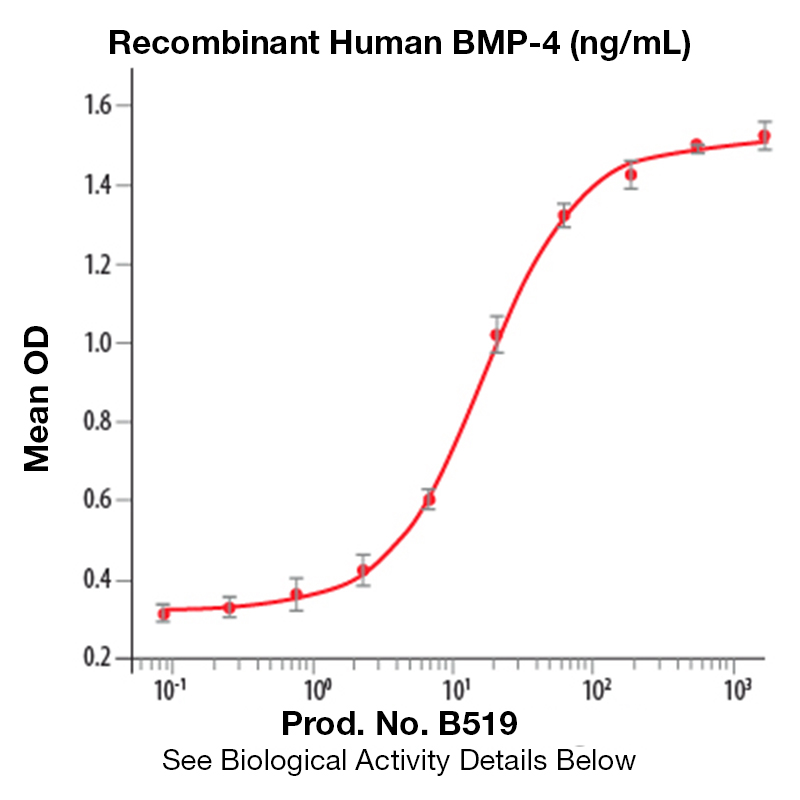
The biological activity of Human BMP-4 was determined by its ability to induce alkaline phosphatase production by mouse ATDC5 chondrogenic cells. The expected ED<sub>50</sub> for this effect is 10 - 30 ng/ml.
Recombinant Human BMP-4 is a homodimeric protein consisting of two 116 amino acid chains. The predicted molecular weight of each monomer is Mr 13 kDa. However due to glycosylation, the actual molecular weight of the monomer as observed by migration on SDS Page under reducing conditions is Mr 22 kDa.
Predicted Molecular Mass
13
Formulation
This recombinant protein was lyophilized from a 0.2 μm filtered solution in 30% acetonitrile (CH3CN) and 0.1% trifluoroacetic acid (TFA).
Storage and Stability
This lyophilized protein is stable for six to twelve months when stored desiccated at -20°C to -70°C. After aseptic reconstitution, this protein may be stored at 2°C to 8°C for one month or at -20°C to -70°C in a manual defrost freezer. Avoid Repeated Freeze Thaw Cycles. See Product Insert for exact lot specific storage instructions.
Powered by AI: AI is experimental and still learning how to provide the best assistance. It may occasionally generate incorrect or incomplete responses. Please do not rely solely on its recommendations when making purchasing decisions or designing experiments.
Recombinant Human BMP-4 is widely used in research due to its critical roles in regulating cell differentiation, embryonic development, tissue regeneration, and stem cell biology.
Key reasons to use recombinant human BMP-4 in research applications include:
Directed Differentiation of Stem Cells: BMP-4 is essential for inducing differentiation of human embryonic stem (ES) and induced pluripotent stem (iPS) cells into specific lineages, such as mesoderm and ectoderm, making it invaluable for developmental biology and regenerative medicine studies.
Tissue Engineering and Regeneration: BMP-4 promotes the formation of bone, cartilage, and other tissues, supporting applications in bone regeneration, cartilage repair, and engineered tissue development.
Functional Assays and Cell Culture: It is commonly used in functional assays to study signaling pathways, cell fate decisions, and maintenance of pluripotency or differentiation in various cell types.
Modeling Developmental Processes: BMP-4 is a key regulator in embryogenesis, including neural tube, heart, kidney, and skeletal development, making it crucial for modeling these processes in vitro.
Disease Modeling and Therapeutic Research: Altered BMP-4 signaling is implicated in diseases such as bone disorders, fibrosis, and cancer, so recombinant BMP-4 is used to model these conditions and test potential therapies.
Cost-Effective and Reproducible: Recombinant production ensures batch-to-batch consistency, animal-free options, and scalability for both basic and translational research.
Supporting details:
In vitro, BMP-4 drives mesenchymal stem cell differentiation toward chondrocyte and osteoblast lineages, and is used to generate specific cell types from pluripotent stem cells.
In vivo, BMP-4 enhances bone and cartilage repair, as demonstrated in animal models of tendon-bone healing and bone regeneration.
BMP-4 is a member of the TGF-β superfamily, with broad roles in cell signaling, morphogenesis, and tissue patterning throughout development and adulthood.
Applications span:
Stem cell differentiation protocols
Organoid and tissue engineering
Bone and cartilage repair models
Developmental biology studies
Disease modeling and drug screening
Using recombinant human BMP-4 provides a controlled, defined tool to manipulate and study these fundamental biological processes in a reproducible and scalable manner.
Yes, recombinant human BMP-4 can be used as a standard for quantification or calibration in ELISA assays, provided it is properly validated and matched to your assay system. Recombinant BMP-4 is commonly employed as a standard in commercial BMP-4 ELISA kits, where it is used to generate standard curves for quantitative measurement of BMP-4 in biological samples.
Key considerations and best practices:
Validation: Ensure the recombinant BMP-4 standard is compatible with your ELISA antibodies and assay format. Most sandwich ELISA kits for BMP-4 use recombinant human BMP-4 as the calibrator, and results have shown accurate quantification of both recombinant and natural BMP-4 samples.
Standard Curve Preparation: Prepare the standard curve using serial dilutions of recombinant BMP-4 in the same buffer or matrix as your samples to minimize matrix effects and ensure accurate interpolation.
Concentration Range: The dynamic range of BMP-4 ELISA assays typically spans from low picogram to nanogram levels (e.g., 12–750 pg/mL, 62.5–4000 pg/mL), so ensure your standard covers the expected concentration range of your samples.
Recovery and Precision: Commercial kits report high recovery rates (91–109%) for recombinant BMP-4 spiked into various matrices, and intra/inter-assay precision is generally within acceptable limits (<10% CV).
Storage and Handling: Follow recommended storage conditions for recombinant BMP-4 (usually 2–8°C or -20°C for long-term storage) and avoid repeated freeze-thaw cycles to maintain protein integrity.
Matrix Matching: Use the same diluent for standards and samples to avoid discrepancies due to buffer composition.
Limitations:
Recombinant BMP-4 standards are for research use only and not for diagnostic procedures.
The standard should be reconstituted and used according to the manufacturer’s instructions, and not mixed with reagents from other lots or sources.
Summary Table: Use of Recombinant Human BMP-4 as ELISA Standard
Application
Compatibility
Precision/Recovery
Notes
ELISA standard curve
Yes
High
Validate with assay antibodies
Quantification in samples
Yes
High
Matrix matching recommended
Diagnostic use
No
N/A
For research use only
In conclusion, recombinant human BMP-4 is suitable as a standard for ELISA quantification, provided you follow best practices for validation, preparation, and matrix matching to ensure accurate and reproducible results.
Recombinant Human BMP-4 has been validated for a broad range of applications in published research, primarily in studies involving stem cell biology, tissue engineering, developmental biology, and functional assays.
Key validated applications include:
Stem Cell Differentiation: BMP-4 is widely used to induce differentiation of human embryonic stem cells (hESCs) and induced pluripotent stem cells (iPSCs) into mesodermal, endodermal, and hematopoietic lineages. It is also used for the generation of embryoid bodies from human iPSCs.
Functional Assays: BMP-4 is validated for use in bioassays to assess its biological activity, such as induction of alkaline phosphatase in chondrogenic cell lines and osteogenic differentiation.
Cell Culture: BMP-4 is routinely used in cell culture systems to maintain pluripotency or direct lineage specification in stem cell populations.
Tissue Engineering and Regeneration: BMP-4 is applied in bone and cartilage tissue engineering, bone remodeling, and wound healing studies, often to promote osteogenic and chondrogenic differentiation.
Developmental Biology: BMP-4 is used to study embryonic development, mesenchyme formation, organogenesis, and neural development.
Immunomodulation: BMP-4 has been used to modulate immune responses and study hematopoietic stem and progenitor cell differentiation.
Cancer Research: Overexpression and signaling of BMP-4 have been investigated in cancer models, including melanoma, hepatocellular carcinoma, and colorectal cancer cell lines.
Protein Detection: BMP-4 has been validated for use in ELISA and Western blot assays for protein quantification and detection.
Supporting details:
BMP-4 is commonly expressed in systems such as E. coli, HEK293, and CHO cells for recombinant production.
It is used in both research-only and preclinical/clinical-grade formats, depending on the application.
BMP-4’s activity is often measured by its ability to induce specific marker expression (e.g., alkaline phosphatase, Runx2, Sox9) and functional outcomes in cell-based assays.
Summary of major published research applications:
Directed differentiation of pluripotent stem cells (endoderm, mesoderm, hematopoietic, neural, and retinal lineages).
Osteogenic and chondrogenic differentiation for bone and cartilage tissue engineering.
Studies of BMP-4 signaling in cancer and immune modulation.
These applications are supported by numerous peer-reviewed publications and product validation data from recombinant protein suppliers.
To properly reconstitute and prepare Recombinant Human BMP-4 protein for cell culture experiments, follow these best practices based on manufacturer recommendations and scientific protocols:
Reconstitution Steps:
Centrifuge the Vial: Before opening, briefly centrifuge the lyophilized vial in a microcentrifuge (20–30 seconds) to ensure all powder is at the bottom.
Warm to Room Temperature: Allow the vial to warm to room temperature before opening to prevent condensation.
Reconstitution Buffer:
For most recombinant human BMP-4 proteins, reconstitute in sterile 4 mM HCl (or 10 mM HCl for some suppliers) at a concentration of 50–200 μg/mL (0.05–0.2 mg/mL).
If your protein includes a carrier (e.g., BSA), use 4 mM HCl containing at least 0.1% human or bovine serum albumin (BSA/HSA).
For carrier-free versions, use 4 mM HCl alone.
Gentle Mixing:
Do not vortex or mix vigorously.
Gently swirl or pipette up and down to dissolve the protein.
If solubility issues arise, allow the solution to incubate at 4°C overnight.
Aliquoting:
After reconstitution, aliquot the protein into small volumes to avoid repeated freeze-thaw cycles.
Preparation for Cell Culture:
Further Dilution:
Dilute the reconstituted BMP-4 in cell culture medium or a buffer containing 0.1% BSA or HSA (e.g., PBS with 0.1% BSA) to prevent protein loss due to adsorption.
Working Concentration:
Typical working concentrations for cell culture range from 1–100 ng/mL, depending on the cell type and experimental design.
The ED₅₀ for BMP-4 activity (e.g., alkaline phosphatase induction) is often between 3–18 ng/mL.
Storage:
Store reconstituted BMP-4 at –20°C or –80°C in a manual defrost freezer.
Avoid repeated freeze-thaw cycles.
Key Tips:
Always check the Certificate of Analysis (COA) or product manual for specific instructions, as formulations may vary between suppliers.
Use low-binding tubes and tips to minimize protein loss.
For sensitive assays, confirm protein integrity by running a small amount on SDS-PAGE.
By following these steps, you will ensure optimal activity and stability of recombinant human BMP-4 for your cell culture experiments.
References & Citations
1. Sato, K. et al. (2006) J Comp Neurol.499(4):613-25.
2. Christian, JL. et al. (2006) J Biol Chem. 281(45):34021-31.
3. Gilchrest, BA. et al> (2006) J Biol Chem. 281 (35):25307-14.
4. Mowla, SJ. et al. (2006) Anat Histol Embryol. 35(4):271-8.
5. Keski-Oja, J. et al. (2006) Am J Pathol.169(1):61-71.




 Products are for research use only. Not for use in diagnostic or therapeutic procedures.
