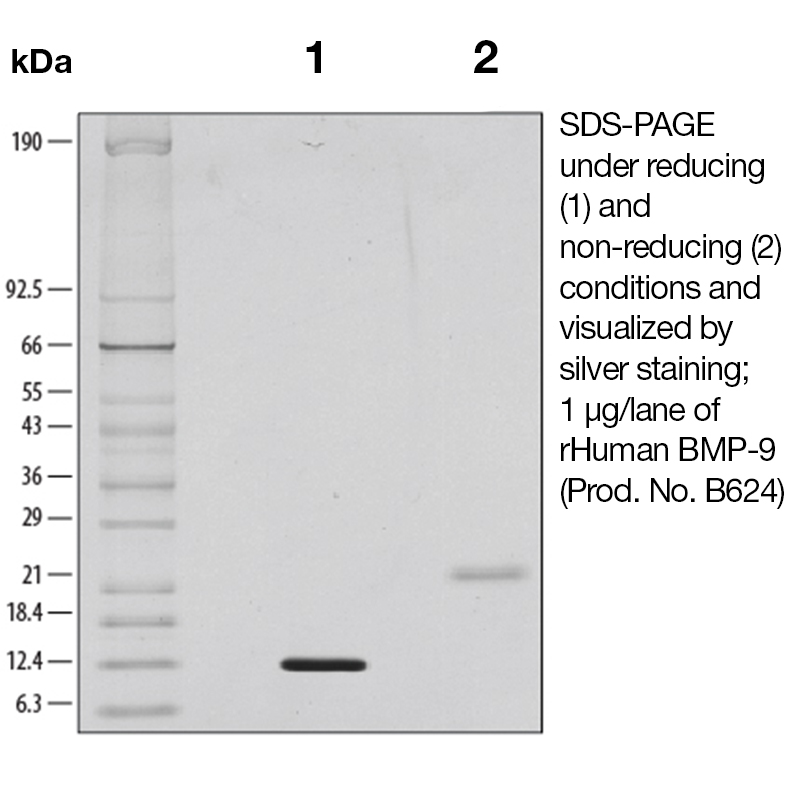
The predicted molecular weight of Recombinant Human GDF-2, BMP-9 is Mr 12.1 kDa. However, the actual molecular weight as observed by migration on SDS-PAGE is Mr 13 kDa.
Predicted Molecular Mass
12.1
Formulation
This recombinant protein was lyophilized from a 0.2 μm filtered solution in 35% acetonitrile (CH3CN) and 0.1% trifluoroacetic acid (TFA).
Storage and Stability
This lyophilized protein is stable for six to twelve months when stored desiccated at -20°C to -70°C. After aseptic reconstitution, this protein may be stored at 2°C to 8°C for one month or at -20°C to -70°C in a manual defrost freezer. Avoid Repeated Freeze Thaw Cycles. See Product Insert for exact lot specific storage instructions.
Applications and Recommended Usage ? (Quality Tested by Leinco)
ELISA Sandwich: This antibody is useful as the capture antibody in a sandwich ELISA. The suggested coating concentration is 5 µg/ml (100 µl/well) µg/ml. Flow Cytometry: PN:A106 Flow Cytometry: It is recommended to use the indirect method for signal enhancement when enumerating cells expressing CXCR5. A suggested method would be to stain cells expressing CXCR5 with approximately 10 µl per test. A typical test sample constitutes approximately 50 µl of packed whole blood or 1 x 10⁵ continuous passage or activated cell cultures that have been centrifuged at 500 X g for five minutes. Labeling of the cells with the biotin conjugate should be followed by PN:A104, resuspended in 200-400 µl of 1X PBS.
Leinco Protein Advisor
Powered by AI: AI is experimental and still learning how to provide the best assistance. It may occasionally generate incorrect or incomplete responses. Please do not rely solely on its recommendations when making purchasing decisions or designing experiments.
Recombinant Human BMP-9 is widely used in research due to its potent biological activities in regulating cell differentiation, tissue development, inflammation, angiogenesis, and bone formation, making it highly valuable for studies in regenerative medicine, vascular biology, immunology, and disease modeling.
Key scientific applications and rationale for using Recombinant Human BMP-9:
Osteogenic Differentiation and Bone Regeneration: BMP-9 is one of the most osteogenic BMPs, strongly inducing differentiation of mesenchymal stem cells (MSCs) into osteoblasts and promoting bone formation both in vitro and in vivo. It has demonstrated superior efficacy compared to BMP-2 at lower concentrations, making it a preferred factor for bone tissue engineering, dental regeneration, and studies of osteoporosis.
Vascular Biology and Angiogenesis: BMP-9 regulates endothelial cell function, inhibits proliferation induced by growth factors such as FGF and VEGF, and modulates angiogenesis by binding to ALK-1 and ALK-2 receptors. It is used to study vascular development, endothelial permeability, and the mechanisms underlying diseases such as pulmonary hypertension and tumor angiogenesis.
Inflammation and Immune Modulation: BMP-9 plays a dual role in inflammation, capable of both promoting and suppressing inflammatory responses depending on context. It regulates cytokine expression, immune cell recruitment, and has shown protective effects in models of chronic inflammation-induced bone lesions and bronchopulmonary dysplasia.
Cardiac and Lymphatic Function: BMP-9 has been shown to protect against myocardial infarction by improving lymphatic drainage, reducing cardiac edema, and enhancing mitochondrial bioenergetics in cardiomyocytes. It is used to investigate cardiac repair mechanisms and inter-organ signaling in cardiovascular research.
Disease Modeling and Therapeutic Research: Recombinant BMP-9 is utilized in models of sepsis, nonalcoholic steatohepatitis, and other inflammatory or metabolic diseases to study its regulatory effects on immune cells, tissue repair, and metabolic pathways.
Best practices for research applications:
Use recombinant BMP-9 in bioassays, cell culture, and in vivo models to study its effects on specific cell types or tissues.
Optimize concentration and exposure time based on the target cell type and desired biological outcome, as BMP-9 is highly potent and context-dependent.
Employ appropriate controls and receptor-specific inhibitors to dissect BMP-9 signaling pathways (e.g., ALK-1, ALK-2, Smad1/5).
Summary of advantages:
High osteogenic potency for bone and dental research.
Regulation of angiogenesis and vascular integrity for cardiovascular and cancer studies.
Modulation of inflammation and immune responses for immunology and tissue repair.
Versatility in cell and animal models for mechanistic and translational research.
Using recombinant human BMP-9 enables precise investigation of these biological processes, supporting both fundamental research and the development of novel therapeutic strategies.
Yes, recombinant human BMP-9 can be used as a standard for quantification or calibration in ELISA assays, provided it is of appropriate purity and form. This is a common practice in BMP-9 ELISA protocols and is supported by both commercial kit instructions and published research.
Key considerations and supporting details:
Recombinant BMP-9 as ELISA Standard: Multiple ELISA kits for human BMP-9 use recombinant BMP-9 as the standard for generating calibration curves, enabling quantification of BMP-9 in biological samples. For example, the Cohesion Biosciences Human BMP9 ELISA Kit specifically instructs users to reconstitute lyophilized recombinant BMP-9 to prepare the standard curve. Published research also describes the use of recombinant human BMP-9 (from reputable suppliers) to generate standard curves for BMP-9 ELISA quantification.
Formulation and Handling: Recombinant BMP-9 is often supplied lyophilized and may contain carrier proteins such as BSA to enhance stability, which is suitable for use as an ELISA standard. Carrier-free forms are also available but may require special handling to prevent adsorption losses. Always follow the supplier’s reconstitution and storage recommendations to maintain protein integrity.
Validation: Ensure that the recombinant BMP-9 standard is compatible with your ELISA’s antibody pair and detection system. Most commercial ELISA kits are validated to detect both natural and recombinant BMP-9, but if you are developing a custom assay, confirm that your antibodies recognize the recombinant form you are using.
Concentration Range: Prepare a standard curve covering the expected concentration range in your samples. For example, typical BMP-9 ELISA standard curves range from low pg/mL to tens of ng/mL, depending on assay sensitivity.
Documentation: Always document the source, lot number, and concentration of your recombinant BMP-9 standard for reproducibility and troubleshooting.
Summary Table: Use of Recombinant BMP-9 as ELISA Standard
Application
Supported?
Notes
Calibration/Quantification
Yes
Widely used in commercial kits and research protocols.
Formulation
Yes
Use BSA-containing or carrier-free as appropriate.
Validation Required
Yes
Confirm antibody compatibility, especially for custom assays.
In conclusion: Recombinant human BMP-9 is suitable and commonly used as a standard for ELISA quantification, provided it is handled and validated appropriately for your specific assay system.
Recombinant Human BMP-9 has been validated for a broad range of applications in published research, primarily in bioassays, cell culture, and in vivo models. Its main uses include studies of osteogenic differentiation, angiogenesis, immunomodulation, and disease modeling.
Key validated applications:
Osteogenic differentiation and bone regeneration: BMP-9 is highly effective at inducing osteoblast differentiation and bone formation in vitro and in vivo, outperforming other BMPs such as BMP-2 in some studies. It is used to assess alkaline phosphatase activity, calcium deposition, and mineralization in mesenchymal stem cells and pre-osteoblasts.
Angiogenesis and vascular biology: BMP-9 regulates endothelial cell function, vascular permeability, and angiogenesis. It has been used to study endothelial cell signaling, monocyte recruitment, and blood vessel formation, often via ALK1/ALK2 receptor pathways.
Immunomodulation and inflammation: BMP-9 has been validated in models of sepsis and endotoxemia, where it promotes macrophage recruitment, enhances phagocytosis, and improves survival outcomes in murine models.
Disease modeling: BMP-9 is used in models of nonalcoholic steatohepatitis, cardiac fibrosis, pulmonary hypertension, and osteoporosis to study its effects on disease progression and tissue regeneration.
Cell signaling and molecular biology: BMP-9 is applied in studies investigating SMAD signaling, Hippo pathway crosstalk, and post-translational regulation of proteins such as endoglin.
Bioassays and protein-protein interaction studies: BMP-9 is validated for use in bioassays to measure its activity, including surface plasmon resonance for binding studies and ELISA for quantification.
Typical sample types and experimental systems:
Whole cells (human, mouse)
Cell lysates
Recombinant protein preparations
In vivo animal models
Representative protocols and endpoints:
Induction of alkaline phosphatase (ALP) activity
Alizarin Red S staining for mineralization
Western blot and phospho-kinase arrays for signaling pathway analysis
Cell proliferation and differentiation assays
Vascular permeability and angiogenesis assays
Macrophage recruitment and phagocytosis assays
Summary Table:
Application Area
Experimental System
Typical Endpoints/Assays
Osteogenic differentiation
MSCs, pre-osteoblasts
ALP, mineralization, gene expression
Angiogenesis
Endothelial cells, in vivo
Tube formation, permeability, signaling
Immunomodulation
Macrophages, in vivo
Recruitment, phagocytosis, survival
Disease modeling
Mouse models
Histology, functional outcomes
Bioassays/protein interaction
Recombinant protein, cells
ELISA, SPR, activity assays
These applications are supported by numerous peer-reviewed studies and reviews, demonstrating the versatility of recombinant human BMP-9 in both basic and translational research.
To properly reconstitute and prepare Recombinant Human BMP-9 protein for cell culture experiments, follow these general guidelines based on manufacturer recommendations and best practices:
Reconstitution Instructions
Centrifuge the Vial Before opening, centrifuge the lyophilized protein vial at 3,000 rpm for 5 minutes to ensure all powder is at the bottom.
Reconstitution Buffer
Most protocols recommend reconstituting the lyophilized protein in sterile 4 mM HCl to a concentration of no less than 100–200 μg/mL.
Some suppliers suggest sterile water (H₂O) as an alternative, but HCl is preferred for BMP-9 to ensure optimal solubility and activity.
If the protein is carrier-free, use HCl; if it contains a carrier protein (e.g., BSA), follow the specific product instructions.
Dissolution
Gently swirl or rotate the vial to dissolve the protein.
For carrier-free proteins, incubate the solution at room temperature for at least 20 minutes to ensure complete dissolution.
Aliquoting
After reconstitution, aliquot the protein into small volumes to avoid repeated freeze-thaw cycles.
Storage and Handling
Short-term: Store reconstituted protein at 2–8°C for up to one month if used frequently.
Long-term: Store aliquots at –20°C or –80°C in a manual defrost freezer.
Avoid repeated freeze-thaw cycles and storage in frost-free freezers.
Preparation for Cell Culture
Dilution: Dilute the stock solution in cell culture medium or buffer just before use.
Carrier Protein: For carrier-free proteins, add 0.1% BSA or serum to the dilution buffer to minimize non-specific binding and loss of activity.
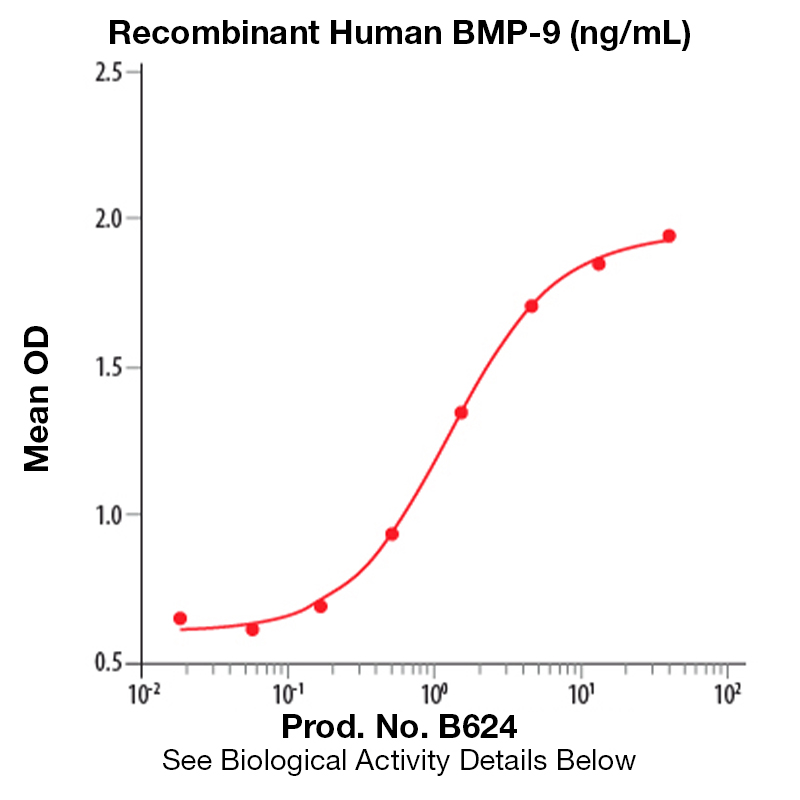
Activity: BMP-9 is highly active; typical working concentrations in cell culture range from 0.1–10 ng/mL, depending on the cell type and assay.
Summary
Reconstitute in 4 mM HCl (100–200 μg/mL), or sterile water if specified.
Centrifuge before opening.
Aliquot and store at –20°C or –80°C.
Dilute in culture medium with 0.1% BSA for cell culture use.
Avoid repeated freeze-thaw cycles.
Always refer to the specific product datasheet for any unique requirements.






 Products are for research use only. Not for use in diagnostic or therapeutic procedures.
