DNAX accessory molecule 1 (DNAM-1), is a tyrosine-phosphorylated signal-transducing molecule belonging to the immunoglobulin superfamily and participates in primary adhesion during cytotoxic T lymphocyte-mediated cytotoxicity. <sup<1 DNAM-1 is a functional glycoprotein expressed on immune cells, such as natural killer and T-cells. It is activated upon interaction with its biological ligands, the poliovirus receptor and nectin-2. Signaling cascades involving stimulation of DNAM-1 lead to various biological responses, including target cell lysis and immune cell activation. DNAM-1 appears to be an integral molecule in immune responses in cancer, allergic inflammatory disorders and autoimmune diseases.2
The predicted molecular weight of Recombinant Human DNAM-1 is Mr 53 kDa. However, the actual molecular weight as observed by migration on SDS-PAGE is Mr 75-80 kDa.
Predicted Molecular Mass
53
Formulation
This recombinant protein was 0.2 µm filtered and lyophilized from modified Dulbecco’s phosphate buffered saline (1X PBS) pH 7.2 – 7.3 with no calcium, magnesium, or preservatives.
Storage and Stability
This lyophilized protein is stable for six to twelve months when stored desiccated at -20°C to -70°C. After aseptic reconstitution, this protein may be stored at 2°C to 8°C for one month or at -20°C to -70°C in a manual defrost freezer. Avoid Repeated Freeze Thaw Cycles. See Product Insert for exact lot specific storage instructions.
Powered by AI: AI is experimental and still learning how to provide the best assistance. It may occasionally generate incorrect or incomplete responses. Please do not rely solely on its recommendations when making purchasing decisions or designing experiments.
Recombinant Human DNAM-1 is valuable in research applications because it enables precise investigation of immune cell activation, tumor recognition, and cytotoxicity mechanisms, especially in the context of cancer immunotherapy and immune cell engineering.
Key scientific applications and advantages:
Functional Studies of Immune Activation: DNAM-1 (CD226) is a critical activating receptor on natural killer (NK) cells, T cells, and monocytes. Recombinant DNAM-1 allows for controlled in vitro studies of its role in immune cell activation, cytotoxicity, and cytokine production, facilitating mechanistic insights into immune responses.
Cancer Immunotherapy Research: DNAM-1 interacts with ligands CD112 and CD155, which are often overexpressed on tumor cells. Recombinant DNAM-1 is used to study and enhance immune cell recognition and lysis of tumor cells, supporting the development of DNAM-1-based chimeric antigen receptor (CAR) T cells and engineered NK cells for targeting hematological and solid tumors.
Ligand Binding and Screening Assays: Recombinant DNAM-1 can be used in binding assays to characterize ligand expression on target cells, screen for therapeutic antibodies, or identify novel immune modulators.
Modeling Immune Cell Trafficking: DNAM-1 is implicated in monocyte transendothelial migration and immune cell trafficking. Recombinant protein enables studies on cell adhesion, migration, and interactions with endothelial cells, which are relevant for understanding tumor microenvironment and immune infiltration.
Acute GVHD and Autoimmunity Models: DNAM-1 is a molecular target in models of acute graft-versus-host disease (GVHD), and recombinant DNAM-1 is useful for dissecting its role in immune-mediated tissue damage and therapeutic intervention.
Best practices for use:
Employ recombinant DNAM-1 in cell-based assays (e.g., cytotoxicity, degranulation, cytokine production) to dissect receptor-mediated signaling pathways.
Use recombinant DNAM-1 in ligand-binding studies to quantify or block interactions with CD112/CD155 on target cells.
Integrate recombinant DNAM-1 in the design and validation of engineered immune cells (e.g., CAR T or NK cells) to enhance tumor targeting and immune activation.
Summary: Using recombinant human DNAM-1 in research provides a controlled, reproducible tool to study immune cell activation, tumor recognition, and therapeutic engineering, supporting advances in cancer immunotherapy, immune modulation, and mechanistic immunology.
Yes, you can use Recombinant Human DNAM-1 (CD226) as a standard for quantification or calibration in your ELISA assays, provided that the recombinant protein is purified and compatible with your assay system.
Key Points to Consider:
Purified Recombinant Protein: Recombinant Human DNAM-1 (such as those with His-tag or Fc-chimera formats) is suitable for use as an ELISA standard because it is a purified antigen with a known sequence and concentration. This allows you to generate a reliable standard curve for quantifying DNAM-1 in your samples.
BSA-Containing vs. Carrier-Free: For ELISA standard use, it is generally recommended to use the recombinant protein formulated with BSA (bovine serum albumin), as BSA helps stabilize the protein and reduces non-specific binding. Carrier-free versions (without BSA) are preferred for applications where BSA might interfere, such as certain bioassays or when BSA could affect downstream detection.
Standard Curve Preparation: To use recombinant DNAM-1 as a standard, prepare a dilution series of the protein in the appropriate buffer (often the assay diluent) and run it alongside your samples. Plot the optical density (OD) values against the known concentrations to generate a standard curve, which is then used to interpolate the concentration of DNAM-1 in your unknown samples.
Validation: Ensure that the recombinant protein is recognized by the antibodies used in your ELISA. If you are using a commercial ELISA kit, check the manufacturer’s instructions to confirm compatibility.
Accuracy: Be aware that calculated concentrations based on ELISA may differ slightly from the labeled protein concentration due to dilution steps and assay variability. A recovery rate within ±25% of the stated concentration is generally considered acceptable.
References:
R&D Systems recommends using recombinant proteins with BSA for ELISA standards and cell culture applications.
Guidelines for ELISA standard preparation emphasize the use of purified antigens or recombinant proteins for accurate quantification.
Commercial ELISA kits for DNAM-1 (CD226) often include recombinant standards for calibration.
In summary, Recombinant Human DNAM-1 is appropriate for use as a standard in ELISA assays for quantification and calibration, especially when formulated with BSA and used according to established protocols.
Recombinant Human DNAM-1 (CD226) has been validated for several key applications in published research, primarily focusing on its role in immune cell signaling, adhesion, and cancer immunotherapy. The main applications supported by peer-reviewed studies include:
Immune Cell Adhesion Assays
Recombinant DNAM-1 has been used to study adhesion of immune cells (such as NK cells and T cells) to endothelial cells and tumor cells, particularly in the context of platelet-endothelium interactions and monocyte extravasation.
Example: DNAM-1-Fc chimera proteins have been immobilized on microplates to support adhesion of colorectal cancer cells (COLO 205), validating its use in cell adhesion bioassays.
Ligand Binding and Receptor-Ligand Interaction Studies
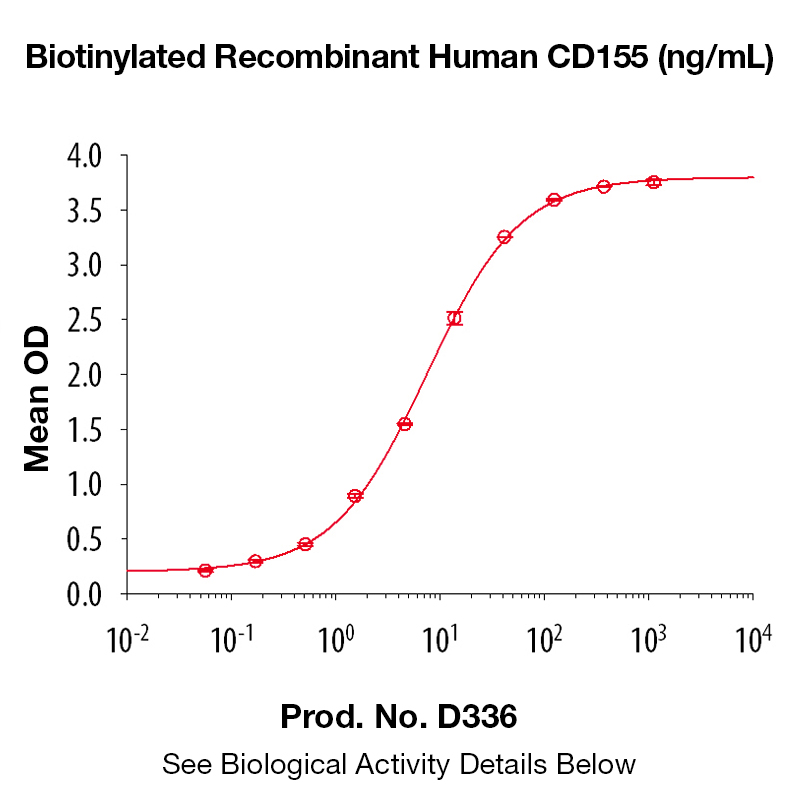
DNAM-1 is known to bind its ligands CD155 (PVR) and CD112 (Nectin-2), which are expressed on tumor and virus-infected cells. Recombinant DNAM-1 is used to investigate these interactions in vitro, often in ELISA or flow cytometry-based binding assays.
NK Cell and T Cell Functional Assays
Recombinant DNAM-1 is used to stimulate or block DNAM-1-mediated signaling in NK and T cells, allowing researchers to study cytotoxicity, cytokine production, and degranulation (e.g., CD107a expression) in response to target cells.
Chimeric Receptor Engineering and Immunotherapy Research
DNAM-1-based chimeric receptors (e.g., DNAM-1-CD3ζ) have been engineered into NK cells to enhance their anti-tumor activity. Recombinant DNAM-1 is used as a reference or control in these studies, and its functional domains are validated for receptor engineering and adoptive cell therapy applications.
Cancer Immunotherapy and Preclinical Studies
Recombinant DNAM-1 is used in proof-of-concept studies for developing novel immunotherapies, including combination therapies with small molecules (e.g., Nutlin-3a) to enhance NK cell-mediated killing of tumor cells, especially in solid tumors like neuroblastoma.
Western Blot and ELISA
Recombinant DNAM-1 is used as a positive control or standard in Western blot and ELISA applications to detect DNAM-1 expression or to quantify DNAM-1 levels in biological samples.
Flow Cytometry and Immunocytochemistry
DNAM-1 antibodies and recombinant proteins are used in flow cytometry and immunocytochemistry to detect and quantify DNAM-1 expression on immune cells.
In summary, Recombinant Human DNAM-1 has been validated for use in adhesion assays, ligand binding studies, immune cell functional assays, chimeric receptor engineering, cancer immunotherapy research, and standard immunoassays such as Western blot, ELISA, and flow cytometry.
To reconstitute and prepare Recombinant Human DNAM-1 (CD226) protein for cell culture experiments, follow these steps:
Centrifuge the vial briefly before opening to ensure all lyophilized protein is at the bottom.
Reconstitute the protein in sterile distilled water or PBS, depending on the formulation and downstream application. For most lyophilized DNAM-1 proteins, a concentration of 0.1–0.5 mg/mL is recommended. Some datasheets specify 250 μg/mL in PBS for carrier-free formulations.
Gently mix by swirling or inverting the vial. Avoid vortexing or vigorous pipetting, as this can denature the protein.
Allow the protein to dissolve for 15–30 minutes at room temperature with gentle agitation.
Aliquot the reconstituted protein to avoid repeated freeze-thaw cycles, which can reduce activity and stability.
Store aliquots at −20 °C or colder for long-term storage. For short-term use, 2–8 °C is acceptable for up to one week.
Additional notes for cell culture experiments:
Use sterile technique throughout to prevent contamination.
If the protein is carrier-free, consider adding BSA (0.1–1 mg/mL) to working solutions to enhance stability, unless BSA interferes with your assay.
For functional assays, dilute the stock solution to the desired working concentration in cell culture medium immediately before use.
Summary Table: Recombinant Human DNAM-1 Reconstitution
Step
Details
Centrifuge vial
Briefly, before opening
Reconstitution
0.1–0.5 mg/mL in sterile water or PBS (datasheet-specific)
Mixing
Gentle swirling/inversion; avoid vortexing
Dissolution
15–30 min at room temperature
Aliquoting
To avoid freeze-thaw cycles
Storage
−20 °C or colder (long-term); 2–8 °C (short-term)
Always consult the specific product datasheet for formulation and recommended diluent, as requirements may vary between preparations.
References & Citations
1. Phillips, JH. et al.(1996) Immunity. 4(6):573-81. 2. Levi-Schaffer, F. et al. (2008) Curr Opin Investig Drugs. 9(5):491-6.





 Products are for research use only. Not for use in diagnostic or therapeutic procedures.
