Recombinant Human/Mouse FGF-8b

Recombinant Human/Mouse FGF-8b

Product No.: F1032

[product_table name="All Top" skus="F1032"]

- -
- -
Alternate Names
Fibroblast Growth Factor-8b, FGF17, FGF17a, AIGF, KAL6, HBGF-8, MGC149376
Product Type
Recombinant Protein
Expression Host
E. coli Cells
Species
Human
Mouse

- -
- -
Select Product Size

Data

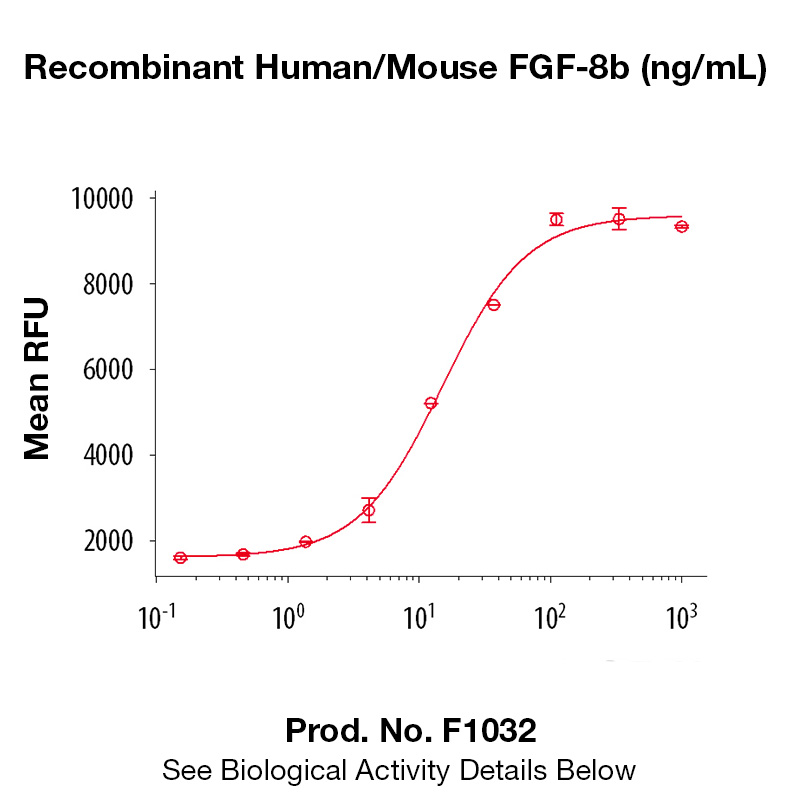
Mouse FGF-8b Bioactivity Data
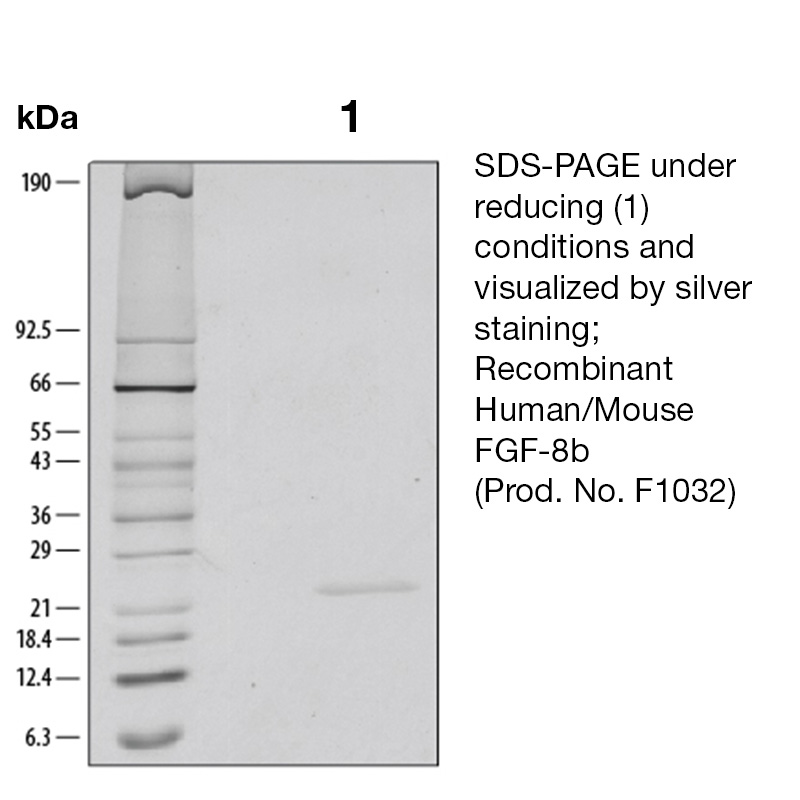
Mouse FGF-8b SDS-PAGE
- -
- -

Background

Fibroblast growth factor-8 (FGF-8), also known as AIGF and HBGF, is a heparin binding growth factor belonging to the FGF family (1). Proteins of this family play a central role during prenatal development and postnatal growth and regeneration of a variety of tissues, by promoting cellular proliferation and differentiation (2). Alternate splicing of FGF-8 mRNA creates eight secreted isoforms (a-h) in mice and four (a, b, e and f) in humans (3). FGF-8a expands the midbrain in transgenic mice, while FGF-8b transforms the midbrain into cerebellum. FGF-8 activates the “c” splice forms of receptors FGF R2, FGF R3 and FGF R4, with differential activity among the FGF-8 isoforms. Overexpression of FGF-8 has been shown to increase tumor growth and angiogenesis. FGF-8b shows the strongest receptor affinity and oncogenic transforming capacity, although isoforms a and e have been found in human tumors (4). The adult expression of FGF-8 is restricted to testes and ovaries.

Protein Details

Purity
>97% by SDS-PAGE and analyzed by silver stain.
Endotoxin Level
<0.01 EU/µg as determined by the LAL method
Protein Accession No.
Amino Acid Sequence
mqvtvqssp nftqhvreqs lvtdqlsrrl irtyqlysrt sgkhvqvlan krinamaedg dpfaklivet dtfgsrvrvr gaetglyicm nkkgkliaks ngkgkdcvft eivlennyta lqnakyegwy maftrkgrpr kgsktrqhqr evhfmkrlpr ghhtteqslr feflnyppft rslrgsqrtw apepr
N-terminal Sequence Analysis
Met
State of Matter
Lyophilized
Predicted Molecular Mass
The predicted molecular weight of Recombinant Human/Mouse FGF-8b is Mr 22.5 kDa. However, the actual molecular weight as observed by migration on SDS-PAGE is Mr 23 kDa.
Predicted Molecular Mass
22.5
Formulation
This recombinant protein was lyophilized from a 0.2 μm filtered solution in MOPS, EDTA, Dithiothreitol (DTT), and sodium sulphate (Na2SO4).
Storage and Stability
This lyophilized protein is stable for six to twelve months when stored desiccated at -20°C to -70°C. After aseptic reconstitution, this protein may be stored at 2°C to 8°C for one month or at -20°C to -70°C in a manual defrost freezer. Avoid Repeated Freeze Thaw Cycles. See Product Insert for exact lot specific storage instructions.
Country of Origin
USA
Shipping
Next Day Ambient
NCBI Gene Bank

Leinco Protein Advisor

Powered by AI: AI is experimental and still learning how to provide the best assistance. It may occasionally generate incorrect or incomplete responses. Please do not rely solely on its recommendations when making purchasing decisions or designing experiments.

Recombinant FGF-8b is a versatile and potent growth factor that offers significant advantages for multiple research applications, particularly in stem cell biology, developmental studies, and tissue regeneration research.

Key Biological Functions

FGF-8b plays a critical role in regulating fundamental cellular processes. It functions broadly to promote cell proliferation, differentiation, and migration, and regulates gastrulation, epithelial-mesenchymal transition, and mesenchymal to epithelial differentiation during embryonic development. The protein exerts a pivotal role in embryogenesis, being expressed during gastrulation and influencing brain, limb, heart, and facial development.

Proliferation Enhancement

One of the most significant advantages of FGF-8b is its robust ability to enhance cell proliferation across diverse cell types and culture conditions. Studies demonstrate that FGF-8b induces robust proliferation regardless of culture medium, with significant increases in DNA content observed at concentrations of 50-100 ng/mL. This proliferative capacity extends across multiple cell lineages, including mesenchymal stem cells, myogenic progenitor cells, endothelial cells, and neural progenitor cells.

Lineage-Specific Differentiation Control

FGF-8b provides selective control over mesenchymal cell fate, making it particularly valuable for directed differentiation protocols. The protein enhances chondrogenic differentiation while simultaneously suppressing adipogenic and tenogenic differentiation in adipose-derived stem cells. Additionally, FGF-8b significantly contributes to myogenic cell maturation, upregulating mature myogenic markers and slow skeletal muscle gene expression, while inhibiting adipogenic differentiation.

Developmental Gene Expression

FGF-8b supplementation successfully recapitulates gene expression patterns related to limb development, making it an excellent tool for studying developmental biology and regenerative processes. The protein enhances expression of downstream FGF signaling components, including FGF-2, FGFR-1, and FGFR-2.

Diverse Research Applications

The recombinant protein is optimized for multiple experimental approaches, including:

  • In vitro expansion of embryonic stem cell-derived neural progenitor cells
  • Survival of neural precursor cells and differentiation into astroglial cells
  • Stimulation of osteoblast proliferation
  • Proliferation of endothelial cells
  • Protection of hippocampal cultures from oxidative stress
  • Cell differentiation studies and functional bioassays

Technical Advantages

Recombinant FGF-8b is produced with high purity (>97%) and is available in multiple formats to accommodate different experimental requirements. The human and mouse versions share 100% amino acid sequence identity, providing flexibility in experimental design. The protein is derived from bacterial expression systems, ensuring consistent quality and reproducibility across experiments.

Therapeutic Potential

The demonstrated effects of FGF-8b in promoting proliferation and controlling differentiation of mesenchymal stem cells suggest significant therapeutic potential for regeneration of musculoskeletal tissues, making it valuable for translational research applications.

Recombinant Human/Mouse FGF-8b can be used as a standard for quantification or calibration in ELISA assays, provided it is properly validated for your specific assay format and detection system.

Essential context and supporting details:

  • Standard Curve Requirement: Quantitative ELISA assays require a standard curve generated from known concentrations of the analyte. Recombinant FGF-8b is commonly used for this purpose, as it allows precise calibration of the assay.
  • Validation: It is critical to ensure that the recombinant FGF-8b standard is compatible with your ELISA antibodies and detection system. Some ELISA kits are specifically calibrated using highly purified recombinant human FGF-8b, and their datasheets confirm its use for standard curve generation.
  • Isoform and Species Consideration: If your assay is designed to detect both human and mouse FGF-8b, recombinant human/mouse FGF-8b is appropriate. However, confirm that the antibody pair in your ELISA recognizes the recombinant protein equivalently to the native protein in your samples.
  • Formulation: Recombinant FGF-8b is available with or without carrier proteins (e.g., BSA). For ELISA standards, formulations with BSA are often recommended to improve stability and mimic sample matrix effects.
  • Reconstitution and Handling: Follow manufacturer instructions for reconstitution and storage to maintain protein integrity. Avoid repeated freeze-thaw cycles and ensure thorough mixing during dilution steps to achieve accurate standard curves.
  • Assay Sensitivity and Range: The detection range and sensitivity of your ELISA should match the expected concentration of FGF-8b in your samples. Typical detection ranges for FGF-8b ELISA kits are in the ng/mL to pg/mL range.

Best Practices:

  • Always run a fresh standard curve with each assay to account for potential variability.
  • Validate the recombinant standard in your specific assay context, especially if using a custom or in-house ELISA.
  • Confirm that the recombinant protein is tag-free or that any tags do not interfere with antibody binding or detection.

Limitations:

  • Some ELISA kits are designed to detect native FGF-8 and may not be validated for recombinant standards; check your kit documentation for compatibility.
  • If using recombinant FGF-8b from a different species or isoform, ensure cross-reactivity is appropriate for your assay.

Summary:
Recombinant Human/Mouse FGF-8b is widely used as a standard for ELISA quantification, but assay-specific validation and careful handling are essential for accurate calibration.

Recombinant Human/Mouse FGF-8b has been validated in published research for a range of applications, primarily in cell biology, developmental biology, and regenerative medicine.

Key validated applications include:

  • Differentiation of pluripotent stem cells: FGF-8b is widely used to induce differentiation of human and mouse embryonic stem cells (ESCs) or induced pluripotent stem cells (iPSCs) into neural progenitor cells and further into specific neuronal subtypes, such as dopaminergic neurons relevant to Parkinson’s disease models. It is also used for differentiation into hypothalamic vasopressin neurons and hepatocyte-like cells.

  • Cell proliferation assays: FGF-8b stimulates proliferation in various cell lines, including NR6R-3T3 and NIH/3T3 mouse fibroblasts, and is used in bioactivity assays to confirm its functional activity.

  • Myogenic and adipogenic differentiation: FGF-8b enhances myogenic differentiation (muscle formation) and inhibits adipogenic differentiation (fat cell formation) in progenitor cells, with implications for muscle regeneration and repair, such as in rotator cuff injury models.

  • Survival and maintenance of neural precursor cells: It supports the survival and astroglial differentiation of neural precursor cells.

  • Osteoblast and endothelial cell proliferation: FGF-8b has been used to stimulate proliferation of osteoblasts (bone-forming cells) and endothelial cells (involved in angiogenesis).

  • Tumor biology and oncogenesis: FGF-8b is studied for its role in tumor growth, particularly in prostate and breast cancer models, due to its strong oncogenic transforming capacity.

  • Developmental biology (in vivo and in ovo models): FGF-8b has been used in animal models (mouse, chicken, zebrafish, Xenopus) to study its role in embryogenesis, including brain, limb, heart, facial, pharyngeal arch, and cardiovascular development.

  • Protection from oxidative stress: It has been shown to protect hippocampal cultures from oxidative stress.

  • Bioassays and receptor binding studies: FGF-8b is validated in bioassays for receptor binding and downstream signaling, such as ERK phosphorylation.

Summary Table of Validated Applications

Application AreaExample Use Cases/ModelsReferences
Neural differentiationDopaminergic, hypothalamic, and noradrenergic neurons
Cell proliferation assaysNR6R-3T3, NIH/3T3 fibroblasts
Myogenic/adipogenic differentiationMuscle regeneration, rotator cuff repair
Osteoblast/endothelial proliferationBone and vascular cell studies
Tumor growth/oncogenesisProstate, breast, ovarian cancer models
Embryonic development (in vivo/in ovo)Mouse, chicken, zebrafish, Xenopus embryos
Neural precursor survival/astroglial fateNeural stem cell maintenance and differentiation
Oxidative stress protectionHippocampal neuron cultures
Bioassays/receptor bindingFGFR binding, ERK signaling

These applications are supported by both product validation data and peer-reviewed research, demonstrating the versatility of recombinant FGF-8b in developmental, cellular, and translational studies.

To reconstitute and prepare Recombinant Human/Mouse FGF-8b protein for cell culture experiments, dissolve the lyophilized protein in sterile water or PBS, typically at a concentration of 100 μg/mL, and include at least 0.1% serum albumin (human or bovine) to stabilize the protein and prevent adsorption to surfaces.

Step-by-step protocol:

  • Centrifuge the vial briefly (e.g., 3000 rpm for 5 min) before opening to ensure all powder is at the bottom.
  • Add sterile water or PBS:
    • For carrier-free formulations, use sterile PBS at 100 μg/mL.
    • For formulations with carrier protein, use sterile PBS containing at least 0.1% human or bovine serum albumin at 25–100 μg/mL.
    • Alternatively, some protocols recommend sterile water with 0.1% endotoxin-free recombinant human serum albumin (HSA).
  • Gently mix by pipetting up and down. Do not vortex or shake vigorously, as this may impair biological activity.
  • Incubate at room temperature for at least 20 minutes to ensure complete dissolution.
  • Aliquot the stock solution to avoid repeated freeze-thaw cycles.
  • Storage:
    • Store reconstituted protein at 2–8 °C for up to 1 week.
    • For longer-term storage, aliquot and freeze at –20 °C to –80 °C; avoid repeated freeze-thaw cycles.

Preparation for cell culture:

  • Dilute the stock solution in your cell culture medium to the desired working concentration (e.g., typical ED₅₀ for cell proliferation is in the range of 1–40 ng/mL, depending on cell type and assay).
  • If using serum-free medium, ensure the presence of a carrier protein (albumin) in all dilutions to maintain stability and activity.

Additional notes:

  • Always consult the Certificate of Analysis (CoA) or product datasheet for lot-specific instructions and recommended diluents.
  • Avoid vigorous mixing and repeated freeze-thaw cycles to preserve protein activity.
  • The protein is suitable for a range of cell culture applications, including proliferation and differentiation assays.

Summary Table:

StepSolution/BufferConcentrationAdditiveStorage
ReconstitutionSterile PBS or water25–100 μg/mL≥0.1% serum albumin2–8 °C (1 week)
Aliquoting–20 °C to –80 °C (months)
Working dilutionCell culture medium1–40 ng/mLAlbumin if serum-freeAs per experiment

This protocol ensures optimal recovery, stability, and biological activity of recombinant FGF-8b for cell culture experiments.

References & Citations

1. Gemel, J. et al. (1996) Genomics 35:253
2. Ruess, B. et al. (2003) Cell Tissue Res. 313:139
3. Tanaka, S. et al. (2001) Digest. Dis. Sci. 46:1016
4. Olsen, SK. et al. (2006) Genes Dev. 20:185

Certificate of Analysis

IMPORTANT Use lot specific datasheet for all technical information pertaining to this recombinant protein.
- -
- -
Prod No.
Description
F1032
Disclaimer AlertProducts are for research use only. Not for use in diagnostic or therapeutic procedures.