This WEHI-279 cell bioassay demonstrates that Murine IFN-gamma exhibits superior biological activity and potency compared to a competitor internal control standard. A prominent left-shift in the dose-response curve highlights an exceptionally active lot with an ED50 of less than 0.02 ng/ml outperforming the standard baseline by roughly 15- to 20-fold.
- -
- -
Background
Interferon-gamma (IFN-γ) or type II interferon is a dimerized soluble cytokine that is the only member of the type II class of interferons.1 It is a cytokine critical for innate and adaptive immunity against viral and intracellular bacterial infections and for tumor control. IFNG is produced predominantly by natural killer (NK) and natural killer T (NKT) cells as part of the innate immune response, and by CD4 and CD8 cytotoxic T lymphocyte (CTL) effector T cells once antigen-specific immunity develops.2 IFN-γ has antiviral, immunoregulatory, and anti-tumour properties.3
Protein Details
Purity
>97% by SDS-PAGE and analyzed by silver stain.
Endotoxin Level
<0.1 EU/µg as determined by the LAL method
Biological Activity
The biological activity was determined by its ability to inhibit the proliferation of murine WEHI-279 cells. The expected ED<sub>50</sub> for this effect is ≤ 0.9 ng/ml. Note: the lot data above shows an ED<sub>50</sub> of ≤ 0.02 ng/ml outperforming the standard competitor's baseline by roughly 15-fold.
The predicted molecular weight of Recombinant Mouse IFN-γ is Mr 15.6 kDa. However, the actual molecular weight as observed by migration on SDS-PAGE is Mr 11-12 kDa (reducing conditions).
Predicted Molecular Mass
15.6
Formulation
This recombinant protein was 0.2 µm filtered and lyophilized from modified Dulbecco’s phosphate buffered saline (1X PBS) with trehalose pH 7.2 – 7.4 with no calcium, magnesium, or preservatives.
Storage and Stability
This lyophilized protein is stable for six to twelve months when stored desiccated at -20°C to -80°C. After aseptic reconstitution, this protein may be stored at 2°C to 8°C for one month or at -20°C to -80°C in a manual defrost freezer. Avoid Repeated Freeze Thaw Cycles. See Product Insert for exact lot specific storage instructions.
Powered by AI: AI is experimental and still learning how to provide the best assistance. It may occasionally generate incorrect or incomplete responses. Please do not rely solely on its recommendations when making purchasing decisions or designing experiments.
Using Recombinant Mouse IFNγ in research is essential for studying immune responses, particularly those involving macrophage activation, Th1 cell differentiation, antigen presentation, and host defense mechanisms against pathogens and tumors. Recombinant protein ensures high purity, batch-to-batch consistency, and species specificity, which are critical for reproducible and interpretable experimental results.
Key scientific applications and rationale include:
Macrophage and Dendritic Cell Activation: IFNγ is a potent activator of macrophages, enhancing their antimicrobial and anti-tumor activities, and is used to stimulate dendritic cells for studies on antigen presentation and immune modulation.
Th1 Immune Response Modeling: IFNγ is the signature cytokine of Th1 cells, making it indispensable for dissecting Th1-mediated immunity, including studies on autoimmune disease, infection, and inflammation.
Antiviral and Antitumor Research: IFNγ exhibits direct antiviral and antiproliferative effects, making it valuable for in vitro and in vivo models of viral infection and cancer.
Antigen Presentation and MHC Regulation: IFNγ upregulates MHC class I and II molecules, facilitating studies on antigen processing, T cell activation, and immune surveillance.
Immunoregulatory Studies: IFNγ modulates the balance between pro- and anti-inflammatory responses, influencing regulatory T cell development and inhibiting Th17 differentiation, which is relevant for autoimmunity and chronic inflammation research.
Neuroimmunology and Disease Models: Recombinant IFNγ has been used to restore microglial autophagy and cognitive function in mouse models of neurodegenerative disease, demonstrating its utility in CNS immune studies.
Species specificity is crucial: mouse IFNγ is highly specific and does not cross-react with human IFNγ, so recombinant mouse IFNγ must be used for murine systems to ensure biological relevance and accurate signaling.
Recombinant production provides:
Defined, endotoxin-controlled preparations.
Consistent biological activity.
Absence of animal-derived contaminants, which is important for mechanistic and translational studies.
In summary, recombinant mouse IFNγ is a fundamental tool for immunological research, enabling precise manipulation of immune pathways in mouse models and cell cultures for studies in infection, cancer, autoimmunity, and neuroimmunology.
Yes, recombinant Mouse IFNγ can be used as a standard for quantification or calibration in ELISA assays. This is a common and validated practice in immunoassays for cytokine quantification.
Supporting Details:
Intended Use: Recombinant Mouse IFNγ is specifically produced and quality-controlled for use as an ELISA standard. It is recommended for generating standard curves in mouse IFNγ sandwich ELISAs, allowing accurate quantification of IFNγ in biological samples.
Calibration and Quantification: ELISA kits and protocols routinely use recombinant Mouse IFNγ to calibrate assays. Standard curves are prepared by serial dilution of the recombinant protein, and sample concentrations are determined by comparison to this curve.
Parallelism with Natural IFNγ: Dose-response curves for recombinant and natural mouse IFNγ are parallel, indicating that recombinant IFNγ is suitable for determining relative mass values of natural IFNγ in samples.
Quality Control: Recombinant Mouse IFNγ standards are typically >98% pure and tested for activity and specificity. They are validated to ensure no significant cross-reactivity or interference with other cytokines in the assay.
Recommended Usage: Standard curves are commonly generated using doubling dilutions, for example from 15–2000 pg/mL, but the optimal range should be titrated for each specific assay setup.
Best Practices:
Aliquot and Storage: Avoid repeated freeze/thaw cycles by aliquoting the recombinant standard and storing at ≤–20°C.
Assay Compatibility: Ensure the recombinant IFNγ standard is compatible with your ELISA antibodies and detection system. Most commercial ELISA kits for mouse IFNγ are validated with recombinant standards.
Documentation: Refer to the datasheet or protocol for your specific recombinant IFNγ for recommended dilution schemes and handling instructions.
Limitations:
Research Use Only: Recombinant Mouse IFNγ standards are intended for research use and not for diagnostic procedures.
Matrix Effects: When quantifying IFNγ in complex biological samples (e.g., serum, plasma), matrix effects may influence recovery and accuracy. Validate recovery in your sample type if possible.
Summary Table: Recombinant Mouse IFNγ as ELISA Standard
Application
Suitability
Notes
Quantification
Yes
Standard curves, validated parallelism
Calibration
Yes
Used for assay calibration
Sample Types
Yes
Cell culture, serum, plasma, lysates
Purity/Validation
Yes
>98% purity, activity tested
Research/Diagnostic
Research
Not for diagnostic use
In conclusion, recombinant Mouse IFNγ is widely accepted and validated as a standard for ELISA quantification and calibration, provided best practices for handling and assay setup are followed.
Recombinant Mouse IFNγ has been validated for a broad range of applications in published research, primarily in immunology, infectious disease, cancer, and cell biology. Key validated applications include:
Macrophage activation and functional assays: Used to stimulate macrophages to study antimicrobial and anti-tumor responses, as well as to assess cytokine-induced cytotoxicity and immune cell activation.
Dendritic cell (DC) maturation and activation: Applied in vitro to promote maturation of dendritic cells, enhancing antigen presentation and T cell priming.
Antiviral and antiparasitic activity assays: Demonstrated to restrict viral replication (e.g., SARS-CoV-2, EMC virus) and confer protection in mouse models of infection.
Bioassays for cytokine activity: Used in dose-dependent cytotoxicity assays (e.g., L929 fibroblast cytotoxicity), and to measure biological activity in various cell-based systems.
Cancer immunotherapy research: Employed as an immunoadjuvant to augment anti-tumor immunity, modulate tumor-associated macrophages, and enhance the efficacy of cancer vaccines.
Upregulation of MHC class I and II expression: Validated for increasing antigen presentation capacity of antigen-presenting cells (APCs), facilitating T cell responses.
Functional studies in immune cell signaling: Used to dissect pathways in Th1 cell development, monocyte/macrophage activation, and immunoglobulin class switching in B cells.
Synergy with TLR agonists and other immunomodulators: Shown to have synergistic effects with agents like poly I:C in activating dendritic cells and enhancing immune responses.
In vivo prophylactic and therapeutic models: Intranasal or systemic administration in mice to study protection against infectious diseases and modulation of immune responses.
Additional validated research applications:
ELISA and Western blot: Used as a standard or positive control in immunoassays.
Immunoprecipitation and functional assays: For studying protein-protein interactions and downstream signaling.
Summary Table: Applications of Recombinant Mouse IFNγ
Intranasal/systemic administration in infection models
Immunoassays (ELISA, WB, IP)
Standard/positive control, protein interaction studies
These applications are supported by both product validation data and peer-reviewed research, demonstrating the versatility of recombinant mouse IFNγ in experimental immunology and disease modeling.
To reconstitute and prepare Recombinant Mouse IFNγ protein for cell culture experiments, dissolve the lyophilized protein in sterile buffer—commonly sterile phosphate-buffered saline (PBS) or sterile water—to a concentration between 0.1–1.0 mg/mL. For optimal stability and recovery, include a carrier protein such as 0.1–1% Bovine Serum Albumin (BSA) in the buffer.
Step-by-step protocol:
Centrifuge the vial briefly (20–30 seconds at 6000–10,000 rpm) before opening to collect all powder at the bottom.
Add sterile buffer (PBS or water) to achieve the desired concentration (e.g., add 1 mL to 100 µg for 0.1 mg/mL).
Include carrier protein (e.g., 0.1–1% BSA) to minimize adsorption and stabilize the protein, especially for long-term storage or low-concentration working solutions.
Mix gently by pipetting or swirling until fully dissolved. Avoid vigorous vortexing to prevent protein denaturation.
Aliquot the solution to minimize freeze-thaw cycles. Store aliquots at −20°C or −70°C for long-term use; at 2–8°C for short-term (up to 1 month).
For cell culture, dilute the stock solution in your culture medium to the required working concentration immediately before use.
Additional notes:
Always use sterile technique to prevent contamination.
Confirm protein concentration and integrity by SDS-PAGE if needed.
Avoid repeated freeze-thaw cycles to preserve bioactivity.
If using for ELISA or bioassay, follow specific reconstitution instructions provided in the kit documentation.
Typical working concentrations for cell stimulation range from 1–100 ng/mL, but optimal dosing should be determined empirically for your specific cell type and assay.
This protocol ensures maximal recovery, stability, and biological activity of recombinant mouse IFNγ for cell culture applications.
References & Citations
1. Soong, L. et al. (2004) Infect Immun.72(2):988-95. PubMed
2. Goeddel, DV. et al. (1982) Nature298: 859
3. Wilson, CB. et al. (2007) Adv. Immunol.96: 41
4. Hume, DA. et al. (2004) J Leukoc Biol.75: 163




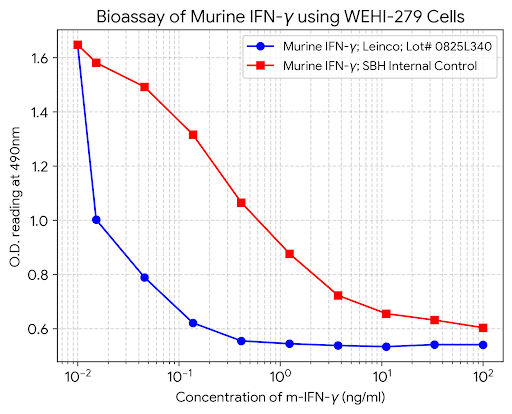 This WEHI-279 cell bioassay demonstrates that Murine IFN-gamma exhibits superior biological activity and potency compared to a competitor internal control standard. A prominent left-shift in the dose-response curve highlights an exceptionally active lot with an ED50 of less than 0.02 ng/ml outperforming the standard baseline by roughly 15- to 20-fold.
 Products are for research use only. Not for use in diagnostic or therapeutic procedures.
