Glial cell derived neurotrophic factor, also known as GDNF is a glycosylated, disulfide-bonded homodimer that is a distantly related member of the transforming growth factor-beta superfamily.1 GDNF potently promotes the survival of many types of neurons, most prominently, dopaminergic and motorneurons. GDNF regulates kidney development and spermatogenesis, and it affects alcohol consumption.2
Protein Details
Purity
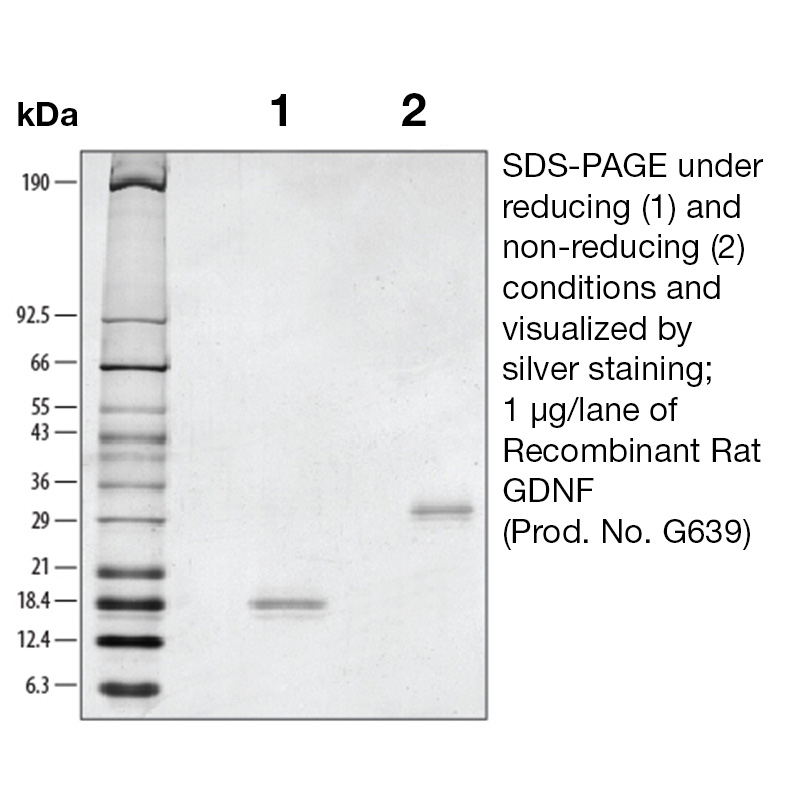
>97% by SDS-PAGE and analyzed by silver stain.
Endotoxin Level
<0.01EU/µg as determined by the LAL method
Biological Activity
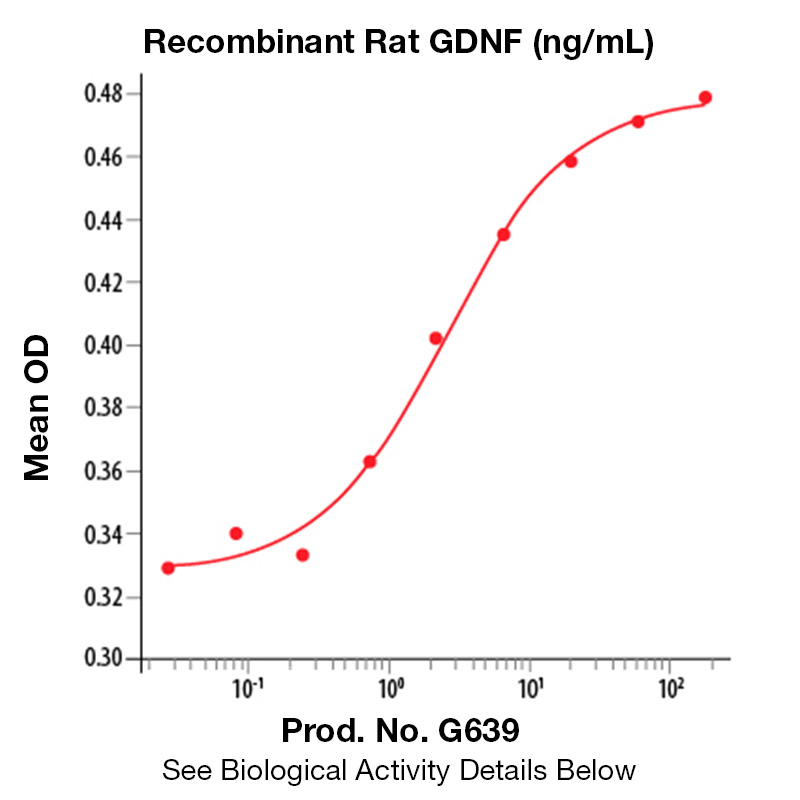
The biological activity of Rat GDNF was determined by its ability to support the survival and stimulate neurite outgrowth of dissociated chick embryonic dorsal root ganglia (DRG) neurons. The expected ED<sub>50</sub> is typically 1-3 ng/ml.
The predicted molecular weight of Recombinant Rat GDNF is Mr 15 kDa.
Predicted Molecular Mass
15
Formulation
This recombinant protein was lyophilized from a 0.2 μm filtered solution in 35% acetonitrile (CH3CN) and 0.1% trifluoroacetic acid (TFA).
Storage and Stability
This lyophilized protein is stable for six to twelve months when stored desiccated at -20°C to -70°C. After aseptic reconstitution, this protein may be stored at 2°C to 8°C for one month or at -20°C to -70°C in a manual defrost freezer. Avoid Repeated Freeze Thaw Cycles. See Product Insert for exact lot specific storage instructions.
Powered by AI: AI is experimental and still learning how to provide the best assistance. It may occasionally generate incorrect or incomplete responses. Please do not rely solely on its recommendations when making purchasing decisions or designing experiments.
Recombinant Rat GDNF (Glial cell line-derived neurotrophic factor) is widely used in research because it is a potent neurotrophic factor that supports the survival, maintenance, and regeneration of various neuronal populations, especially dopaminergic neurons, both in vitro and in vivo.
Key reasons to use recombinant rat GDNF in research applications:
Neuroprotection and Neuronal Survival: GDNF is essential for the survival of dopaminergic neurons, which are particularly relevant in models of Parkinson’s disease and other neurodegenerative disorders. It protects these neurons from toxic insults and oxidative stress, and promotes their morphological and neurochemical maintenance.
Functional Assays: Recombinant rat GDNF is used in cell culture and bioassays to promote the survival of primary neurons, such as embryonic dorsal root ganglia and midbrain dopaminergic neurons, with effective concentrations in the low nanogram per milliliter range.
Disease Modeling and Therapeutic Research: GDNF administration in animal models (e.g., rat models of Parkinson’s disease) has demonstrated the ability to prevent neurotoxin-induced degeneration of dopaminergic neurons, making it a valuable tool for studying neurodegeneration and testing neuroprotective strategies.
Stem Cell and Regeneration Studies: GDNF is used to support the proliferation and migration of neural and spermatogonial stem cells, and to study mechanisms of neuronal differentiation and regeneration.
Mechanistic Studies: Recombinant GDNF enables controlled investigation of signaling pathways (such as RET receptor-mediated pathways) involved in neuronal survival, growth, and repair.
Additional considerations:
Species specificity: Recombinant rat GDNF is preferred for rat models to ensure optimal biological activity and receptor compatibility.
Reproducibility: Using recombinant protein allows for consistent, defined concentrations and batch-to-batch reproducibility, which is critical for experimental reliability.
In summary, recombinant rat GDNF is a critical reagent for neurobiology, regenerative medicine, and disease modeling due to its robust neurotrophic and neuroprotective properties, especially in studies involving dopaminergic neurons and neurodegenerative disease mechanisms.
Yes, recombinant rat GDNF can be used as a standard for quantification or calibration in ELISA assays, provided it is of high purity and its concentration is accurately known. This is a common practice in commercial rat GDNF ELISA kits, which routinely use recombinant rat GDNF as the standard to generate calibration curves for quantifying GDNF in biological samples.
Key considerations and supporting details:
Standard Curve Preparation: ELISA kits for rat GDNF typically include a lyophilized recombinant rat GDNF standard, which is reconstituted and serially diluted to generate a standard curve. The concentration range for these standards commonly spans from low picogram to nanogram levels (e.g., 7.8–500 pg/mL, 78–5,000 pg/mL, or up to 10 ng/mL).
Purity and Source: The recombinant rat GDNF used as a standard should be of high purity (often >95%) and produced in a system that ensures correct folding and biological activity, such as E. coli or mammalian cells. The protein should be well-characterized, with its concentration determined by reliable methods (e.g., absorbance at 280 nm, BCA assay).
Compatibility: The recombinant standard must match the species and isoform of GDNF you intend to quantify. Commercial kits specify that their recombinant rat GDNF standard is designed for quantifying rat GDNF, and cross-reactivity with other species is sometimes noted.
Validation: If you are developing your own ELISA or using a kit with a different standard, you should validate that your recombinant rat GDNF behaves similarly to the kit standard in terms of antibody recognition and assay performance. This ensures accurate quantification.
Documentation: When using recombinant rat GDNF as a standard, document the lot number, source, and concentration determination method for reproducibility and traceability.
Protocol Example:
Reconstitute the lyophilized recombinant rat GDNF standard according to the manufacturer’s instructions.
Prepare serial dilutions in the assay buffer to cover the desired concentration range.
Run the standard curve in parallel with your samples and interpolate sample concentrations from the standard curve.
Summary Table: Use of Recombinant Rat GDNF as ELISA Standard
Requirement
Details
Protein type
Recombinant rat GDNF
Purity
>95% recommended
Concentration range
Typically 7.8–10,000 pg/mL (kit-dependent)
Validation
Should be validated for use with your specific ELISA antibodies
Documentation
Record lot, source, and quantification method
In conclusion, recombinant rat GDNF is suitable and widely used as a standard for ELISA quantification, provided it is appropriately validated and prepared.
Recombinant Rat GDNF has been validated for several key applications in published research, primarily in studies of neuronal survival, differentiation, and neuroprotection.
Validated Applications:
Bioassays: Used to assess neurotrophic activity, such as promoting survival and differentiation of dopaminergic neurons, dorsal root ganglia neurons, and other neuronal populations.
Cell Culture: Applied to cultured neuronal and non-neuronal cells to study effects on proliferation, survival, and differentiation.
In Vivo Studies: Utilized in animal models (e.g., rat tibial nerve transection, Parkinson’s disease models) to evaluate neuroprotective and regenerative effects.
Western Blot Control: Used as a positive control for GDNF detection in protein analysis.
Neutralization Assays: Employed to test the ability of antibodies or other agents to neutralize GDNF activity.
Functional Studies: Includes dose-dependent proliferation assays (e.g., SH-SY5Y neuroblastoma cells), receptor binding, and activation of downstream signaling pathways.
Mass Spectrometry and HPLC: Used for protein characterization and purity assessment.
ELISA Standard/Development: Used as a standard or reagent in ELISA-based quantification of GDNF.
Spatial Biology and Mass Cytometry (CyTOF): Applied in advanced cell biology and tissue mapping studies.
Representative Published Research Applications:
Neuronal Survival and Differentiation: Promotes survival of chick embryonic dorsal root ganglia neurons and dopaminergic neurons; enhances high-affinity dopamine uptake.
Neuroprotection in Disease Models: Investigated for regenerative effects in Parkinson’s disease and protection against apoptosis in motor neuron injury models.
Stem Cell Biology: Studied for its role in spermatogonial stem cell migration and proliferation, as well as hematopoietic stem cell survival.
Mechanistic Studies: Used to dissect signaling pathways (e.g., Ras/Erk1/2, RET receptor activation) and gene regulation in neuronal and cancer cell models.
Summary Table of Validated Applications
Application
Example Use Case/Assay
Reference(s)
Bioassay
Neuronal survival, differentiation
Cell Culture
Proliferation, differentiation assays
In Vivo
Neuroprotection, regeneration
Western Blot Control
Protein detection
Neutralization
Antibody/agent testing
Functional Studies
SH-SY5Y proliferation, receptor activation
Mass Spec/HPLC
Protein characterization
ELISA Standard
Quantification assays
Spatial Biology/CyTOF
Advanced cell/tissue mapping
Key Scientific Context:
GDNF is a neurotrophic factor critical for the survival and function of dopaminergic and motor neurons, acting via the GFRα1/RET receptor complex.
Recombinant rat GDNF is widely used in both basic and translational neuroscience research, including studies of neurodegeneration, regeneration, and stem cell biology.
If you require protocols or specific experimental details for any application, please specify the context or assay type.
To reconstitute and prepare Recombinant Rat GDNF protein for cell culture experiments, dissolve the lyophilized protein at 100 μg/mL in sterile PBS. If the formulation includes a carrier protein (such as BSA), use sterile PBS containing at least 0.1% human or bovine serum albumin for reconstitution.
Step-by-step protocol:
Centrifuge the vial briefly before opening to ensure all lyophilized material is at the bottom.
Add sterile PBS (or PBS + 0.1% BSA if required) to achieve a final concentration of 100 μg/mL.
Gently pipette the solution up and down along the vial walls to fully dissolve the protein—avoid vigorous vortexing to prevent denaturation.
Allow the solution to sit for a few minutes at room temperature to ensure complete dissolution.
Aliquot the reconstituted protein to minimize freeze-thaw cycles.
Store aliquots at 2–8°C for short-term use (up to one month) or at –20°C to –70°C for long-term storage. Avoid repeated freeze-thaw cycles to preserve bioactivity.
Preparation for cell culture:
Before adding to cell culture, further dilute the stock solution to the desired working concentration (e.g., 1–100 ng/mL, depending on your assay requirements) using cell culture medium or PBS containing 0.1% BSA to prevent adsorption to plasticware.
Filter sterilize if necessary, especially if the working solution will be stored or used over several days.
Additional notes:
The effective dose for neuronal survival assays is typically 1–3 ng/mL.
Always consult the specific product datasheet for formulation details and recommended diluents, as some preparations may differ (e.g., inclusion of trehalose or other stabilizers).
If the protein is glycosylated or contains sensitive disulfide bonds, handle gently and avoid reducing agents unless specifically required for your application.
This protocol ensures optimal solubility and bioactivity of recombinant rat GDNF for cell culture experiments.
References & Citations
1. Collins, F. et al. (1993) Science260: 1130 2. Ron, D. et al. (2008) Proc. Natl. Acad. Sci. U.S.A.105: 8114




 Products are for research use only. Not for use in diagnostic or therapeutic procedures.
