

Anti-8-oxoG DNA/RNA Oxidative Damage [Clone 15A3]


Anti-8-oxoG DNA/RNA Oxidative Damage [Clone 15A3]
Product No.: 12501
- -
- -
Clone 15A3 Target 8-oxoG Formats AvailableView All Product Type Monoclonal Alternate Names 8-oxoG, 8-Oxoguanine, 8-oxo-Gua Isotype Mouse IgG2b Applications ELISA , IHC , AP |
Data
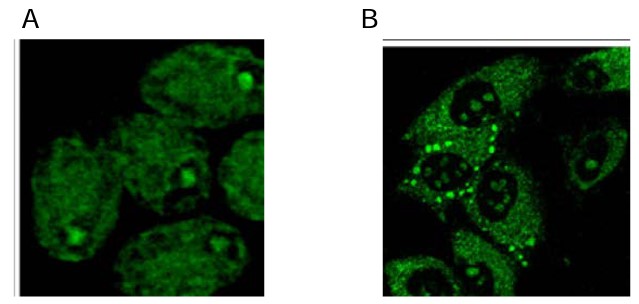 Distribution of 8-oxoG in (A) H2O2-treated Chlamydomonas and (B) Arsenite-treated HeLa cells. Courtesy of William Zerges, Concordia University.(reference #6 below)
 - -
- -
Antibody DetailsProduct DetailsReactive Species Eukaryotic Host Species Mouse Immunogen 8-hydroxyguanosine (oh8G)-BSA and -casein conjugates. Product Concentration Lot Specific Formulation The antibody is supplied in Tris-buffered saline (TBS), pH 7.4, and contains 0.1% sodium azide as a preservative. State of Matter Liquid Product Preparation Purified by Protein G affinity chromatography Storage and Handling This antibody is stable for at least one (1) year at 4°C. Avoid repeated freeze-thaw cycles. Do not freeze as this might result in precipitation of the antibody. Country of Origin USA Shipping Next Day 2-8°C Applications and Recommended Usage? Quality Tested by Leinco IHC Protocol using Anti-DNA/RNA Oxidative Damage Antibody (12501) This antibody may be used in ELISA and immunohistochemistry to detect the markers of oxidative damage to DNA and RNA. May also be used on immunoaffinity columns to isolate oxidative DNA damage adducts from biological fluids. Each investigator should determine their own optimal working dilution for specific applications. See directions on lot specific datasheets, as information may periodically change. DescriptionDescriptionSpecificity Mouse Monoclonal Antibody specific to DNA and RNA Oxidative Damage Markers Background 8-Hydroxyguanosine (8-OHG) is a critical biomarker of oxidative stress and a primary indicator of oxidative DNA and RNA damage. It is formed when Reactive Oxygen Species (ROS), such as hydroxyl radicals, attack the C8 position of guanine—the nucleobase most susceptible to oxidation due to its low redox potential. Research into 8-hydroxy-2'-deoxyguanosine (8-OHdG) and 8-hydroxyguanosine (8-OHG) is essential for understanding the molecular mechanisms of genomic instability and cellular aging. Because 8-OHG can pair with adenine instead of cytosine during replication, it often leads to G:C to T:A transversions, making it a highly mutagenic lesion and a driver of carcinogenesis. Beyond cancer research, 8-OHG is a vital tool in studying neurodegenerative diseases, including Alzheimer’s (AD) and Parkinson’s (PD), as well as metabolic syndrome and chronic inflammation. This mouse monoclonal antibody provides high-sensitivity detection of oxidative modifications across various applications, including Immunohistochemistry (IHC), Immunofluorescence (IF), and ELISA, allowing researchers to quantify oxidative nucleic acid damage in tissue and cellular models. Function As an oxidized nucleoside, 8-OHG does not have a "function" in the traditional sense of a protein; rather, it is a mutagenic lesion and a signaling biomarker:<br>
<br>
Translational Interference: The presence of 8-OHG in mRNA can cause ribosome stalling or lead to the production of truncated or misfolded proteins, contributing to proteotoxic stress.<br>
<br>
Mutagenic Potential: In the context of DNA (as 8-OHdG), it frequently pairs with Adenine instead of Cytosine, leading to G:C to T:A transversions—a hallmark of carcinogenesis and genomic instability.<br>
<br>
Pathological Indicator: Elevated levels of 8-OHG are a primary indicator of "oxidative distress." It is widely used to study the progression of neurodegenerative disorders (such as Alzheimer’s and Parkinson’s), where RNA oxidation often precedes protein aggregation.<br>
<br>
Extracellular Excretion: Once repaired by the Base Excision Repair (BER) pathway, 8-OHG is released from the cell and can be detected in serum, cerebrospinal fluid (CSF), and urine, making it a non-invasive biomarker for systemic oxidative stress. Research Area Immuno-Oncology . Neuroinflammation . Neuroscience . Neurodegeneration References & Citations1. Park et al. (1992) Assay of excised oxidative DNA lesions: Isolation of 8-oxoguanine and its nucleoside derivatives from biological fluids with a monoclonal antibody column. Proc Natl Acad Sci (USA) 89: 3375- 3379. 2. Nunomura et al. (1999) RNA Oxidation is a prominent feature of vulnerable neurons in Alzheimer's Disease. J Neuroscience 19: 1959-1964. 3. Cui et al. (1999) Oxidative damage to the c-fos gene and reduction of its transcription after focal cerebral ischemia. J Neurochemistry 73:1164-1174. 4. Salganik et al. (2000) Dietary antioxidant depletion: enhancement of tumor apoptosis and inhibition of brain tumor growth in transgenic mice. Carcinogenesis 21: 909-914. 5. Tanaka et al. (2007) Oxidized messenger RNA induces translation errors. Proc Natl Acad Sci (USA) 104: 66-71. 6. Zhan et al. (2015) Localized control of oxidized RNA. Journal of Cell Science 128: 4210-4219. 7. Kharel et al. (2016) Evidence of extensive RNA oxidation in normal appearing cortex of multiple sclerosis brain. Neurochemistry International 92: 43-48. Technical Protocols  AP Certificate of Analysis |
Formats Available
 Products are for research use only. Not for use in diagnostic or therapeutic procedures.
