

Anti-ENL [Clone 3.1.1]


Anti-ENL [Clone 3.1.1]
Product No.: 34043
- -
- -
Clone 3.1.1 Target ENL Formats AvailableView All Product Type Monoclonal Alternate Names YEATS domain-containing protein 1 Isotype Mouse IgG1 Applications WB |
Data
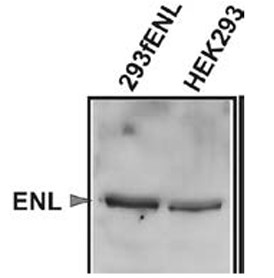 Immunoblotting: use at 1-5ug/ml. A band of ~62kDa is detected. Extracts from transduced 293fENL and HEK293 parental cells blotted with #34043.
 - -
- -
Antibody DetailsProduct DetailsReactive Species Human Host Species Mouse Immunogen Maltose-binding fusion protein containing ENL amino acids 414-472 (Accession no. NP_005925). Product Concentration Lot Specific Formulation This monoclonal antibody is formulated in phosphate buffered saline (PBS) pH 7.2 - 7.4 with no carrier protein or preservatives added. State of Matter Liquid Product Preparation Antibodies are purified by a multi-step process including the use of protein A or G to assure extremely low levels of endotoxins, leachable protein A or aggregates. Storage and Handling This antibody is stable for at least one (1) year at -20°C. Avoid multiple freeze-thaw cycles. Country of Origin USA Shipping Next Day 2-8°C Applications and Recommended Usage? Quality Tested by Leinco Immunoblotting: use at 1-5ug/mL. A band of ~62kDa is detected. Each investigator should determine their own optimal working dilution for specific applications. See directions on lot specific datasheets, as information may periodically change. DescriptionDescriptionSpecificity This antibody recognizes human ENL. Background Anti-ENL [Clone 3.1.1] is a monoclonal antibody targeting the ENL (MLLT1) oncoprotein, a frequent fusion partner of MLL (KMT2A) in acute leukemia. ENL belongs to the AF4/ENL family of MLL fusion partners, which together account for roughly two‑thirds of MLL‑rearranged leukemia cases, making ENL an important biomarker and research target in hematologic malignancies. The ENL protein is a nuclear transcriptional regulator and member of the ENL/AF9 family, which shows structural homology to the yeast Anc1 protein. ENL can activate transcription from synthetic reporter constructs in lymphoid and myeloid cells, as well as in yeast, highlighting its role in regulating gene expression. Deletion mutagenesis experiments mapped the minimal transcriptional activation domain of ENL to its C‑terminal 90 amino acids, a region that is highly conserved between ENL and AF9. This conserved carboxy‑terminal region is retained in all Hrx‑ENL and Hrx‑AF9 fusion proteins, indicating that the leukemogenic activity and transcriptional activation potential of ENL colocalize to its C‑terminal domain. This antibody is ideal for studying ENL expression, ENL/MLL fusion proteins, and downstream transcriptional programs in models of MLL‑rearranged leukemia, and is suitable for applications such as Western blot, immunofluorescence, and immunohistochemistry, depending on validation. Function ENL (MLLT1) is an epigenetic chromatin reader that regulates transcription, particularly of oncogenic genes in hematopoietic cells.<br>
<br>
<i>Core molecular function</i><br>
- ENL is a nuclear chromatin-binding protein that recognizes acylated histone marks (notably histone acetylation and β‑hydroxybutyrylation) via its YEATS domain, acting as a histone “reader.”<br>
<br>
- It functions as a component of the super elongation complex (SEC), helping to stimulate RNA polymerase II transcriptional elongation at active gene<br>
<br>
<i>Role in gene regulation and leukemia</i><br>
- ENL recruits and stabilizes transcriptional machinery at promoters and super‑enhancers of key proto‑oncogenes such as MYC and HOX cluster genes, driving their expression.<br>
<br>
- In MLL‑rearranged and other acute leukemias, ENL is essential for maintaining leukemogenic transcriptional programs, and its YEATS domain is a critical determinant of this oncogenic activity.<br>
<br>
<i>Functional domain relevance</i><br>
- The C‑terminal region of ENL contains a strong transcriptional activation domain required for reporter gene activation and is retained in ENL fusion oncoproteins, linking this region to leukemogenic function.
(Zhou J, Ng Y, Chng WJ. ENL: structure, function, and roles in hematopoiesis and acute myeloid leukemia. Cell Mol Life Sci. 2018 Nov;75(21):3931-3941. doi: 10.1007/s00018-018-2895-8. Epub 2018 Jul 31. PMID: 30066088; PMCID: PMC11105289.) NCBI Gene Bank ID UniProt.org Research Area Cancer Research References & Citations1) Rubnitz JE et al. 1994 Blood 84: 1747-1752. 2) Yokoyama A et al. 2010 Cancer Cell 17: 198-212. 3) Mueller D at al. 2007 Blood 110: 4445-4454. Technical Protocols Certificate of Analysis |
Formats Available
- -
- -
Prod No. | Description |
|---|---|
34043 | |
19501 |
 Products are for research use only. Not for use in diagnostic or therapeutic procedures.
