

Anti-Nav1.8 [Clone S134-12]


Anti-Nav1.8 [Clone S134-12]
Product No.: 11523
- -
- -
Clone S134-12 Target Nav1.8 Na+ Channel Formats AvailableView All Product Type Monoclonal Alternate Names Peripheral nerve sodium channel 3, PN3, Sensory neuron sodium channel, Sodium channel protein type X subunitα, Voltage-gated sodium channel subunitα Nav1.8 Isotype Mouse IgG2a Applications ICC , IF , IHC , WB , AM |
Data
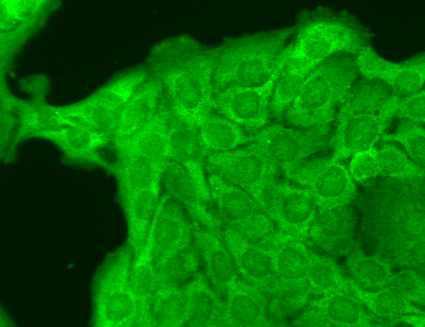 Immunocytochemistry/Immunofluorescence analysis using Mouse Anti-Nav1.8 Monoclonal Antibody, Clone S134 (11523). Tissue: HaCaT cells. Species: Human. Fixation: Cold 100% methanol for 10 minutes at -20°C. Primary Antibody: Mouse Anti-Nav1.8 Monoclonal Antibody (11523) at 1:100 for 1 hour at RT. Secondary Antibody: FITC Goat Anti-Mouse (green) at 1:50 for 1 hour at RT. Localization: Cytoplasmic staining and some dull nuclear staining.
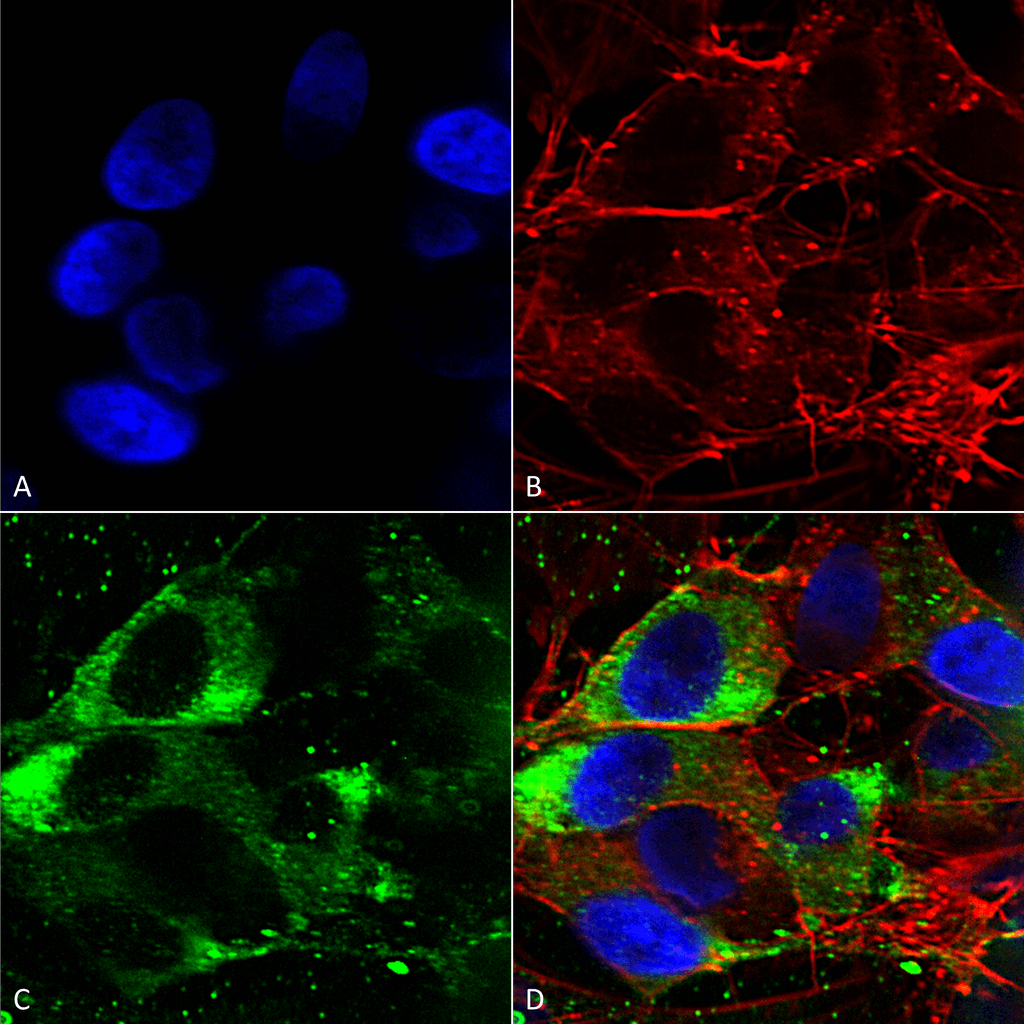 Immunocytochemistry/Immunofluorescence analysis using Mouse Anti-Nav1.8 Monoclonal Antibody, Clone S134 (11523). Tissue: Neuroblastoma cells (SH-SY5Y). Species: Human. Fixation: 4% PFA for 15 min. Primary Antibody: Mouse Anti-Nav1.8 Monoclonal Antibody (11523) at 1:50 for overnight at 4°C with slow rocking. Secondary Antibody: AlexaFluor 488 at 1:1000 for 1 hour at RT. Counterstain: Phalloidin-iFluor 647 (red) F-Actin stain; Hoechst (blue) nuclear stain at 1:800, 1.6mM for 20 min at RT. (A) Hoechst (blue) nuclear stain. (B) Phalloidin-iFluor 647 (red) F-Actin stain. (C) Nav1.8 Antibody (D) Composite.
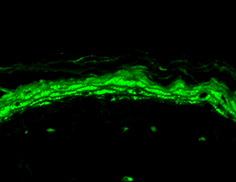 Immunohistochemistry analysis using Mouse Anti-Nav1.8 Monoclonal Antibody, Clone S134 (11523). Tissue: backskin. Species: Mouse. Fixation: Bouin’s Fixative and paraffin-embedded. Primary Antibody: Mouse Anti-Nav1.8 Monoclonal Antibody (11523) at 1:100 for 1 hour at RT. Secondary Antibody: FITC Goat Anti-Mouse (green) at 1:50 for 1 hour at RT. Localization: Heavy filaggrin-like staining, lower epidermal cells have some staining.
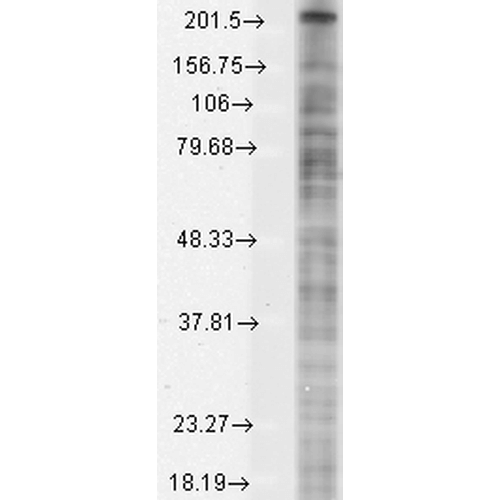 Western Blot analysis of Monkey COS transient cell lysate showing detection of Nav1.8 protein using Mouse Anti-Nav1.8 Monoclonal Antibody, Clone S134 (11523). Load: 15 µg. Block: 1.5% BSA for 30 minutes at RT. Primary Antibody: Mouse Anti-Nav1.8 Monoclonal Antibody (11523) at 1:1000 for 2 hours at RT. Secondary Antibody: Sheep Anti-Mouse IgG: HRP for 1 hour at RT.
 - -
- -
Antibody DetailsProduct DetailsReactive Species Human ⋅ Monkey ⋅ Mouse ⋅ Rat Host Species Mouse Immunogen Fusion protein, aa 1724-1956 (cytoplasmic C-terminus) of rat Nav1.8 (accession no. Q62968). Product Concentration Lot Specific Formulation Phosphate-Buffered Saline (PBS), pH 7.2 - 7.4, containing 50% Glycerol and 0.09% Sodium Azide ($NaN_3$). State of Matter Liquid Product Preparation Purified by Protein G affinity chromatography Storage and Handling This antibody is stable for at least one (1) year at -20°C. Country of Origin USA Shipping Next Day 2-8°C Applications and Recommended Usage? Quality Tested by Leinco Immunoblotting: use at 1-10ug/mL. A band of ~220kDa is detected.Immunohistochemistry and
Immunocytochemistry: use at 0.1-1ug/mL Immunofluorescence: use at 1-10ug/mL These are recommended concentrations. User should determine optimal concentrations for their application. Positive control: Rat dorsal root ganglia or lysate of COS cells transiently expressing Nav1.8. Each investigator should determine their own optimal working dilution for specific applications. See directions on lot specific datasheets, as information may periodically change. DescriptionDescriptionSpecificity Mouse Monoclonal Antibody specific to Nav1.8 Na+ Channel Background Nav1.8, encoded by the SCN10A gene, is a tetrodotoxin-resistant voltage-gated sodium channel primarily expressed in peripheral sensory neurons such as nociceptors. It plays a key role in pain signal transmission by contributing to the upstroke of action potentials in nociceptive pathways. Highly selective for peripheral tissues, Nav1.8 is a major mediator of inflammatory and neuropathic pain and remains active at lower temperatures, linking it to cold-induced pain mechanisms. Because of its restricted expression outside the central nervous system, Nav1.8 is an attractive target for developing peripheral analgesics. Emerging evidence also connects chronic peripheral nerve dysfunction with neuroinflammation and cognitive decline, suggesting that targeting Nav1.8 may have broader implications in modulating pain-related neurodegenerative processes. Function Nav1.8 is a tetrodotoxin-resistant voltage-gated sodium channel that mediates sodium influx in peripheral sensory neurons, contributing critically to the transmission of pain signals and the rising phase of action potentials. Its function is essential for neuronal excitability and the propagation of noxious stimuli in pain pathways {PubMed:12514212, PubMed:8538791, PubMed:8626372}. NCBI Gene Bank ID UniProt.org Research Area Ion Channels References & CitationsTechnical ProtocolsICC IF   AM Certificate of Analysis |
Formats Available
 Products are for research use only. Not for use in diagnostic or therapeutic procedures.
