

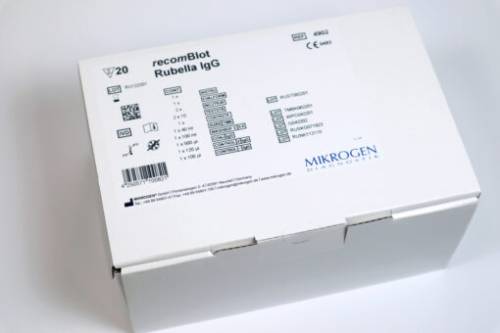
Mikrogen Diagnostik recomBlot Rubella IgG Immunoblot Test Kit

Data
- -
- -
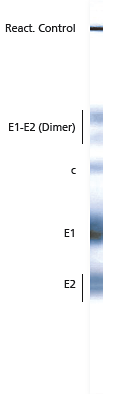
Product DetailsDescription This recomBlot Rubella IgG is a high-specificity line immunoassay designed for the detection of IgG antibodies against the Rubella virus in human serum or plasma. Utilizing Rubella virus lysate derived from Vero cells, this immunoblot presents electrophoretically separated viral antigens on a nitrocellulose membrane. The test is specifically optimized as a confirmatory and differentiation tool to exclude primary Rubella infections. It features the specific detection of IgG antibodies against the Rubella E2 antigen, which typically appear three months post-infection or vaccination. The presence of the E2 band allows for the reliable serological exclusion of an acute infection (within the last 3 months), making it a crucial tool for clarifying Rubella status, particularly in prenatal care diagnostics. Intended Use Research Use Only Materials Provided 1.) 5X Wash Buffer (100 mL) 2.) TMB Substrate (40 mL) 3.) Incubation Tray (2 Each) 4.) Control Strip (1 Each) 5.) Instructions for Use (1 Each) 6.) Evaluation Form (1 Each) 7.) Test Strips (2 Vials x 10 Each) 8.) Weak Positive Control (120 uL) 9.) Negative Control (100 uL) 10.) Anti-Human IgG Conjugate (500 uL) Other Materials and Solutions Required • Deionised water (high quality) • Plastic forceps • Horizontal shaker • Vortex mixer or other rotators • Vacuum pump or similar device • Volumetric cylinders, 50 ml and 1000 ml • Micropipettes with disposable tips, 20 µl and 1000 µl • 10 ml pipette or dispenser • Timer • Absorbent paper towels • Disposable protective gloves • Waste container for bio-hazardous materials Precautions All blood products must be treated as potentially infectious. The test strips were prepared with inactivated whole cell lysates and/or recombinant bacterial, viral or parasitic antigens. After the addition of patient or control specimens the strip material must be considered infectious and treated as such. Suitable disposable gloves must be worn throughout the entire test procedure. The reagents contain the antimicrobial agents and preservatives sodium azide, MIT (methylisothiazolone), oxypyrion and chloroacetamide and hydrogen peroxide. Avoid contact with the skin or materials contaminated with potentially infectious samples must be treated with disinfectants or disposed of according to the hygiene regulations. The concentrations and incubation periods stated by the manufacturer must be observed. Note: Sodium azide can form an explosive azide upon contact with heavy metals such as copper and lead azide. All siphoned liquids must be collected. All collecting containers must contain suitable disinfecting agents for deactivating pathogenic human viruses and other pathogens. Use incubation trays only once. Handle strips carefully using plastic forceps. Do not substitute or mix the reagents with reagents from other manufacturers. Read the entire instructions for use before carrying out the test and be sure to follow them carefully. Deviation from the test protocol provided in the instructions for use can lead to erroneous results. Reagent Preparation Expose all ingredients to room temperature (+18°C to +25°C) for at least 30 minutes before beginning the test. The test procedure is carried out at room temperature. Washing buffer, milk powder, dilution buffer, conjugate and TMB can be interchanged between the different recomLine and recomBlot test systems, if these components carry the same symbols. Consider the shelf life of these components. Mix the concentrated reagents and samples thoroughly before use. Avoid a build up of foam. Only open the tube containing the test strip immediately before use to avoid condensation. Leave unused strips in the tube and continue to store at +2 to +8°C (reseal tube tightly, test strips may not become moist before the test!). The E2 weakly positive control must be carried out in each test step irrespective of the number of serums to be tested. Correct test interpretation is possible only then. The negative control can be included. Protect the kit components from direct sunlight throughout the entire test procedure. The substrate solution (TMB) is especially sensitive to light. The strips must be completely wetted and immersed throughout the entire procedure BackgroundWhile Rubella (German measles) is typically a mild or asymptomatic illness in childhood, it poses a severe threat to the fetus if contracted by a mother shortly before conception or during early pregnancy. The risk is most critical during the first 12 weeks of gestation (organogenesis). Infection during this period can lead to spontaneous abortion, premature birth, or Congenital Rubella Syndrome (CRS)—often referred to as Gregg’s syndrome—which presents as a classic triad of heart, eye, and inner ear impairments. The risk of embryopathy decreases significantly as pregnancy progresses; infections occurring after the 20th week are generally considered to have no adverse impact on the fetus. Because of these risks, accurate serological determination of Rubella antibody status is vital for pregnant women, particularly when an acute infection is suspected or vaccination history is incomplete. Test Principle: The recomBlot Rubella IgG utilizes Rubella virus lysate derived from Vero cells. Through electrophoretic separation and Western Blotting, specific viral antigens are transferred to a nitrocellulose membrane to allow for a comprehensive serological evaluation. A key diagnostic feature of this test is the detection of IgG antibodies against the Rubella E2 antigen. These conformational antibodies appear, at the earliest, three months after infection or vaccination. Consequently, if the E2 band is detected, a primary infection within the last three months can be serologically excluded. Note: This kit/product is for research use only References & Citations1. Zangh T et al., Detection of Rubella Virus-Specific Immunoglobulin G (IgG), IgM, and IgA Antibodies ba Immunoblot Assays, Journal of Clinical Microbiology 1992, Vol 30 (4) p. 824-830 2. Pustowoit B, Standardization of rubella testing, Infection 1993, 21, 4-5 3. Hobmann TC et al., Assembly of Rubella Virus Structural Proteins into Virus-like Particles in Transfected Cells, Virology 1994, 202 p.574-585 4. Pustowoit B et al., Evaluation of recombinant rubella-like particles in acommercial immunoassay for the detection of anti-rubella IgG, Clinical and Diagnostic Virology 1996, 5 p.13-20 |
 Products are for research use only. Not for use in diagnostic or therapeutic procedures.
