

ADAPT-3D: Rapid Tissue and Organoid Clearing for 3D Fluorescence Imaging
Accelerated Deep-Tissue Labeling with ADAPT-3D

What is ADAPT-3D Tissue Clearing?
ADAPT-3D (Accelerated Deep Adaptable Processing of Tissue for 3-Dimensional imaging) is an aqueous clearing and immunolabeling protocol for fixed tissue and organoids. It renders samples optically transparent for 3D fluorescence imaging while maintaining sample morphology and preserving endogenous fluorescence. Leinco offers two kits: the ADAPT-3D Tissue Clearing Kit (A630) for whole organs and thick tissue slices, and the ADAPT-3D Organoid Clearing Kit (A640) for organoids grown in 96-well glass-bottom plates.
The ADAPT-3D Advantage
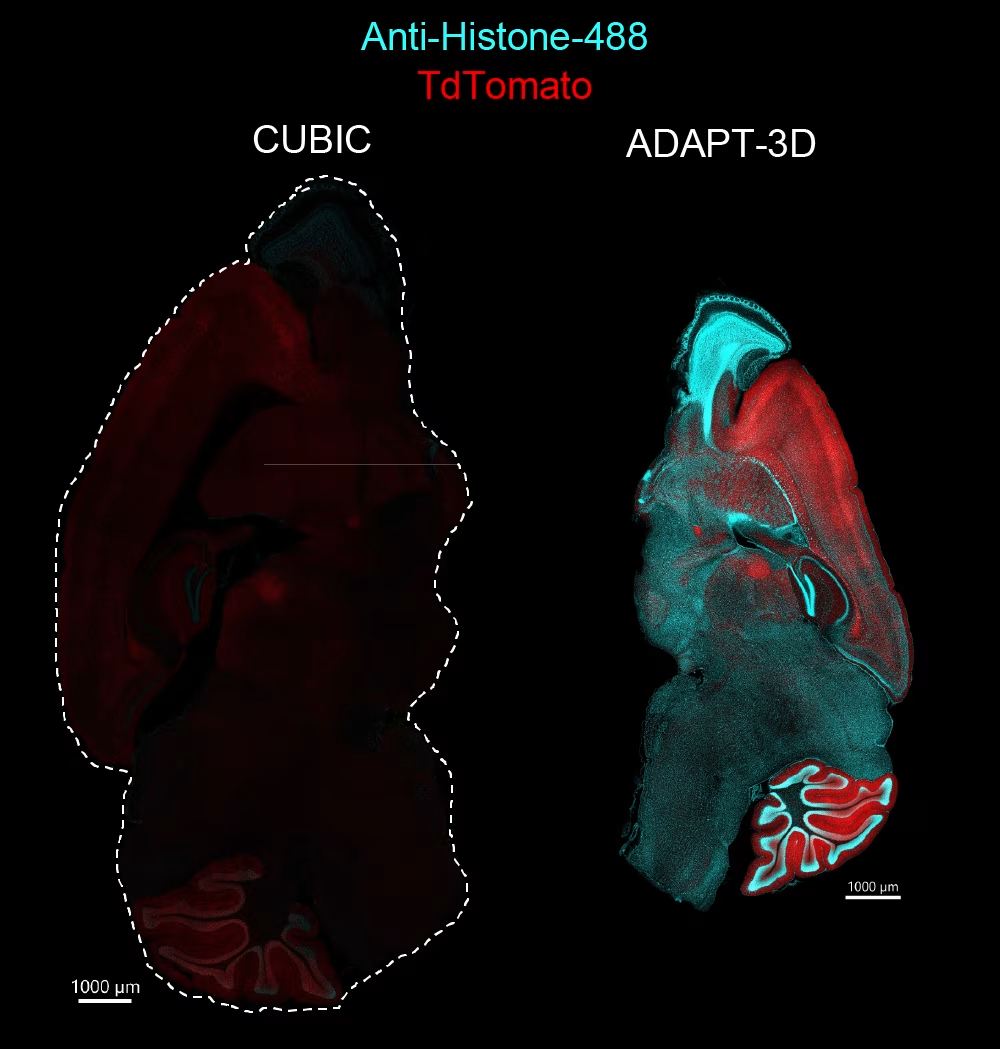
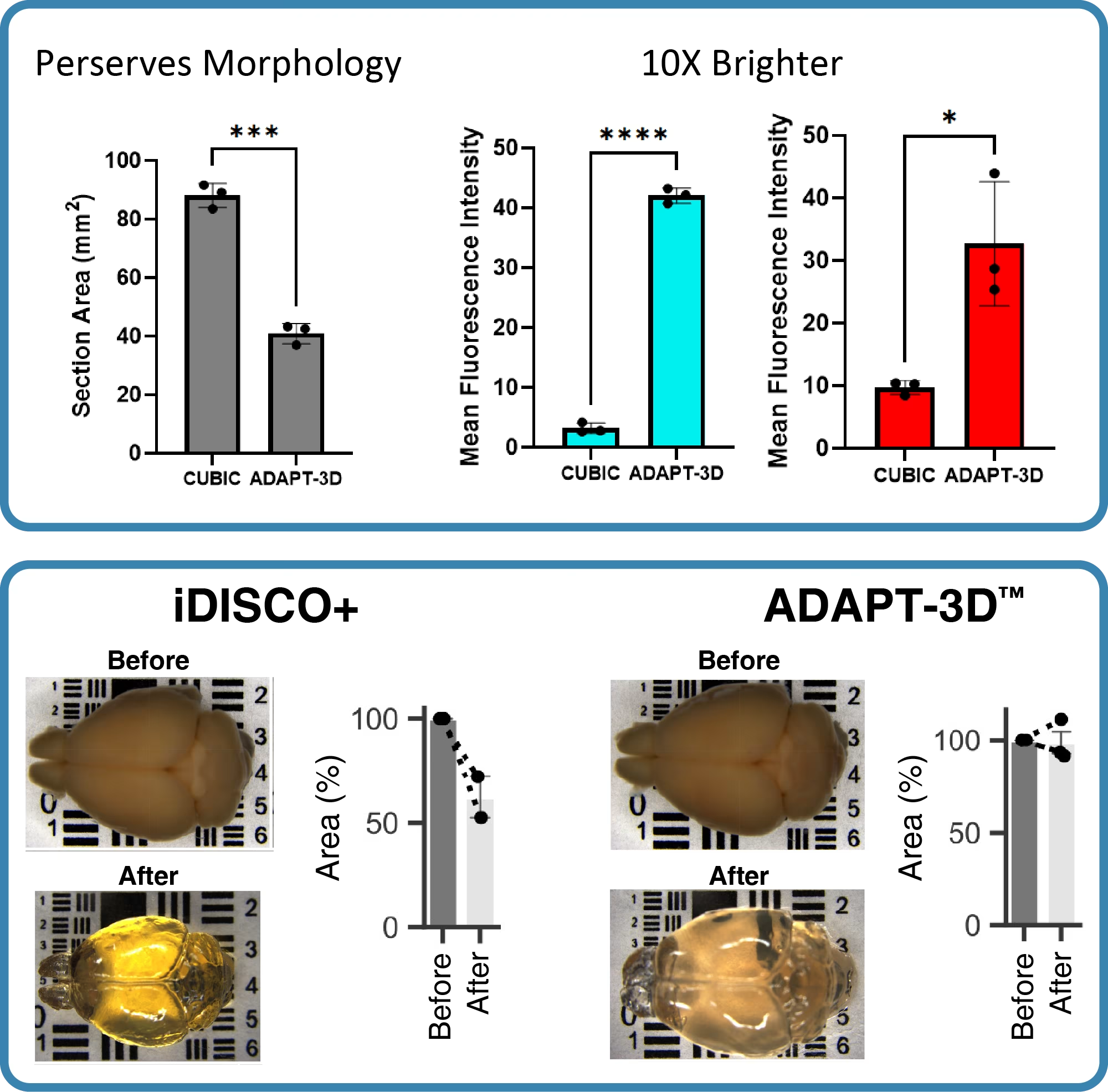
Traditional tissue sectioning disrupts the three-dimensional spatial relationships of the cellular environment, while existing whole-mount clearing methods, such as CLARITY and iDISCO, often require weeks for antibody penetration and can struggle to achieve uniform labeling deep within the tissue. ADAPT-3D overcomes these limitations through an optimized, sample preparation and staining workflow that preserves tissue morphology, retains endogenous fluorescent signals, and rapidly facilitates antibody penetration to deliver consistent signal intensity from the tissue surface to its core.
Preserve Tissue Morphology and Fluorescence Signal Compared to Alternative Methods
Designed for simplicity and efficiency, ADAPT-3D uses an aqueous based approach that eliminates the need for organic solvents and toxic chemicals, while streamlining sample preparation and immunolabeling to produce high-quality, publication-ready images in less time. Unlike conventional clearing approaches, which introduce workflow-specific trade-offs, ADAPT-3D is an integrated, clearing ecosystem that chemically coordinates fixation, decolorization, partial delipidation, immunolabeling, and refractive index matching into a streamlined, end-to-end workflow. This is unlike organic-solvent-based methods (iDISCO/DISCO) which cause tissue shrinkage of up to 40% and quench endogenous fluorescent reporters, hydrogel-based methods (CLARITY) which induce tissue swelling, and aqueous hyperhydration methods (CUBIC) that cause substantial swelling and elongate processing times.
Accelerate Your Timelines With ADAPT-3D: Shorten the Time to Imaging from Weeks to Days
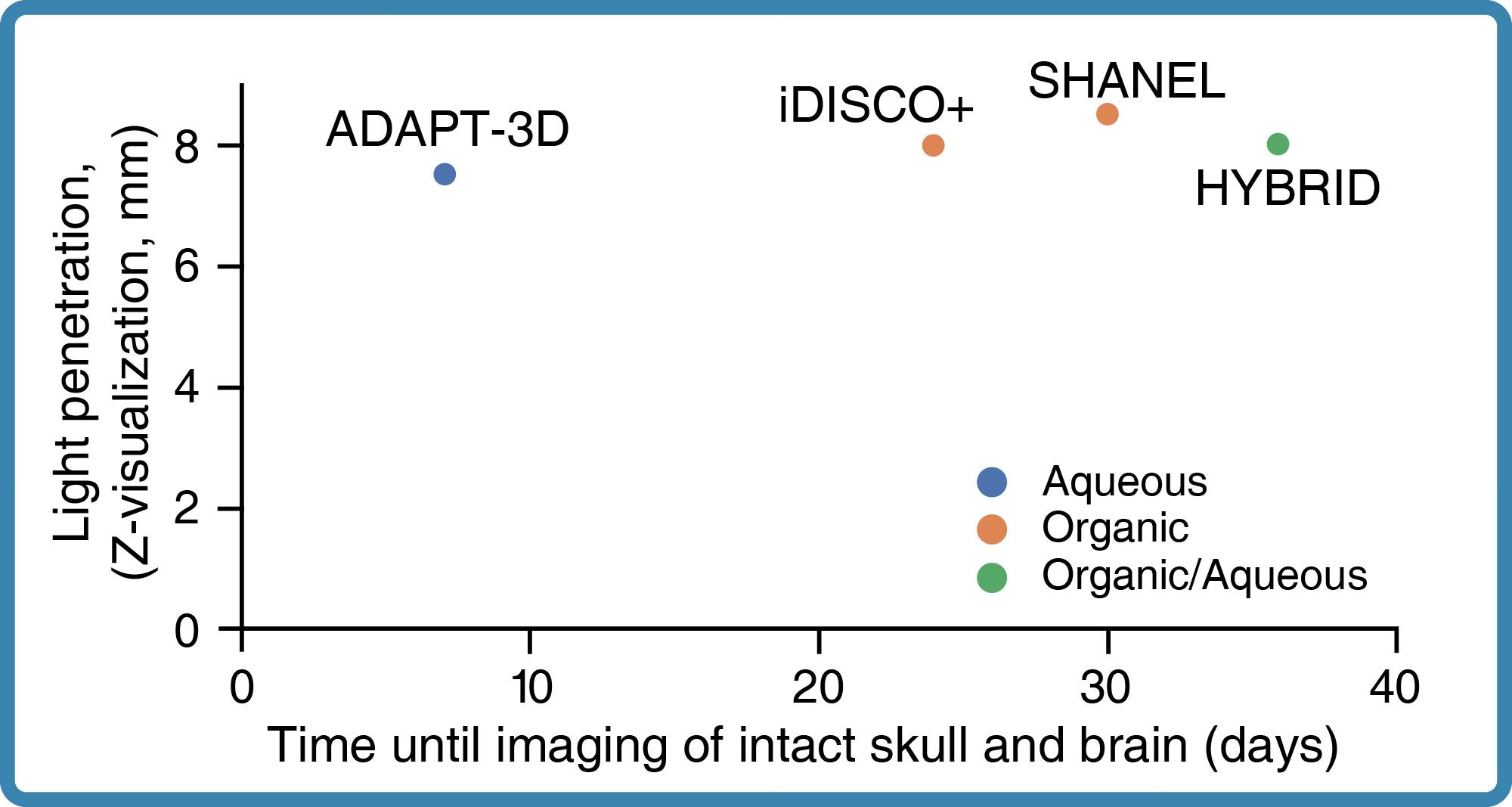
Together, ADAPT-3Ds ability to preserve tissue morphology, retain endogenous fluorescence, accelerate processing, eliminate harsh chemicals, and integrate every step into a coordinated easy-to-follow workflow establishes a new benchmark for three-dimensional tissue clearing.
Choose Your Kit: Tissue Clearing (A630) or Organoid Clearing (A640)
| ADAPT-3D Tissue Clearing Kit | ADAPT-3D Organoid Clearing Kit | |
|---|---|---|
| Catalog no. | A630 | A640 |
| Best for | Whole organs, thick slices, bone | Organoids of 100–500 µm |
| Sample format | Fixed tissue in glass tubes or vials (not included) | Organoids fixed, stained, cleared and imaged in a 96-well glass-bottom plate |
| Validated samples | Human intestine; intact mouse skull and brain; spleen, lung and liver; bone after decalcification. Species: mouse, human, pig | Broadly applicable to many different organoid models |
| Clearing time | Days instead of weeks | Hours instead of days |
| Imaging | Widefield, confocal, light-sheet | Widefield, confocal, light-sheet |
| Buffers included | B671, B672, B676, B673, B675, B674 | B671, B672, B676, B673, B675, B674 |
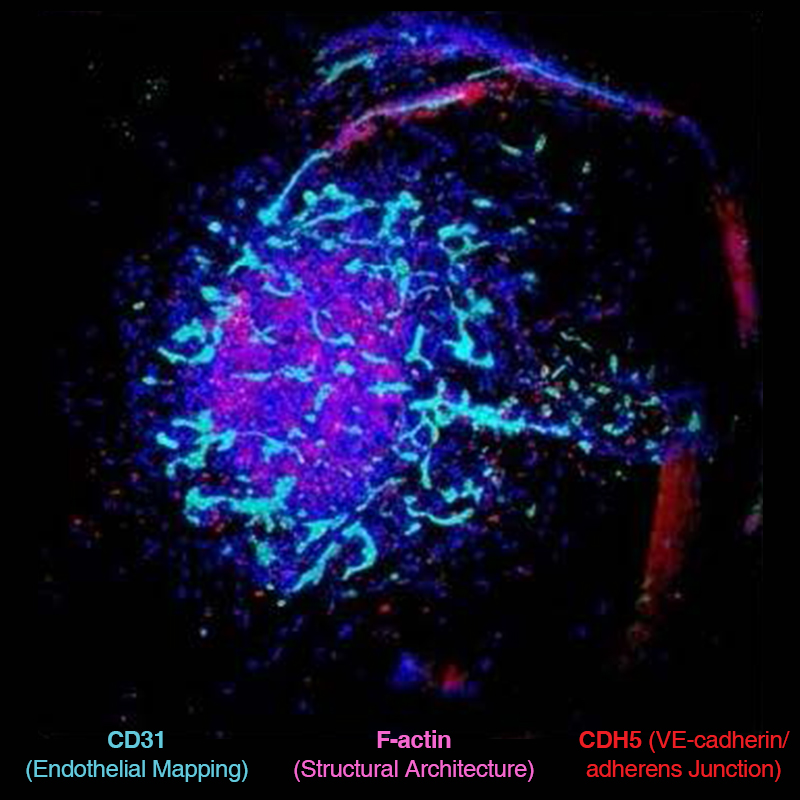
Applications: Neuroscience, Oncology, Immunology, Drug Discovery
Technical Specifications & Workflow

Published Data: Supporting Scientific Reports
Individual Bulk Options Now Available
All ADAPT-3D components are now available for individual bulk purchase. This modular approach allows you to scale efficiently by ordering only the specific elements your project requires.