Ciliary neurotrophic factor (CNTF), also known as HCNTF, is a cytokine that supports survival and/or differentiation of a variety of neuronal cell types including sensory, sympathetic and motoneurons (1). It is structurally related to IL-6, IL-11, LIF and OSM. CNTF is expressed in glial cells within the central and peripheral nervous systems. It lacks the classical signal peptide sequence of a secreted protein, but is thought to convey its cytoprotective effects after release by some mechanism induced by injury. The receptors for CNTF are CNTF Rα subunit and gp130, which are expressed exclusively in the nervous system and skeletal muscle. In addition to its neuronal actions, CNTF also acts on non-neuronal cells such as glia, hepatocytes, skeletal muscle, embryonic stem cells and bone marrow stromal cells. Because CNTF is predominantly expressed in the nervous system, its modulation may have implications for Parkinson's disease, ALS and cell-replacement therapies for other disorders (2-3). CNTF mimics the biological actions of leptin while overcoming "leptin resistance" and appears to reduce inflammatory signaling cascades associated with lipid accumulation in liver and skeletal muscle (4). Therefore, it may be a therapeutic target for obesity-related metabolic disease. CNTF is highly conserved across species and exhibits cross-species bioactivity.
Protein Details
Purity
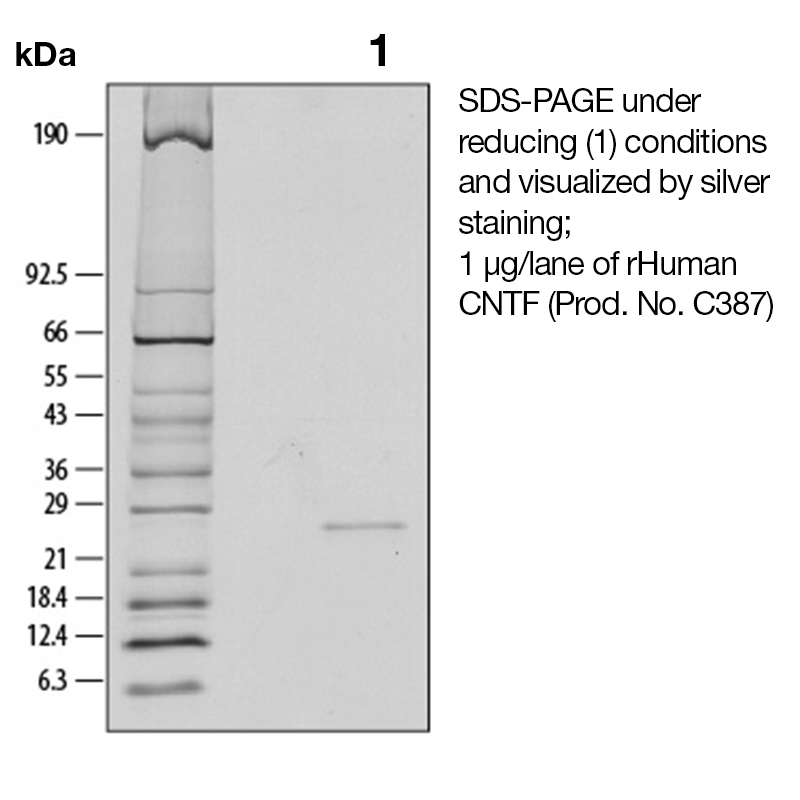
>97% by SDS-PAGE and analyzed by silver stain.
Endotoxin Level
<0.1 EU/µg as determined by the LAL method
Biological Activity
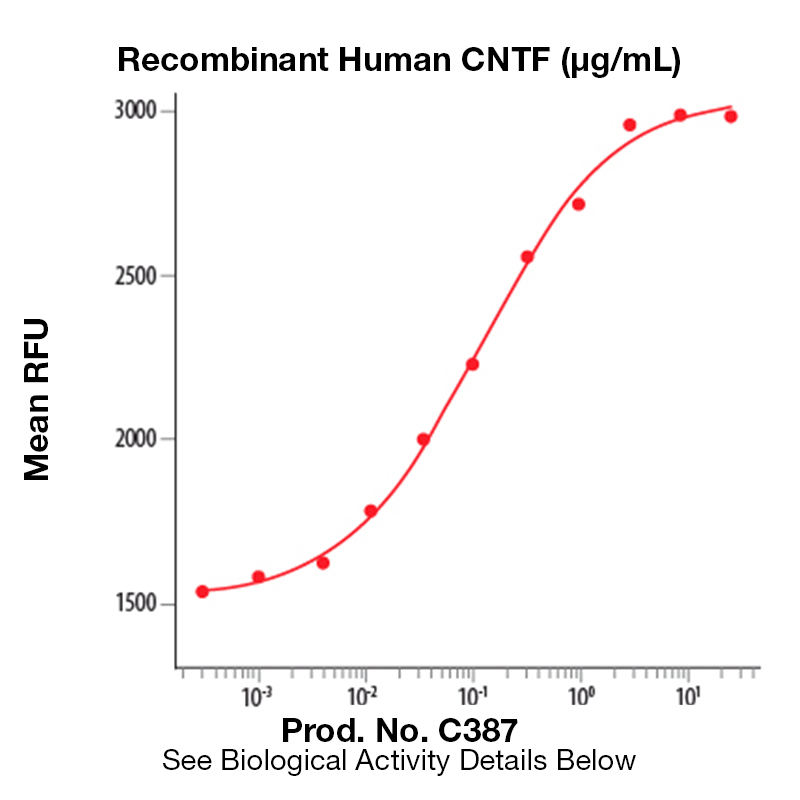
The biological activity of Human CNTF was measured in a cell proliferation assay using a factor-dependent human erythroleukemic cell line, TF-1 (Kitamura, T. et al., 1989, J. Cell Physiol. 140:323). The expected ED<sub>50</sub> is typically 50 - 150 ng/ml.
The predicted molecular weight of Recombinant Human CNTF is Mr 22.8 kDa. However, the actual molecular weight as observed by migration on SDS-PAGE is Mr 23-26 kDa.
Predicted Molecular Mass
22.8
Formulation
This recombinant protein was 0.2 µm filtered and lyophilized from modified Dulbecco’s phosphate buffered saline (1X PBS) and cysteine pH 7.2 – 7.3 with no calcium, magnesium, or preservatives.
Storage and Stability
The lyophilized protein should be stored desiccated at -20°C. The reconstituted protein can be stored for at least one week at 4°C. For long-term storage of the reconstituted protein, aliquot into working volumes and store at -20°C in a manual defrost freezer. Avoid Repeated Freeze Thaw Cycles.
Powered by AI: AI is experimental and still learning how to provide the best assistance. It may occasionally generate incorrect or incomplete responses. Please do not rely solely on its recommendations when making purchasing decisions or designing experiments.
Recombinant Human CNTF (Ciliary Neurotrophic Factor) is widely used in research applications due to its potent neuroprotective, neurotrophic, and cytoprotective properties, supporting the survival, differentiation, and regeneration of diverse neuronal and glial cell populations.
Key scientific reasons to use recombinant human CNTF in research include:
Neuroprotection and Survival: CNTF promotes the survival of neurons (sensory, motor, basal forebrain), oligodendrocytes, and astrocytes, making it valuable for studies on neurodegeneration, neural injury, and cell viability.
Neuronal Differentiation and Regeneration: It induces neural induction, differentiation, and neurite outgrowth in vitro, and supports regeneration in models of peripheral nerve injury and motor neuron disease.
Retinal and Ophthalmic Research: CNTF is effective in impeding retinal degeneration, protecting photoreceptors, and is under investigation for treating conditions such as retinitis pigmentosa and age-related macular degeneration.
Metabolic and Inflammatory Modulation: CNTF mimics leptin’s actions, can overcome leptin resistance, and reduces inflammatory signaling linked to metabolic diseases and obesity-related disorders.
Bioassay and Drug Development: Recombinant CNTF is essential for reproducible bioanalytical assays, drug screening, and therapeutic formulation optimization, especially in translational and preclinical studies.
Cell Culture Applications: It is used to culture and maintain primary neurons and glial cells, and to study cellular pathways relevant to CNS and PNS development and disease.
Regenerative Medicine: CNTF is being explored for cell replacement strategies and enhancing tissue repair in neuromuscular and neurodegenerative contexts.
Technical advantages of recombinant human CNTF:
High purity and biological activity: Recombinant production ensures batch-to-batch consistency, defined activity, and suitability for controlled experimental protocols.
Cross-species activity: Human CNTF is highly conserved and active across multiple species, facilitating translational research.
Versatile delivery platforms: Innovations include encapsulated cell implants, hydrogels, and gene therapy vectors for sustained and targeted delivery in vivo.
Typical research applications:
Neurobiology: Mechanistic studies of neurotrophic signaling, neurodegeneration, and synaptic plasticity.
Ophthalmology: Retinal cell survival, photoreceptor preservation, and therapeutic intervention models.
Metabolic disease: Investigating leptin signaling, energy metabolism, and obesity.
Regenerative medicine: Neural induction, cell replacement, and tissue repair protocols.
Bioassays: Standardizing activity measurements and validating therapeutic candidates.
In summary, recombinant human CNTF is a critical reagent for advancing basic neuroscience, translational medicine, and therapeutic development, offering robust, reproducible, and versatile support for a wide range of experimental and clinical research applications.
You can use recombinant human CNTF as a standard for quantification or calibration in your ELISA assays, provided that the recombinant protein is of high purity, its concentration is accurately known, and it is compatible with the antibodies used in your assay.
Key considerations and supporting details:
Recombinant CNTF is commonly used as an ELISA standard: Many ELISA kits and protocols specify the use of recombinant human CNTF as the standard for generating calibration curves. This is standard practice in quantitative ELISA, as long as the recombinant protein is structurally and immunologically equivalent to the native protein targeted by the assay antibodies.
Purity and quantification: The recombinant CNTF should be highly purified and its concentration precisely determined, typically by absorbance at 280 nm or amino acid analysis. Impurities or inaccurate quantification can lead to errors in your standard curve.
Compatibility with your assay: The recombinant CNTF must be recognized by both the capture and detection antibodies in your ELISA. Most commercial sandwich ELISAs for CNTF are validated to detect both natural and recombinant forms. However, if you are developing your own assay or using non-standard antibodies, confirm that your recombinant standard is detected equivalently to native CNTF.
Matrix effects: When preparing your standard curve, dilute the recombinant CNTF in the same buffer or matrix as your samples (e.g., serum, plasma, or culture medium) to minimize matrix effects and ensure accurate quantification.
Documentation and validation: Always run a standard curve with each assay and validate the linearity, sensitivity, and reproducibility of your quantification.
Caveats:
Some ELISA kits or protocols may not be validated for recombinant proteins with certain tags, truncations, or from non-mammalian expression systems, which could affect antibody recognition. Check the datasheet or validation data for your specific ELISA kit and recombinant CNTF.
If your recombinant CNTF is prone to degradation or aggregation, this can affect its performance as a standard. Use freshly prepared aliquots and avoid repeated freeze-thaw cycles.
In summary, recombinant human CNTF is suitable as a standard for ELISA quantification if it is pure, accurately quantified, and recognized by your assay antibodies. Always validate its performance in your specific assay context.
Recombinant Human CNTF has been validated in published research for a range of applications, primarily in neurobiology, regenerative medicine, and ophthalmology. Key validated uses include:
Neuroprotection and Neuroregeneration: CNTF is widely used to support the survival, differentiation, and regeneration of neurons in both the central and peripheral nervous systems. It has been shown to promote the survival of motor neurons, induce axonal sprouting, and delay degeneration in models of motor neuron disease.
Retinal Degeneration and Ophthalmic Disorders: Recombinant human CNTF has been validated in preclinical and clinical studies for protecting photoreceptors and retinal ganglion cells, promoting axonal regeneration, and preserving retinal structure in models of retinitis pigmentosa, age-related macular degeneration, glaucoma, and macular telangiectasia type 2. Encapsulated cell implants secreting CNTF have advanced to phase 2 and 3 clinical trials for these indications.
Stem Cell and Neural Progenitor Research: CNTF is used to promote the proliferation and differentiation of neural stem cells, including the differentiation of induced pluripotent stem cell (iPSC)-derived neural progenitors into neurons, Schwann cells, and astrocytes.
Cell Culture and Functional Assays: It is validated for use in cell culture to support the survival and differentiation of various neuronal and glial cell types, as well as in functional bioassays (e.g., STAT3 phosphorylation, cell proliferation assays such as with TF-1 erythroleukemic cells).
Metabolic Disease Models: CNTF has been investigated for its leptin-mimetic effects, including modulation of energy metabolism, attenuation of inflammatory signaling, and potential therapeutic effects in obesity-related metabolic disorders.
Peripheral Nerve Injury and Regeneration: Studies have validated CNTF for enhancing nerve regeneration and promoting neurite outgrowth in models of peripheral nerve injury and chronic inflammatory diseases such as multiple sclerosis.
Cancer Research: CNTF has been explored as a negative modulator of invasion processes in prostate cancer models.
Summary Table of Validated Applications
Application Area
Example Validations/Models
Neuroprotection/Neuroregeneration
Motor neuron survival, axonal sprouting, ALS, Parkinson’s models
These applications are supported by both preclinical and clinical research, with ongoing studies expanding the therapeutic and experimental scope of recombinant human CNTF.
To reconstitute and prepare Recombinant Human CNTF protein for cell culture experiments, follow these best-practice steps based on current protocols:
Centrifuge the vial briefly before opening to ensure all lyophilized protein is at the bottom.
Add the appropriate reconstitution buffer:
For most applications, use sterile PBS (pH 7.2–7.4) or sterile distilled water.
Some protocols recommend 10 mM HCl (especially for carrier-free preparations) or 5–10 mM sodium phosphate, pH 7.5.
Target concentration: Reconstitute to 0.1–1.0 mg/mL (100–1000 μg/mL) depending on your experimental needs.
Carrier protein: For stability, especially at low concentrations or for extended storage, add 0.1% BSA or human serum albumin to the buffer.
Dissolution: Gently pipet up and down or swirl to dissolve. Avoid vigorous vortexing, which can denature the protein.
Ensure full recovery: Wash down the sides of the vial with buffer to recover all protein.
If precipitate forms: Centrifuge and use only the clear supernatant for experiments.
Aliquot and storage:
Prepare single-use aliquots to avoid repeated freeze-thaw cycles.
Store at –20 °C (short-term) or –80 °C (long-term).
Avoid frost-free freezers, which can cause temperature fluctuations.
Example protocol for cell culture use:
Centrifuge the vial briefly.
Add sterile PBS (pH 7.4) with 0.1% BSA to achieve 0.1 mg/mL.
Gently pipet to dissolve, washing the vial walls.
If undissolved material remains, centrifuge and use the supernatant.
Aliquot and store at –80 °C.
Thaw aliquots on ice and dilute to working concentration in cell culture medium immediately before use.
Key notes:
Always check the specific product datasheet for any unique requirements.
Avoid repeated freeze-thaw cycles to maintain protein activity.
For sensitive cell types, ensure all reagents are endotoxin-free.
This approach ensures maximum protein stability and bioactivity for reliable cell culture experiments.
References & Citations
1. Thoenen, H. et al. (1994) J. Neurobiol. 25:1436
2. Hagg, T. et al. (2008) J. Neurosci. 28:2231
3. Masu, Y. et al. (1993) Nature 365:27
4. Febbraio, MA. et al. (2008) J. Mol. Med. 86:3




 Products are for research use only. Not for use in diagnostic or therapeutic procedures.
