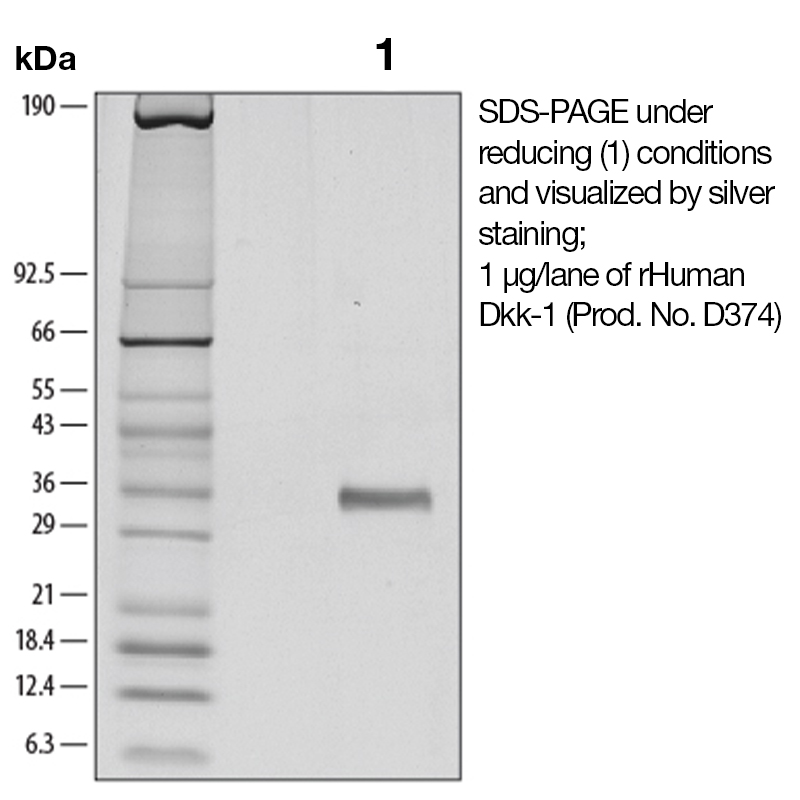
The predicted molecular weight of Recombinant Human Dkk-1 is Mr 25.8 kDa. However, the actual molecular weight as observed by migration on SDS-PAGE is Mr 33-40 kDa.
Predicted Molecular Mass
25.8
Formulation
This recombinant protein was 0.2 µm filtered and lyophilized from modified Dulbecco’s phosphate buffered saline (1X PBS) pH 7.2 – 7.3 with no calcium, magnesium, or preservatives.
Storage and Stability
This lyophilized protein is stable for six to twelve months when stored desiccated at -20°C to -70°C. After aseptic reconstitution, this protein may be stored at 2°C to 8°C for one month or at -20°C to -70°C in a manual defrost freezer. Avoid Repeated Freeze Thaw Cycles. See Product Insert for exact lot specific storage instructions.
Applications and Recommended Usage ? (Quality Tested by Leinco)
ELISA Sandwich: This antibody is useful as the capture antibody in a sandwich ELISA. The suggested coating concentration is 5 µg/ml (100 µl/well) µg/ml. Flow Cytometry: PN:A106 Flow Cytometry: It is recommended to use the indirect method for signal enhancement when enumerating cells expressing CXCR5. A suggested method would be to stain cells expressing CXCR5 with approximately 10 µl per test. A typical test sample constitutes approximately 50 µl of packed whole blood or 1 x 10⁵ continuous passage or activated cell cultures that have been centrifuged at 500 X g for five minutes. Labeling of the cells with the biotin conjugate should be followed by PN:A104, resuspended in 200-400 µl of 1X PBS.
Leinco Protein Advisor
Powered by AI: AI is experimental and still learning how to provide the best assistance. It may occasionally generate incorrect or incomplete responses. Please do not rely solely on its recommendations when making purchasing decisions or designing experiments.
Recombinant Human Dkk-1 is widely used in research applications due to its role as a potent and specific inhibitor of the Wnt/β-catenin signaling pathway, which is critical in development, stem cell biology, cancer, bone metabolism, and immune regulation.
Key scientific reasons to use Recombinant Human Dkk-1 in your research:
Wnt Pathway Modulation: Dkk-1 binds to LRP5/6 co-receptors, blocking canonical Wnt signaling and shifting cellular responses. This allows precise experimental control over Wnt pathway activity, which is essential for dissecting mechanisms in cell fate, differentiation, and disease models.
Developmental Biology: Dkk-1 is crucial for anterior-posterior patterning, limb development, and neural differentiation. Recombinant Dkk-1 enables studies on embryogenesis, tissue morphogenesis, and organogenesis.
Cancer Research: Dysregulation of Wnt signaling is common in cancers. Dkk-1 is both a biomarker and a therapeutic target, with roles in tumor growth, angiogenesis, and immune evasion. Recombinant Dkk-1 is used to model tumor microenvironments and test anti-cancer strategies.
Bone and Joint Biology: Dkk-1 regulates bone formation and joint remodeling, making it valuable for investigating osteoporosis, arthritis, and bone metastasis. It is used to study osteogenic differentiation and bone loss diseases.
Stem Cell and Regenerative Medicine: Dkk-1 modulates stem cell differentiation, including mesenchymal, dental pulp, and neural stem cells. Recombinant Dkk-1 is applied in protocols for directed differentiation and disease modeling.
Immunology: Dkk-1 supports the generation of myeloid-derived suppressor cells (MDSCs), influencing antitumor immune responses and inflammation.
Cardiovascular Research: Elevated Dkk-1 is associated with atherosclerosis and vascular remodeling. Recombinant Dkk-1 is used to study endothelial function and vascular disease mechanisms.
Bioassays and Cell Culture: Recombinant Dkk-1 is validated for use in bioassays, reporter assays (e.g., TCF/LEF), and cell culture experiments to quantify Wnt pathway inhibition and downstream effects.
Best practices:
Use recombinant Dkk-1 at experimentally determined concentrations for dose-dependent inhibition of Wnt signaling.
Validate pathway inhibition using reporter assays or downstream target analysis.
Employ in models where Wnt signaling is implicated, such as stem cell differentiation, cancer cell lines, or primary tissue cultures.
Summary: Recombinant Human Dkk-1 is a versatile tool for manipulating Wnt signaling in diverse biological systems, enabling mechanistic studies and therapeutic research in development, disease, and tissue regeneration.
Yes, recombinant human Dkk-1 can be used as a standard for quantification or calibration in ELISA assays, provided it is compatible with your assay system and matches the form of Dkk-1 detected by your antibodies. This is a common practice in commercial Dkk-1 ELISA kits, where recombinant human Dkk-1 is used to generate the standard curve for quantification.
Key considerations and supporting details:
Commercial ELISA kits for human Dkk-1 routinely use recombinant human Dkk-1 as the standard. The standard curve is generated using serial dilutions of recombinant Dkk-1, and sample concentrations are interpolated from this curve.
Parallelism and dilution linearity are critical. Well-validated ELISA kits demonstrate that the dose-response curves for recombinant and endogenous (natural) Dkk-1 are parallel, indicating that the recombinant protein is immunologically equivalent to the native protein in the assay context. This ensures accurate quantification of endogenous Dkk-1 using a recombinant standard.
Source and form of recombinant Dkk-1: The recombinant protein should be as similar as possible to the native form in your samples (e.g., glycosylation status, folding, tag presence, expression system), as differences can affect antibody recognition and quantification accuracy.
Matrix effects: If you are preparing your own standards, it is best to dilute recombinant Dkk-1 in a matrix similar to your samples (e.g., serum, plasma, or assay buffer) to minimize matrix effects and ensure accurate calibration.
Validation: If you are not using a commercial kit, you should validate that your recombinant Dkk-1 standard produces a standard curve with appropriate sensitivity, linearity, and parallelism to endogenous Dkk-1 in your sample matrix.
Best practices:
Use recombinant Dkk-1 from a reliable source, with documented purity and activity.
Prepare standards in the same buffer or matrix as your samples.
Confirm that your assay antibodies recognize both recombinant and endogenous Dkk-1 equivalently.
Validate recovery and parallelism if using a custom assay or a new recombinant standard.
In summary: Recombinant human Dkk-1 is widely accepted and validated as a standard for ELISA quantification, but assay-specific validation is essential for accurate results.
Applications of Recombinant Human DKK-1 in Published Research
Recombinant human DKK-1 has been validated for a diverse range of applications across developmental biology, cell differentiation, disease modeling, and functional assays.
Stem Cell Differentiation and Development
DKK-1 is widely used in cardiac differentiation of human embryonic stem cells (ES) and induced pluripotent stem cells (iPS), as well as in mesenchymal stem cell differentiation protocols. The protein has also been applied to support the generation of myeloid-derived suppressor cells and to regulate embryonic development more broadly.
Functional and Biochemical Assays
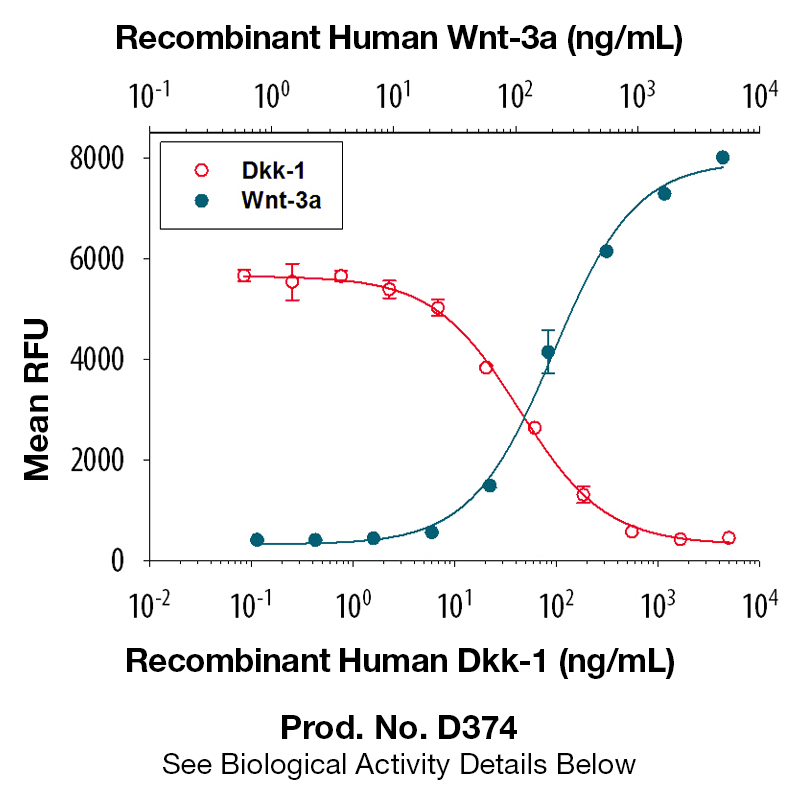
The protein has been validated for use in functional assays and ELISA applications. Specifically, DKK-1 has been employed in TCF reporter assays to measure its ability to inhibit Wnt-induced signaling in HEK293 cells, demonstrating dose-dependent inhibition of luciferase production. These bioassays measure the protein's capacity to antagonize canonical Wnt/β-catenin signaling by blocking LRP5/6 interaction with Wnt ligands.
Disease Research and Biomarker Studies
Published research has utilized recombinant DKK-1 in bioassay applications across multiple disease contexts. These include investigations of DKK-1's role in hepatocellular carcinoma as a biomarker for hepatic stem cell-like phenotypes, its involvement in neuronopathic Gaucher disease pathology, tumor growth promotion in esophageal adenocarcinoma, and its association with chondrosarcoma progression. The protein has also been studied in cardiovascular research, where it serves as a target of statin therapy in primary human vascular endothelial cells.
Cell Culture Applications
For cell culture studies, recombinant DKK-1 is typically formulated with carrier proteins such as BSA to maintain stability and bioactivity in culture conditions. The protein has been used to investigate signaling mechanisms in various cell types, including endothelial cells, smooth muscle cells, and cancer cell lines.
To reconstitute and prepare Recombinant Human Dkk-1 protein for cell culture experiments, follow these best practices based on manufacturer protocols and scientific recommendations:
Reconstitution Steps
Centrifuge the Vial: Briefly centrifuge the lyophilized protein vial (e.g., 20–30 seconds in a tabletop centrifuge) before opening to ensure all powder is at the bottom.
Reconstitution Buffer: Most protocols recommend reconstituting the protein in sterile, deionized water or sterile 1× PBS (pH 7.4).
If the protein is carrier-free or for long-term storage, add 0.1% human or bovine serum albumin (BSA) or 5% trehalose to stabilize the protein.
Reconstitution Procedure:
Gently add the appropriate volume of sterile buffer to the vial.
Do not vortex or pipette vigorously.
Gently swirl or tap the vial to dissolve the protein.
Allow the protein to dissolve completely at room temperature (do not heat).
Aliquoting and Storage:
Aliquot the reconstituted protein into small volumes to avoid repeated freeze-thaw cycles.
Store aliquots at –20°C or below for long-term storage.
For short-term use (within a week), store at 4°C.
Avoid repeated freeze-thaw cycles to maintain protein activity.
Preparation for Cell Culture
Dilution: Dilute the reconstituted Dkk-1 protein in your cell culture medium or assay buffer to the desired working concentration (typically in the range of 10–100 ng/mL, depending on your experimental needs).
Sterility: Ensure all reagents and buffers used are sterile to prevent contamination in cell culture.
Handling:
Avoid vigorous mixing or vortexing after reconstitution.
Use gentle pipetting to mix solutions.
Example Protocol
Centrifuge the lyophilized Dkk-1 vial for 20–30 seconds.
Reconstitute with sterile PBS or water to 100–200 µg/mL.
Gently mix until fully dissolved.
Aliquot and store at –20°C.
For cell culture, dilute to working concentration in sterile medium.
Notes
Always refer to the Certificate of Analysis (CoA) or product datasheet for specific instructions, as formulations may vary between suppliers.
Adding carrier protein (BSA) is recommended for carrier-free proteins or for extended storage.
By following these steps, you can ensure optimal activity and stability of Recombinant Human Dkk-1 protein for your cell culture experiments.






 Products are for research use only. Not for use in diagnostic or therapeutic procedures.
