

Recombinant Human Heregulin-β1 (HRG1-β EGF Domain)


Recombinant Human Heregulin-β1 (HRG1-β EGF Domain)
Product No.: H1420
Alternate Names Heregulin 1-β1, Neuregulin1-β1 [NRG-β1], HRG, Breast Cancer Cell Differentiation Factor p45, Acetylcholine Receptor Inducing Activity [ARIA], Glial Factor, Neu Differentiation Factor Product Type Recombinant Protein Expression Host E. coli Cells Species Human |
Data
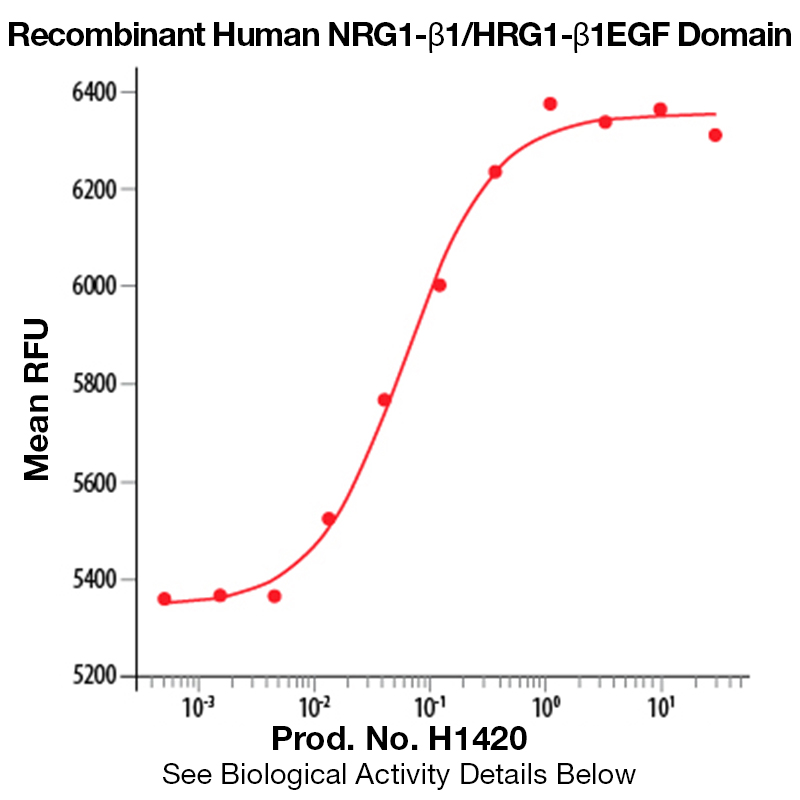
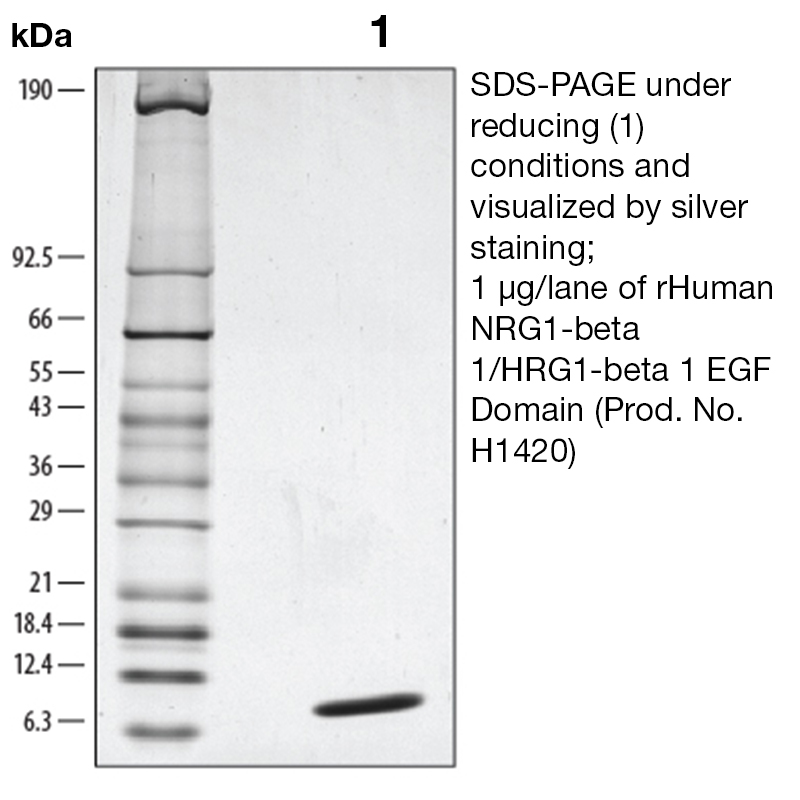
BackgroundNeuregulin/Heregulin is a family of related growth factors that are differentially spliced variants of four genes: NRG1, NRG2, NRG3 and NRG4. The longest forms of NRG contains several different modular domains and tissue-specific splicing results in many NRG isoforms containing different sets of these domains. Alternative splicing produces two types of EGF domain, designated a and b. HRG-Beta1 contains an Ig domain and an EGF domain necessary for direct binding to receptor tyrosine kinases erbB-3 and erbB-4. HRG-Beta1 binding causes erbB-3 and erbB-4 to dimerize with erbB-2 (Her2/neu) and thereby regulates the phosphorylation of erbB-2 tyrosines. HRG-Beta1 stimulates proliferation and motility of breast cancer cells and plays a role in wound healing by stimulating epidermal migration and differentiation of epidermal cells and by stimulating the expression of integrins in the epidermis. Protein DetailsPurity >97% by SDS-PAGE and analyzed by silver stain. Endotoxin Level <0.01 EU/µg as determined by the LAL method Biological Activity The biological activity of Human HRG-Beta1 was determined by its ability to stimulate the proliferation of human MCF-7 cells grown under serum-free conditions.<sup>1</sup> The expected ED<sub>50</sub> for this effect is typically 0.5 - 2 ng/ml. Protein Accession No. Amino Acid Sequence tshlv kcaekektfc vnggecfmvk dlsnpsrylc kcpneftgdr cqnyvmasfy khlgiefmea eelyqk N-terminal Sequence Analysis Thr176 State of Matter Lyophilized Predicted Molecular Mass The predicted molecular weight of Recombinant Human HRG1-Beta1 is Mr 8 kDa. Additionally, the actual molecular weight as observed by migration on SDS-PAGE is Mr 8 kDa (reducing conditons). Predicted Molecular Mass 8 Formulation This recombinant protein was lyophilized from a 0.2 μm filtered solution in 35% acetonitrile (CH3CN) and 0.1% trifluoroacetic acid (TFA). Storage and Stability This lyophilized protein is stable for six to twelve months when stored desiccated at -20°C to -70°C. After aseptic reconstitution, this protein may be stored at 2°C to 8°C for one month or at -20°C to -70°C in a manual defrost freezer. Avoid Repeated Freeze Thaw Cycles. See Product Insert for exact lot specific storage instructions. Country of Origin USA Shipping Next Day Ambient NCBI Gene Bank Leinco Protein AdvisorPowered by AI: AI is experimental and still learning how to provide the best assistance. It may occasionally generate incorrect or incomplete responses. Please do not rely solely on its recommendations when making purchasing decisions or designing experiments. Recombinant Human Heregulin-β1 (HRG1-β EGF Domain) is widely used in research due to its critical role as a growth factor that modulates cell proliferation, differentiation, migration, and survival, particularly through activation of the ERBB family of receptor tyrosine kinases. Key reasons to use HRG1-β EGF Domain in research applications:
Typical applications include:
Summary: Yes, Recombinant Human Heregulin-β1 (HRG1-β EGF Domain) can be used as a standard for quantification or calibration in ELISA assays, provided it is formulated and validated for this purpose. Recombinant proteins containing the EGF domain of Heregulin-β1 are commonly used as ELISA standards, especially when supplied with a carrier protein such as BSA to enhance stability and reproducibility. Key considerations for use as an ELISA standard:
Limitations and best practices:
Summary Table: ELISA Standard Use
In conclusion: Recombinant Human Heregulin-β1 (HRG1-β EGF Domain) is suitable as an ELISA standard if it is formulated and validated for this use. Always consult the product datasheet and follow recommended protocols for optimal results. Recombinant Human Heregulin-β1 (HRG1-β EGF Domain) has been validated for several applications in published research, primarily centered on its role as a growth factor and its effects on cell signaling, proliferation, and differentiation. Key applications supported by the literature include:
These applications demonstrate the versatility of Recombinant Human Heregulin-β1 (HRG1-β EGF Domain) in both basic research and translational studies, particularly in cancer biology, neuroscience, and regenerative medicine. Reconstitution GuidelinesRecombinant Human Heregulin-β1 (HRG1-β1) is supplied as a lyophilized powder and requires proper reconstitution before use in cell culture applications. The protein is a 7.5 kDa polypeptide consisting of the EGF domain of heregulin-β1, spanning 65 amino acid residues. Solvent SelectionMultiple reconstitution solvents are suitable depending on your specific experimental requirements:
The choice of solvent should be determined by compatibility with your specific assay or cell culture system. Reconstitution ConcentrationThe standard reconstitution concentration is 100 μg/mL. However, some protocols recommend a range of 0.1–1.0 mg/mL depending on your downstream application requirements. Carrier Protein ConsiderationsWhen reconstituting, consider whether your experiments require carrier protein supplementation:
The addition of BSA helps stabilize the protein during storage and use, particularly when preparing dilute working solutions. Pre-Reconstitution PreparationBefore opening the vial, perform a quick spin to collect any protein residue from the vial walls and cap. This ensures you recover all the lyophilized material during reconstitution. Storage After ReconstitutionOnce reconstituted, follow these storage protocols to maintain protein stability:
For extended storage beyond one week, freezing at −20°C or −70°C is strongly recommended. Typical Application ConcentrationIn cell culture experiments, heregulin-β1 is typically used at a 10 nM concentration in culture media supplemented with serum and other growth factors. This concentration provides mitogenic stimulation for various cell types while maintaining physiological relevance. Quality ConsiderationsVerify that your reconstituted protein meets purity standards (typically >97%) and contains minimal endotoxin contamination (less than 0.1 ng per μg of protein). These parameters are critical for reliable cell culture results and reproducible experimental outcomes. References & Citations1. Karey, KP. et al. (1988) Cancer Research 48:4083. Certificate of AnalysisIMPORTANT Use lot specific datasheet for all technical information pertaining to this recombinant protein. |
Related Products
Prod No. | Description |
|---|---|
N195 | |
H1420 | |
N188 |
 Products are for research use only. Not for use in diagnostic or therapeutic procedures.
