Chemokine (C-C motif) ligand 6 (CCL6) is a small cytokine belonging to the CC chemokine family. It is a potent chemoattractant of macrophages, but it can also attract B cells, CD4+ lymphocytes and eosinophils. CC16 might be an important mediator in the development of lung injury.1
The predicted molecular weight of Recombinant Mouse CCL6 is Mr 10.7 kDa.
Predicted Molecular Mass
10.7
Storage and Stability
This lyophilized protein is stable for six to twelve months when stored desiccated at -20°C to -70°C. After aseptic reconstitution, this protein may be stored at 2°C to 8°C for one month or at -20°C to -70°C in a manual defrost freezer. Avoid Repeated Freeze Thaw Cycles. See Product Insert for exact lot specific storage instructions.
Country of Origin
USA
Shipping
Next Day Ambient
Leinco Protein Advisor
Powered by AI: AI is experimental and still learning how to provide the best assistance. It may occasionally generate incorrect or incomplete responses. Please do not rely solely on its recommendations when making purchasing decisions or designing experiments.
Recombinant Mouse CCL6 is a valuable tool for research applications focused on immunology, inflammation, host defense, and tissue remodeling, due to its well-characterized roles in chemotaxis, antibacterial activity, and immune regulation.
Key scientific reasons to use Recombinant Mouse CCL6:
Chemotactic Activity: CCL6 is a potent chemoattractant for lymphocytes, monocytes, macrophages, and neutrophils, making it essential for studies investigating immune cell migration, recruitment, and activation in response to infection or inflammation.
Antibacterial Function: Recombinant CCL6 displays direct antibacterial activity, notably against E. coli, at physiologically relevant concentrations, supporting its use in host defense and mucosal immunity research.
Immune Modulation: CCL6 expression is regulated by cytokines such as IL-4, GM-CSF, and SCF, and is involved in the immune response to viral infections (e.g., norovirus), where it can inhibit viral replication and modulate antiviral immunity.
Tissue Remodeling and Disease Models: CCL6 participates in remodeling processes such as alveolar remodeling, pulmonary fibrosis, skin wound healing, and demyelinating disorders, making it relevant for studies of tissue repair and chronic inflammatory diseases.
Murine Specificity: CCL6 is rodent-specific, with human homologs being CCL14 and CCL15, so it is particularly suited for mouse models of disease and immunological research.
Typical research applications include:
Cell migration assays (e.g., transwell chemotaxis assays) to study immune cell recruitment.
Antimicrobial assays to assess direct effects on bacterial viability.
In vitro and in vivo immune response studies to dissect cytokine signaling and chemokine networks.
Disease modeling for fibrosis, wound healing, and neuroinflammation.
Best practices:
Use recombinant CCL6 validated for bioactivity and stability, ensuring reproducible results in functional assays.
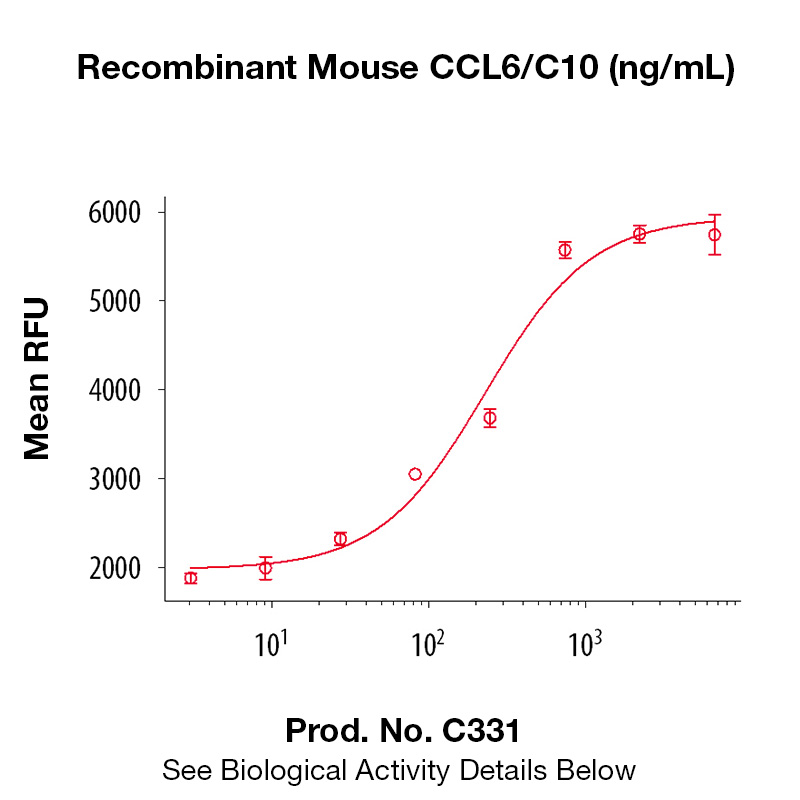
Select appropriate concentrations based on published ED50 values for chemotaxis (typically 50–250 ng/mL for mouse CCR1+ cells).
Confirm purity and endotoxin levels to avoid confounding effects in sensitive assays.
In summary, Recombinant Mouse CCL6 is a critical reagent for dissecting immune cell dynamics, host-pathogen interactions, and tissue remodeling in mouse models, providing mechanistic insights into chemokine biology and disease processes.
Yes, you can use recombinant Mouse CCL6 as a standard for quantification or calibration in ELISA assays, provided it is of high purity and its concentration is accurately known. This is a common practice in quantitative ELISA, where a standard curve is generated using known concentrations of a purified or recombinant protein to enable precise measurement of the target analyte in samples.
Key considerations and best practices:
Purity and Characterization: The recombinant CCL6 should be highly purified (typically >90% purity is preferred, though >80% is sometimes used) and well-characterized, with a known concentration determined by reliable methods such as absorbance at 280 nm or BCA assay.
Standard Curve Preparation: Prepare a standard curve by serially diluting the recombinant CCL6 in the same buffer or matrix as your samples to minimize matrix effects.
Compatibility: Ensure the recombinant CCL6 is recognized by the capture and detection antibodies used in your ELISA. Most commercial ELISA kits are validated with recombinant standards, but if you are developing your own assay, confirm cross-reactivity and linearity.
Formulation: Recombinant standards are often supplied lyophilized or in a carrier-free solution. Follow the manufacturer’s instructions for reconstitution and storage to maintain protein integrity.
Native vs. Recombinant: Some ELISA kits are optimized for native CCL6 and may not detect recombinant forms with certain tags or truncations. However, most quantitative ELISAs for cytokines and chemokines use recombinant proteins as standards.
Protocol summary:
Reconstitute or dilute the recombinant Mouse CCL6 to a known concentration.
Prepare a series of dilutions (e.g., 0–1000 pg/mL) to cover the expected range of your samples.
Run the standard curve in parallel with your samples on the same ELISA plate.
Use the standard curve to interpolate the concentration of CCL6 in your unknown samples.
Limitations:
If your recombinant CCL6 has modifications (e.g., tags, truncations) that affect antibody recognition, it may not be suitable as a standard for all ELISA formats.
Always verify that the recombinant standard behaves similarly to the native protein in your assay system.
In summary: Recombinant Mouse CCL6 is widely used as a standard for ELISA quantification, provided it is pure, well-characterized, and compatible with your assay antibodies and format.
Recombinant Mouse CCL6 has been validated for several key applications in published research, primarily in the fields of immunology, cell biology, and inflammation.
Validated Applications:
ELISA (Enzyme-Linked Immunosorbent Assay):Used as a standard or analyte to quantify CCL6 levels in biological samples such as serum, lung tissue, and bronchoalveolar lavage fluid.
Functional Bioassays:Applied to assess chemotactic activity, especially in transwell migration/chemotaxis assays. CCL6 has been shown to attract mouse CCR1+ cells, BaF3 pro B cells transfected with human CCR1, and various leukocyte populations.
Western Blot:Used to detect and quantify CCL6 protein expression in cell and tissue lysates, including validation of knockout efficiency and protein induction in response to stimuli.
Cell Migration/Motility Assays:Demonstrated to induce migration of monocytes, macrophages, neutrophils, lymphocytes, and eosinophils, confirming its role as a chemoattractant.
Macrophage Polarization and Wound Healing Models:Recombinant CCL6 has been used to promote M2 macrophage polarization and accelerate skin wound healing in vitro and in vivo, with mechanistic studies involving PI3K/Akt signaling.
Antiviral Assays:Investigated for its direct inhibitory effects on norovirus (NoV) replication in cell culture models, showing decreased viral genome replication upon CCL6 treatment.
Inflammatory Disease Models:Utilized in studies of allergic airway inflammation, eosinophil differentiation, and hematopoietic stem cell activation, often in conjunction with CCR1 antagonists or gene knockout approaches.
Additional Context:
CCL6 is frequently used to study its role in recruiting and activating immune cells during inflammation, infection, and tissue remodeling.
It has demonstrated antibacterial activity and is constitutively expressed in murine intestinal epithelial cells, binding to subsets of intestinal microflora.
Applications also include studies of pulmonary fibrosis, skin wound healing, and demyelinating disorders.
These applications are supported by peer-reviewed studies and product validation data, confirming the utility of recombinant mouse CCL6 in diverse experimental systems.
To reconstitute and prepare Recombinant Mouse CCL6 protein for cell culture experiments, dissolve the lyophilized protein at 100 μg/mL in sterile PBS. If the formulation contains no carrier protein, you may add 0.1–1% BSA or HSA to improve stability and prevent adsorption to surfaces.
Step-by-step protocol:
Centrifuge the vial briefly to collect all lyophilized powder at the bottom before opening.
Add sterile PBS (phosphate-buffered saline) to achieve a final concentration of 100 μg/mL. For example, add 100 μL PBS to 100 μg protein.
If recommended or desired for stability, add carrier protein (e.g., 0.1–1% BSA or HSA) to the PBS before reconstitution.
Gently mix by pipetting up and down or swirling; avoid vigorous vortexing to prevent protein denaturation.
Allow the solution to sit at room temperature for a few minutes to ensure complete dissolution.
Aliquot the reconstituted protein to minimize freeze-thaw cycles. Store aliquots at −20 °C or −70 °C for long-term storage, or at 2–8 °C for up to one month.
Avoid repeated freeze-thaw cycles to maintain protein activity.
Preparation for cell culture:
Before use, dilute the stock solution to the desired working concentration in cell culture medium. Typical bioactive concentrations for CCL6 range from 50–250 ng/mL for chemotaxis assays, but optimal concentrations should be determined empirically for your specific application.
Ensure all solutions are sterile and handle under aseptic conditions.
Additional notes:
If the protein is supplied in liquid format, it may already be in PBS and can be aliquoted directly.
Always consult the specific product datasheet for formulation details and any additional instructions, as buffer composition and recommended reconstitution may vary by supplier.
Summary of key points:
Reconstitute at 100 μg/mL in sterile PBS (optionally with 0.1–1% BSA/HSA).
Aliquot and store at −20 °C or −70 °C; avoid freeze-thaw cycles.
Dilute to working concentration in cell culture medium before use.
Maintain sterility throughout preparation and handling.




 Products are for research use only. Not for use in diagnostic or therapeutic procedures.
