Glycoprotein 130 (also known as gp130, IL6ST, IL6-beta or CD130) is a transmembrane protein which is the founding member of the class of tall cytokine receptors. It forms one subunit of type I cytokine receptors within the IL-6 receptor family. It is often referred to as the common gp130 subunit, and is important for signal transduction following cytokine engagement.1 Gp130 signals are mediated by tyrosine kinases of the JAK family and by their binding partners, transcription factors of the STAT family.2 Gp130 signaling is very important for osteoblast function and calcium homeostasis.3
Protein Details
Purity
>90% by SDS-PAGE and analyzed by silver stain.
Endotoxin Level
<1.0 EU/µg as determined by the LAL method
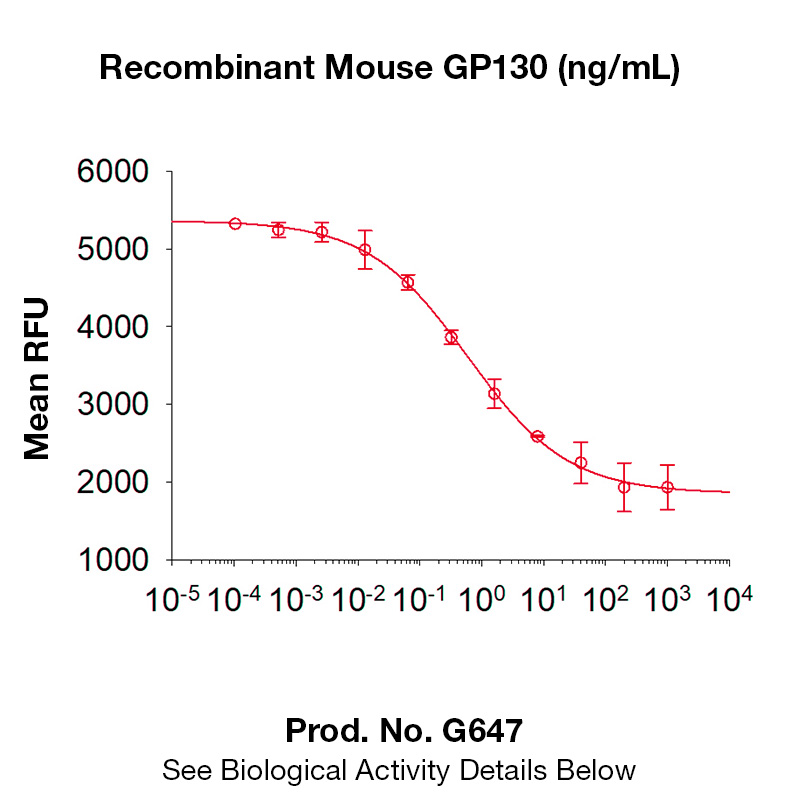
Biological Activity
The biological activity of Mouse gp130 was determined by by its ability to inhibit the IL-6 sR enhancement of IL-6 activity on a mouse myeloid leukemia cell line, M1 (Saito, T. et al., 1991, J. Immunol. 147:168). The expected ED<sub>50</sub> for this effect is typically 0.03-0.10 mg/ml in the presence of 10 ng/ml rhIL-6 sR and
20 ng/ml rhIL-6.
The predicted molecular weight of Recombinant Mouse gp130 is Mr 94 kDa. However, the actual molecular weight as observed by migration on SDS-PAGE is Mr 115 kDa.
Predicted Molecular Mass
94
Formulation
This recombinant protein was 0.2 µm filtered and lyophilized from modified Dulbecco’s phosphate buffered saline (1X PBS) pH 7.2 – 7.3 with no calcium, magnesium, or preservatives.
Storage and Stability
This lyophilized protein is stable for six to twelve months when stored desiccated at -20°C to -70°C. After aseptic reconstitution, this protein may be stored at 2°C to 8°C for one month or at -20°C to -70°C in a manual defrost freezer. Avoid Repeated Freeze Thaw Cycles. See Product Insert for exact lot specific storage instructions.
Powered by AI: AI is experimental and still learning how to provide the best assistance. It may occasionally generate incorrect or incomplete responses. Please do not rely solely on its recommendations when making purchasing decisions or designing experiments.
Recombinant Mouse gp130 is a valuable tool in research applications focused on cytokine signaling, inflammation, oncology, and immunology because it acts as a key regulator and inhibitor of the IL-6 trans-signaling pathway, allowing precise modulation and investigation of gp130-mediated biological processes.
Key scientific applications and rationale:
Selective inhibition of IL-6 trans-signaling: Recombinant soluble gp130 (sgp130) specifically blocks IL-6 trans-signaling by binding the IL-6/sIL-6R complex, without affecting classical signaling via membrane-bound IL-6R. This enables researchers to dissect the distinct roles of classical versus trans-signaling in disease models, such as inflammation, fibrosis, and cancer.
Modeling and modulating disease progression: In mouse models, recombinant sgp130 has been shown to reduce STAT3 phosphorylation, suppress overexpression of IL-6, IL-6R, and gp130, and protect tissues from inflammatory damage. It significantly decreases tumor burden and fibrosis in hepatocellular carcinoma models, demonstrating its utility in studying tumorigenesis and therapeutic interventions.
Therapeutic target validation: By inhibiting gp130 signaling, researchers can evaluate the therapeutic potential of targeting this pathway in diseases where aberrant cytokine signaling drives pathology, such as autoimmune disorders, chronic inflammation, and cancer.
Functional studies in cell culture and in vivo: Recombinant Mouse gp130 is used in bioassays and animal studies to investigate cytokine-dependent cell proliferation, immune cell differentiation, and tissue responses. For example, it inhibits IL-6-dependent proliferation of mouse hybridoma cells and modulates immune responses in various disease models.
Mechanistic studies of cytokine receptor signaling: gp130 is the common signal transducer for the IL-6 family of cytokines. Recombinant forms allow detailed analysis of receptor assembly, downstream signaling events, and the impact of selective blockade on cellular and systemic responses.
Best practices:
Use recombinant Mouse gp130 to distinguish between classical and trans-signaling effects in experimental systems.
Apply in vivo to modulate disease progression or validate therapeutic strategies targeting cytokine signaling.
Employ in cell-based assays to study proliferation, differentiation, or inflammatory responses mediated by IL-6 family cytokines.
Summary of scientific value: Recombinant Mouse gp130 enables precise control and investigation of cytokine signaling pathways, particularly IL-6 trans-signaling, making it indispensable for mechanistic studies, disease modeling, and therapeutic target validation in immunology, oncology, and inflammation research.
Yes, recombinant mouse gp130 can generally be used as a standard for quantification or calibration in ELISA assays, provided it is recognized by the antibodies used in your specific kit. Most commercial mouse gp130 ELISA kits are designed to detect both natural and recombinant forms of gp130, and the standard curve is typically generated using a recombinant gp130 protein supplied with the kit.
Key considerations and supporting details:
Recognition of Recombinant Protein: ELISA kits for mouse gp130 are validated to recognize both endogenous (natural) and recombinant mouse gp130, as stated in multiple kit manuals and product descriptions. This ensures that the recombinant protein can be reliably used to generate a standard curve for quantification.
Standard Preparation: The standard curve in these assays is constructed by serially diluting a recombinant mouse gp130 standard (often lyophilized and reconstituted according to the kit instructions) and measuring the optical density (OD) at each concentration. The concentration of gp130 in unknown samples is then interpolated from this standard curve.
Kit-Specific Validation: It is important to confirm that the recombinant gp130 you intend to use as a standard is compatible with the antibodies in your ELISA kit. Most kits supply their own recombinant standard, which has been validated for use with their antibody pairs. If you are using a recombinant gp130 from a different source, verify that it is full-length and properly folded, as some antibodies may not recognize truncated or misfolded forms.
Potential Limitations: Some ELISA kits note that certain recombinant proteins may not be detected if there is a mismatch with the coated or detection antibody, particularly if the recombinant protein lacks relevant epitopes or post-translational modifications. If you are not using the standard provided with the kit, a preliminary validation experiment is recommended to ensure accurate quantification.
Best Practices:
Use the recombinant gp130 standard provided with your ELISA kit whenever possible.
If using an alternative recombinant gp130, confirm its compatibility with your kit’s antibodies.
Prepare and handle the standard according to the kit’s instructions to ensure reproducibility and accuracy.
Summary Table: Use of Recombinant Mouse gp130 as ELISA Standard
Requirement
Supported by Kits?
Notes
Recognized by kit antibodies
Yes
Most kits validated for both natural and recombinant gp130
Standard curve generation
Yes
Serial dilutions of recombinant gp130 standard
Compatibility with all kits
Usually
Confirm if using non-kit recombinant protein
Validation recommended for new lots
Yes
Especially if using a different recombinant source
In summary: You can use recombinant mouse gp130 as a standard for ELISA quantification, but ensure it is compatible with your kit’s antibodies and validated for your specific assay conditions.
Recombinant Mouse gp130 has been validated in published research primarily for the following applications:
Bioassays: Used to inhibit IL-6-dependent proliferation in cell-based assays, such as with the 7TD1 mouse hybridoma cell line, demonstrating its functional activity in blocking IL-6 signaling pathways.
In vivo studies: Extensively applied in mouse models to investigate the role of IL-6 trans-signaling in various disease contexts, including:
Diabetic retinopathy and oxidative stress
Tumor progression and immune modulation
Experimental ulcerative colitis
Maintenance of Th17 cells during inflammation
Protein-protein interaction and binding assays: Used to study interactions with IL-6 family cytokines and their receptors, as well as to characterize inhibitory mechanisms.
Therapeutic model validation: Employed in preclinical models to assess the efficacy of gp130 blockade in inflammatory diseases, cancer, and autoimmunity.
Supporting details:
The recombinant mouse gp130 Fc chimera protein has been shown to inhibit IL-6-dependent proliferation in vitro, with an ED₅₀ of 0.12–1.2 ng/mL in 7TD1 cell assays.
In vivo, it has been used to block IL-6 trans-signaling in mouse models of diabetic retinopathy, ulcerative colitis, and tumor progression, demonstrating its utility in disease mechanism studies and therapeutic intervention research.
Published studies have validated its use in both whole cell and animal (in vivo) experimental systems, confirming its biological activity and specificity for IL-6 family cytokine signaling.
Additional applications include mechanistic studies of immune cell differentiation (e.g., Th17 maintenance) and investigation of cytokine signaling pathways in inflammation and cancer.
Binding and inhibition studies with IL-6 family cytokines
Therapeutic validation
Preclinical models of inflammation, autoimmunity, and cancer
These applications are well-supported by peer-reviewed studies and product validation data, confirming the recombinant mouse gp130 protein’s utility in both basic and translational research.
To reconstitute and prepare Recombinant Mouse gp130 protein for cell culture experiments, dissolve the lyophilized protein in sterile phosphate-buffered saline (PBS) to a final concentration of 100 μg/mL unless otherwise specified by the manufacturer. For liquid formulations, dilute directly in sterile PBS or cell culture medium as needed.
Essential steps and considerations:
Reconstitution:
Add sterile PBS (pH 7.2–7.4) to the lyophilized protein to reach the desired stock concentration, typically 100 μg/mL.
If the protein is supplied as a liquid, confirm the concentration (often 1 mg/mL in PBS with 10% glycerol) and dilute accordingly.
For some preparations, sterile distilled water may be used, but PBS is preferred for cell culture compatibility.
Gently mix by pipetting or inversion; avoid vigorous vortexing to prevent protein denaturation.
Carrier Proteins (Optional):
If recommended, add 0.1% bovine serum albumin (BSA) to the reconstitution buffer to stabilize the protein, especially for low concentrations or prolonged storage.
Carrier-free formulations are preferred for sensitive cell culture applications to avoid interference.
Sterility:
Use sterile technique throughout to prevent contamination.
Filter the reconstituted solution through a 0.2 μm filter if sterility is uncertain.
Aliquoting and Storage:
Aliquot the stock solution to avoid repeated freeze-thaw cycles, which can degrade the protein.
Store aliquots at –80 °C for long-term storage or at –20 °C for short-term use.
Avoid multiple freeze-thaw cycles.
Working Solution Preparation:
Dilute the stock solution in cell culture medium immediately before use to the final working concentration required for your experiment (commonly in the range of 1–100 ng/mL, but optimize based on assay).
Ensure the final buffer composition is compatible with your cells (e.g., serum-free or serum-containing medium).
Protocol Example:
1. Add sterile PBS to the lyophilized gp130 protein to achieve 100 μg/mL.2. Gently mix until fully dissolved.3. Aliquot and store at –80 °C.4. Before use, thaw an aliquot and dilute in cell culture medium to the desired final concentration.5. Add directly to cell cultures under sterile conditions.
Additional Notes:
If the protein contains glycerol (e.g., 10%), this is generally compatible with cell culture at low concentrations, but excessive glycerol should be avoided.
Always consult the specific product datasheet for any unique instructions regarding reconstitution and storage.
This protocol ensures the recombinant mouse gp130 protein is prepared in a manner suitable for cell culture experiments, maintaining protein integrity and biological activity.
References & Citations
1. Bravo, J. et al. (1998) EMBO J17: 1665 2. Graeve, L et al. (1998) Biochem J334: 297 3. Kronenber, HM. et al. (2004) Endocrinology145: 1376




 Products are for research use only. Not for use in diagnostic or therapeutic procedures.
