

Anti-Mouse MHC Class I (H-2) [Clone M1/42.3.9.8] – Purified in vivo PLATINUM™ Functional Grade
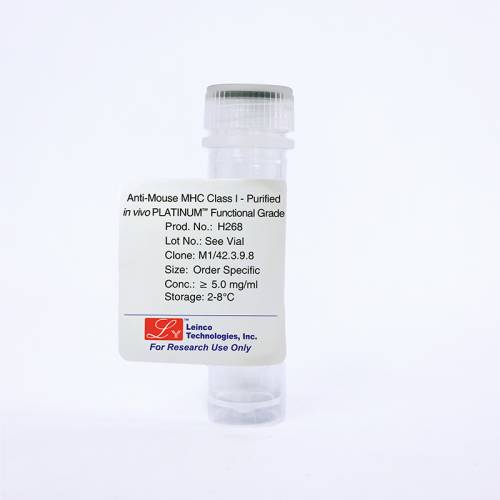

Anti-Mouse MHC Class I (H-2) [Clone M1/42.3.9.8] – Purified in vivo PLATINUM™ Functional Grade
Product No.: H268
- -
- -
Clone M1/42.3.9.8 Target MHC Class I Formats AvailableView All Product Type Hybridoma Monoclonal Antibody Alternate Names H-2 Class I; Mouse MHC Class I; Mouse MHC-I. Isotype Rat IgG2a κ Applications FC , IP , Blockade of MHC I-dependent interactions , IHC-F |
- -
- -
Antibody DetailsProduct DetailsReactive Species Mouse Host Species Rat Recommended Dilution Buffer Immunogen Mouse B10 spleen cells or C57BL/10 mouse spleen cells enriched for T cells. Product Concentration ≥ 5.0 mg/ml Endotoxin Level <0.5 EU/mg as determined by the LAL method Purity ≥98% monomer by analytical SEC ⋅ >95% by SDS Page Formulation This monoclonal antibody is aseptically packaged and formulated in 0.01 M phosphate buffered saline (150 mM NaCl) PBS pH 7.2 - 7.4 with no carrier protein, potassium, calcium or preservatives added. Due to inherent biochemical properties of antibodies, certain products may be prone to precipitation over time. Precipitation may be removed by aseptic centrifugation and/or filtration. State of Matter Liquid Product Preparation Functional grade preclinical antibodies are manufactured in an animal free facility using in vitro cell culture techniques and are purified by a multi-step process including the use of protein A or G to assure extremely low levels of endotoxins, leachable protein A or aggregates. Pathogen Testing To protect mouse colonies from infection by pathogens and to assure that experimental preclinical data is not affected by such pathogens, all of Leinco’s Purified Functional PLATINUM ™ antibodies are tested and guaranteed to be negative for all pathogens in the IDEXX IMPACT I Mouse Profile. Storage and Handling Functional grade preclinical antibodies may be stored sterile as received at 2-8°C for up to one month. For longer term storage, aseptically aliquot in working volumes without diluting and store at ≤ -70°C. Avoid Repeated Freeze Thaw Cycles. Regulatory Status Research Use Only Country of Origin USA Shipping Frozen Dry Ice Applications and Recommended Usage? Quality Tested by Leinco FC, IHC-F, IP, Blockade of MHC I-dependent interactions Each investigator should determine their own optimal working dilution for specific applications. See directions on lot specific datasheets, as information may periodically change. DescriptionDescriptionSpecificity Activity is directed against a monomorphic determinant of the mouse Major
Histocompatibility Complex (MHC) Class I. Clone M1/42.3.9.8 recognizes a conserved epitope
on the 44-46 kDa heavy chain of H-2 antigens in association with beta2-microglobulin that is
expressed across the majority of mouse haplotypes1. Background MHC Class I (H-2) is a type I transmembrane glycoprotein existing as a
heterodimer consisting of a polymorphic 45 kDa heavy chain non-covalently associated with a
12 kDa light chain, beta2-microglobulin. It plays a fundamental role in the adaptive immune
system by presenting endogenous peptide fragments to CD8+ T lymphocytes, thereby
facilitating the identification of virally infected or malignant cells3. The clone M1/42.3.9.8 is
historically significant for its broad reactivity, identifying a "monomorphic framework" epitope
present in most inbred mouse strains (e.g., a, b, d, f, k, p, q, r, s, u, v), which distinguishes it
from strain-specific antibodies4. Upon synthesis and peptide loading in the endoplasmic
reticulum, the MHC I complex is transported to the cell surface. Within the cellular environment, MHC I molecules are subject to dynamic regulation; for example, they are frequently downregulated by viral proteins to facilitate immune evasion and upregulated by pro-inflammatory cytokines like IFN-gamma5. Because MHC I is essential for T-cell mediated surveillance and "self" recognition, its expression levels are tightly correlated with the immune system's ability to clear intracellular pathogens. Consequently, MHC I is actively investigated in the context of tumor immunology, where loss of expression is a common mechanism of cancer immune escape, and in the development of vaccine delivery systems5,6. Clone M1/42.3.9.8 is widely used for the quantification of H-2 expression and the assessment of MHC I density across diverse genetic backgrounds. Unlike antibodies that target specific peptide-binding grooves, M1/42 binds a structural framework epitope, making it suitable for immunoprecipitation and flow cytometric studies where a general assessment of MHC I is required1,4. Antigen Distribution MHC Class I is expressed at high levels on virtually all nucleated cells,
including T and B lymphocytes, myeloid cells, and nucleated erythroid precursors, but is lost
as reticulocytes differentiate into mature erythrocytes2. Ligand/Receptor Interacts with the T cell receptor (TCR) and CD8 co-receptor. Research Area Immunology . Microbiology References & Citations1. Stallcup KC, Springer TA, Mescher MF. A monoclonal antibody with broad anti-H-2 specificity. J Immunol. 127(4):1441-1445. 1981. 2. Springer TA. Monoclonal antibodies specific for rat IgG2a, IgG2b, and IgG2c. Hybridoma. 1(3):257-273. 1982. 3. Townsend AR, Gotch FM, Davey J. Association of class I MHC molecules with mutant mice. Nature. 301(5901):616-618. 1983. 4. David-Watine B, Israel A, Kourilsky P. Structure and expression of the murine MHC class I genes. Immunol Today. 11(8):286-292. 1990. 5. Girdlestone J. Regulation of MHC class I transcription. Heredity (Nature). 75(1):110. 1995. 6. Neefjes J, Jongsma ML, Paul P, Bakke O. Towards a systems understanding of MHC class I and MHC class II antigen presentation. Nature Rev Immunol. 11(12):823-836. 2011. Technical Protocols  Blockade of MHC I-dependent interactions IHC-F Certificate of Analysis |
Formats Available
 Products are for research use only. Not for use in diagnostic or therapeutic procedures.
