

Anti-Nav1.7 Na+ Channel [Clone S68-6]


Anti-Nav1.7 Na+ Channel [Clone S68-6]
Product No.: 11517
Data
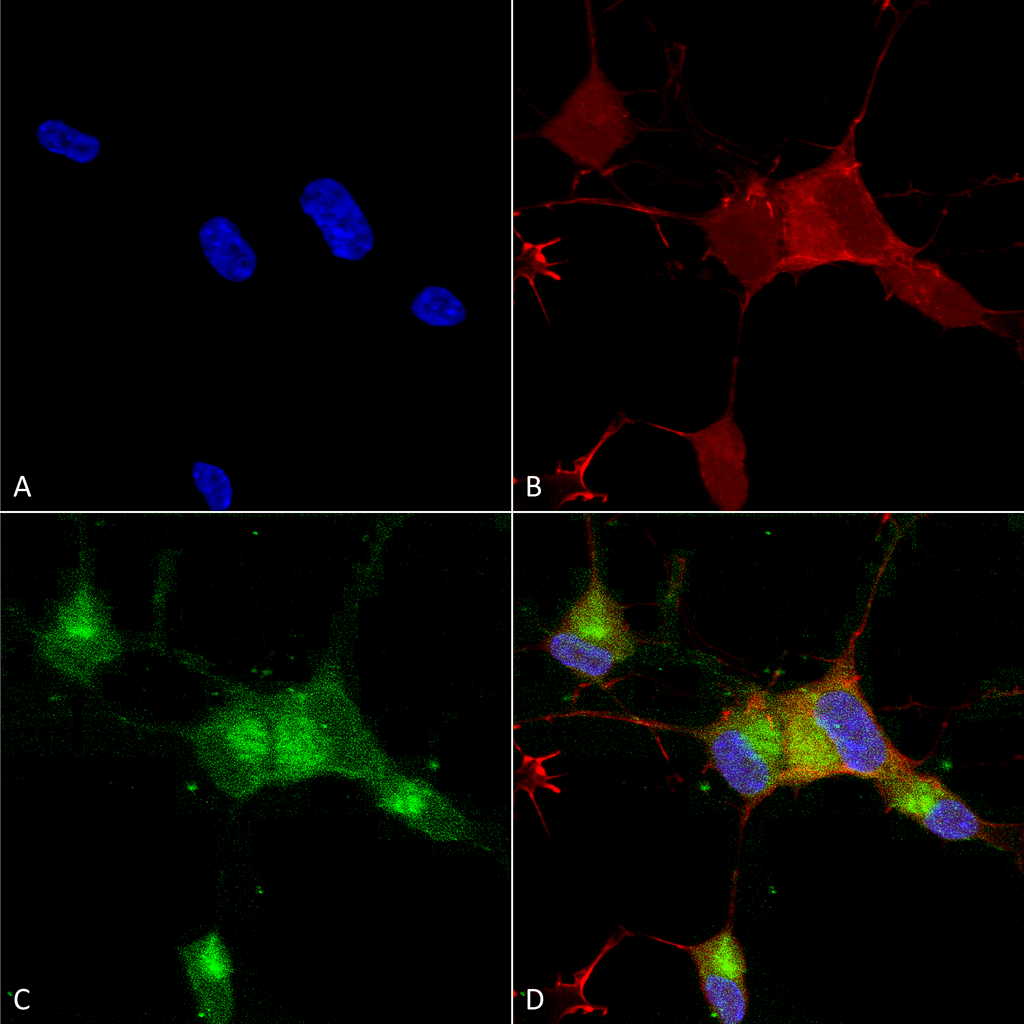 Immunocytochemistry/Immunofluorescence analysis using Mouse Anti-Nav1.7 Monoclonal Antibody, Clone N68/6 (11517). Tissue: Neuroblastoma cells (SH-SY5Y). Species: Human. Fixation: 4% PFA for 15 min. Primary Antibody: Mouse Anti-Nav1.7 Monoclonal Antibody (11517) at 1:100 for overnight at 4°C with slow rocking. Secondary Antibody: AlexaFluor 488 at 1:1000 for 1 hour at RT. Counterstain: Phalloidin-iFluor 647 (red) F-Actin stain; Hoechst (blue) nuclear stain at 1:800, 1.6mM for 20 min at RT. (A) Hoechst (blue) nuclear stain. (B) Phalloidin-iFluor 647 (red) F-Actin stain. (C) Nav1.7 Antibody (D) Composite.
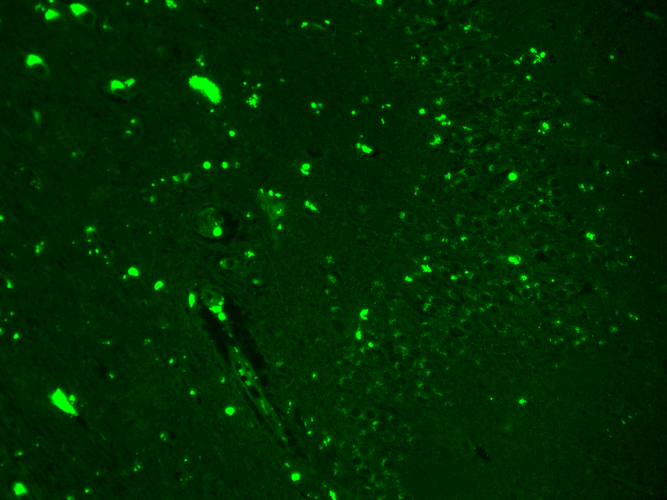 Immunohistochemistry analysis using Mouse Anti-Nav1.7 Sodium Channel Monoclonal Antibody, Clone N68/6 (11517). Tissue: hippocampus. Species: Human. Fixation: Bouin’s Fixative and paraffin-embedded. Primary Antibody: Mouse Anti-Nav1.7 Sodium Channel Monoclonal Antibody (11517) at 1:1000 for 1 hour at RT. Secondary Antibody: FITC Goat Anti-Mouse (green) at 1:50 for 1 hour at RT.
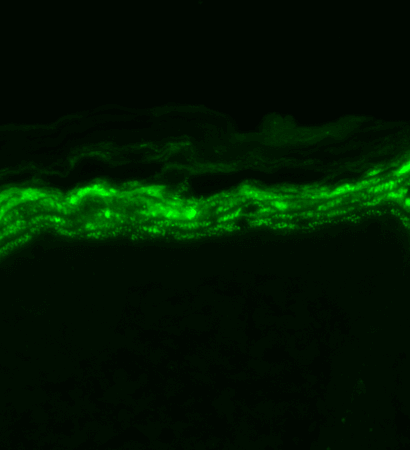 Immunohistochemistry analysis using Mouse Anti-Nav1.7 Sodium Channel Monoclonal Antibody, Clone N68/6 (11517). Tissue: backskin. Species: Mouse. Fixation: Bouin’s Fixative and paraffin-embedded. Primary Antibody: Mouse Anti-Nav1.7 Sodium Channel Monoclonal Antibody (11517) at 1:100 for 1 hour at RT. Secondary Antibody: FITC Goat Anti-Mouse (green) at 1:50 for 1 hour at RT.
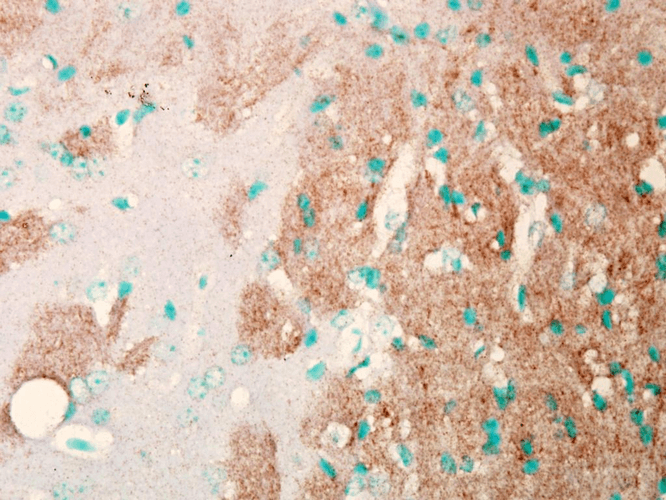 Immunohistochemistry analysis using Mouse Anti-Nav1.7 Sodium Channel Monoclonal Antibody, Clone N68/6 (11517). Tissue: Brain Slice. Species: Mouse. Fixation: Frozen sections. Primary Antibody: Mouse Anti-Nav1.7 Sodium Channel Monoclonal Antibody (11517) at 1:1000. Secondary Antibody: HRP/DAB Detection System: Biotinylated Goat Anti-Mouse, Streptavidin Peroxidase, DAB Chromogen (brown). Counterstain: Mayer Hematoxylin (purple/blue) nuclear stain.
 - -
- -
Antibody DetailsProduct DetailsReactivity Species Human ⋅ Mouse ⋅ Rat Host Species Mouse Immunogen Fusion protein, aa 1751-1946 (cytoplasmic C-terminus) of human Nav1.7 (accession no. Q15858). Product Concentration Lot Specific Formulation PBS, pH 7.4; 50% glycerol, 0.09% sodium azide. State of Matter Liquid Product Preparation Purified by Protein G affinity chromatography Storage and Handling This antibody is stable for at least one (1) year at -20°C. Avoid repeated freeze-thaw cycles. Regulatory Status For in vitro investigational use only. Not for use in therapeutic or diagnostic procedures. Country of Origin USA Shipping Next Day 2-8°C Applications and Recommended Usage? Quality Tested by Leinco Immunoblotting: use at 1ug/mL
Immunohistochemistry: use at 1ug/mL These are recommended concentrations. Enduser should determine optimal concentrations for their applications. Each investigator should determine their own optimal working dilution for specific applications. See directions on lot specific datasheets, as information may periodically change. DescriptionSpecificity This antibody recognizes human, mouse, and rat Nav1.7. It does not cross-react with other Nav channels. Background Ion channels are integral membrane proteins that help establish and control the small voltage gradient across the plasma membrane of living cells by allowing the flow of ions down their electrochemical gradient. Nav1.7 is a voltage-gated sodium channel that plays an important role in the generation and conduction of action potentials making it important for electrical signaling by most excitable cells. Since Nav1.7 is not present in cardiac muscle or neurons in the central nervous system, blockers of Nav1.7 will not directly affect those cells. Antigen DetailsFunction Mediates the voltage-dependent sodium ion permeability of excitable membranes. Assuming opened or closed conformations in response to the voltage difference across the membrane, the protein forms a sodium-selective channel through which Na(+) ions may pass in accordance with their electrochemical gradient (PubMed:7720699, PubMed:17167479, PubMed:25240195, PubMed:26680203, PubMed:15385606, PubMed:16988069, PubMed:17145499, PubMed:19369487, PubMed:24311784). It is a tetrodotoxin-sensitive Na(+) channel isoform (PubMed:7720699). Plays a role in pain mechanisms, especially in the development of inflammatory pain (PubMed:17167479, PubMed:17145499, PubMed:19369487, PubMed:24311784). {PubMed:15178348, PubMed:15385606, PubMed:16988069, PubMed:17145499, PubMed:17167479, PubMed:19369487, PubMed:24311784, PubMed:25240195, PubMed:26680203, PubMed:7720699}. NCBI Gene Bank ID UniProt.org Research Area Ion Channels References & CitationsTechnical ProtocolsICC IF    AM |
Formats Available
 Products are for research use only. Not for use in diagnostic or therapeutic procedures.
