Recombinant Human FGF-Basic

Recombinant Human FGF-Basic

Product No.: F110

[product_table name="All Top" skus="F110"]

- -
- -
Alternate Names
Fibroblast Growth Factor-Basic, B-FGF, FGF-2, FGF-β, FGFB, Prostatropin, NUDT6
Product Type
Recombinant Protein
Expression Host
E. coli Cells
Species
Human

- -
- -
Select Product Size

Data

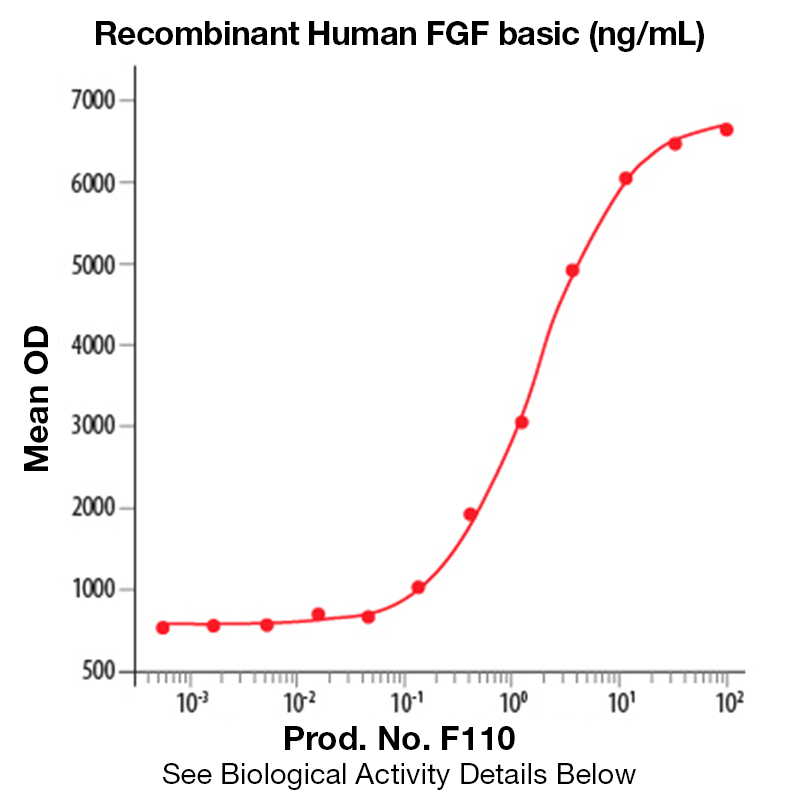
Human FGF-Basic Bioactivity Data
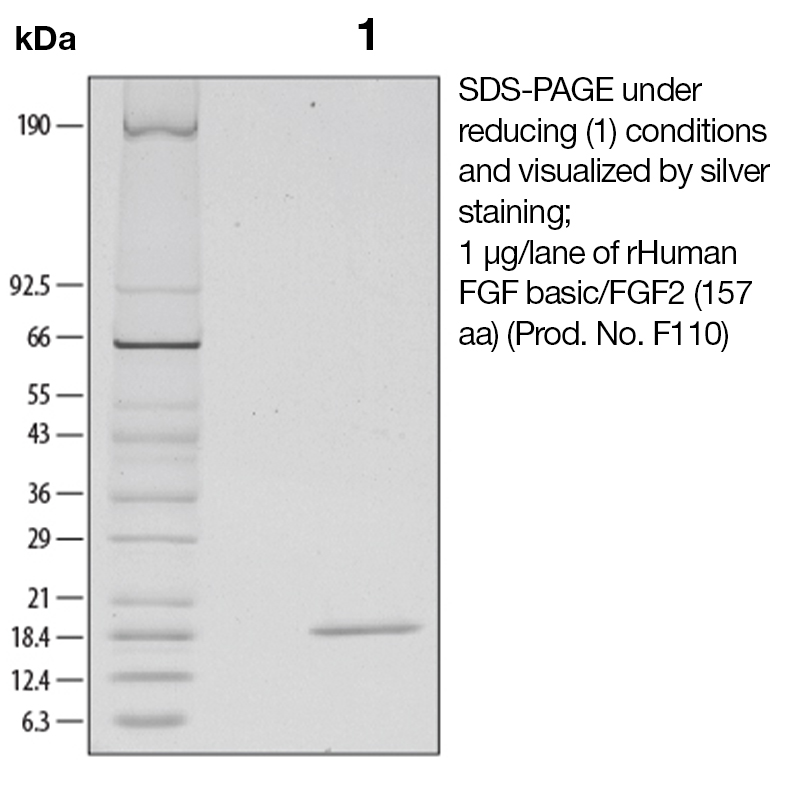
Human FGF-Basic SDS-PAGE
- -
- -

Background

Basic fibroblast growth factor (bFGF), also known as FGF-2 and FGF-β, is a non-glycosylated heparin binding growth factor and member of the FGF family of mitogenic proteins. Members of this family play a central role during prenatal development, postnatal growth and regeneration of a variety of tissues, by promoting cellular proliferation and differentiation (1). bFGF is expressed in the brain, pituitary, kidney, retina, bone, testis, adrenal gland, liver, placenta, and monocytes, epithelial and endothelial cells. It is secreted by mechanisms other than the classical protein secretion pathway due to the lack of a signal peptide. Acidic FGF (aFGF) and bFGF bind to the same high affinity receptors (2). Binding of bFGF to heparin or cell surface heparan sulfate proteoglycans is a prerequisite for ligation of bFGF to these receptors. aFGF and BFGF have a similar range of biological activities which are implicated in several important physiological and pathological processes, such as embryonic development and differentiation, morphogenesis, angiogenesis, and wound healing (3-4).

Protein Details

Purity
>97% by SDS-PAGE and analyzed by silver stain.
Endotoxin Level
<0.1 EU/µg as determined by the LAL method
Biological Activity
The biological activity of Human FGF-basic was monitored in a mitogenic assay by measuring the FGF basic dependent <sup>3</sup>H-thymidine incorporation in quiescent NR6R-3T3 fibroblasts (Rizzino, A. et al., 1988. Cancer Research 48:4266 - 4271). The expected ED<sub>50</sub> for this effect is typically 0.1 - 0.25 ng/ml.
Protein Accession No.
NP_001997
Amino Acid Sequence
gtmaagsit tlpalpedgg sgafppghfk dpkrlyckng gfflrihpdg rvdgvreksd phiklqlqae ergvvsikgv canrylamke dgrllaskcv tdecffferl esnnyntyrs rkytswyval krtgqyklgs ktgpgqkail flpmsaks
N-terminal Sequence Analysis
Gly132
State of Matter
Solution
Predicted Molecular Mass
The predicted molecular weight of Recombinant Human FGF-Basic is Mr 17.4 kDa. However, the actual molecular weight as observed by migration on SDS-PAGE is 19 kDa (reducing conditions).
Predicted Molecular Mass
17.4
Formulation
This recombinant protein solution was 0.2 µm filtered and formulated in Tris and NaCl.
Storage and Stability
This protein is stable for > twelve months when stored at -20°C to -70°C. After thawing and addition of a carrier protein, this protein may be stored at 2°C to 8°C for one month or for up to three months at -20°C to -70°C in a manual defrost freezer. Avoid Repeated Freeze Thaw Cycles. See Product Insert for exact lot specific storage instructions.
Country of Origin
USA
Shipping
Next Day 2-8°C
NCBI Gene Bank

Leinco Protein Advisor

Powered by AI: AI is experimental and still learning how to provide the best assistance. It may occasionally generate incorrect or incomplete responses. Please do not rely solely on its recommendations when making purchasing decisions or designing experiments.

Recombinant Human FGF-Basic (FGF-2/bFGF) is a versatile growth factor that offers significant advantages across multiple research and therapeutic applications due to its broad biological activity and well-characterized mechanisms of action.

Cellular Proliferation and Differentiation

FGF-Basic possesses broad mitogenic activity and stimulates proliferation across diverse cell types, including fibroblasts, myoblasts, osteoblasts, neuronal cells, endothelial cells, keratinocytes, chondrocytes, astrocytes, oligodendrocytes, and smooth muscle cells. Beyond proliferation, it induces neuronal differentiation, survival, and regeneration, making it particularly valuable for studies involving neural development and function. The protein also significantly promotes the proliferation of adipose-derived mesenchymal cells and enhances chondrogenesis in three-dimensional micromass culture.

Tissue Regeneration and Wound Healing

FGF-Basic demonstrates remarkable effectiveness in promoting tissue regeneration through multiple complementary mechanisms. It maintains osteoblast precursors in a proliferative state while simultaneously promoting angiogenesis, which is crucial for nutrient and oxygen supply in newly formed tissue. The protein stimulates secretion of other growth factors, such as vascular endothelial growth factor and hepatocyte growth factor, further enhancing vascular development and creating a favorable microenvironment for regeneration. In bone regeneration applications specifically, optimal efficacy has been demonstrated at a 0.3% concentration, which has received formal regulatory approval for periodontal regenerative medicine. Chronic wound research represents one of the largest areas of FGF-2 investigation, as these wounds often have reduced endogenous FGF-2 concentrations.

Angiogenic Activity

FGF-Basic exhibits potent angiogenic activity and plays a key role in both physiological and pathological conditions. This property makes it essential for studying vascular development, wound repair, inflammation, and tumor biology. The protein binds to a family of four distinct, high-affinity tyrosine kinase receptors (FGFR-1 to FGFR-4) and also interacts with αvβ3 integrin, enabling multiple signaling pathways.

Diverse Research Applications

The protein's versatility extends to numerous research contexts, including embryonic development, stem cell maintenance, organoid culture, and disease modeling. It has proven valuable in bioassay applications across whole cell systems and organoid models, supporting investigations ranging from basic cell biology to translational research.

Yes, recombinant human FGF-basic (FGF2) can be used as a standard for quantification or calibration in ELISA assays, provided it is compatible with your assay system. Multiple sources confirm that recombinant FGF-basic is routinely used as a standard in commercial ELISA kits and for assay calibration.

Key considerations and supporting details:

  • Assay Compatibility:
    Recombinant human FGF-basic is commonly used as a standard in ELISA kits designed to quantify FGF2 in biological samples. These kits are validated to detect both natural and recombinant forms, and standard curves generated with recombinant FGF-basic are used for quantification.

  • Protein Form and Source:
    The recombinant protein is typically expressed in E. coli and is available in carrier-free or BSA-containing formulations. Carrier-free forms are preferred if BSA or other additives could interfere with your assay.

  • Standard Curve Validity:
    Commercial ELISA kits demonstrate that standard curves generated with recombinant FGF-basic are linear and parallel to those generated with natural FGF-basic, indicating equivalence for quantification purposes. This ensures accurate calibration and quantification of FGF2 in your samples.

  • Reconstitution and Handling:
    Follow the manufacturer’s instructions for reconstitution (e.g., using Tris buffer, gentle mixing) and prepare further dilutions in a buffer containing a carrier protein (such as 0.1% BSA) to minimize protein loss.

  • Stability:
    Recombinant FGF-basic can be unstable in aqueous solution, so aliquot and store at recommended temperatures, and avoid repeated freeze-thaw cycles to maintain protein integrity and assay accuracy.

  • Concentration Range:
    ELISA kits using recombinant FGF-basic as a standard typically cover a wide dynamic range (from low pg/mL to ng/mL), suitable for most biological sample quantification needs.

Best Practices:

  • Confirm that your ELISA antibodies recognize the recombinant form you are using (e.g., full-length, specific isoform, or tag-free).
  • Validate the standard curve in your specific assay matrix (serum, plasma, cell culture supernatant) for optimal accuracy.
  • Use freshly prepared or properly stored aliquots of the recombinant standard to ensure consistent results.

Summary Table: Use of Recombinant FGF-basic as ELISA Standard

ApplicationSupported?Notes
ELISA calibrationYesWidely used in commercial kits; ensure compatibility with your assay.
QuantificationYesStandard curves are linear and parallel to natural FGF2.
Sample typesYesPlasma, serum, cell culture supernatant, lysates.

In conclusion:
Recombinant human FGF-basic is suitable and widely accepted as a standard for quantification and calibration in ELISA assays, provided it matches the requirements of your specific assay system and is handled according to best practices.

Recombinant Human FGF-Basic (FGF2/bFGF) has been validated in published research for a wide range of applications, primarily in cell culture, bioassays, tissue engineering, regenerative medicine, and therapeutic studies.

Key validated applications include:

  • Stem Cell Culture and Maintenance:
    FGF-basic is widely used to maintain the proliferation and pluripotency of human embryonic stem cells (hESCs) and induced pluripotent stem cells (iPSCs), supporting their undifferentiated state and self-renewal. It upregulates pluripotency markers such as Oct4, Sox2, and Nanog.

  • Cell Differentiation and Developmental Biology:
    It is used to induce differentiation of various cell types, including neuronal cells, Schwann cells, chondrocytes, and fibroblasts, and to study embryonic development and neurogenesis. FGF-basic has been applied in protocols for deriving neural crest cells and Schwann cells from hPSCs for disease modeling.

  • Angiogenesis and Wound Healing:
    FGF-basic promotes angiogenesis, tissue repair, and regeneration, and is validated for use in wound healing models, including clinical studies for burn treatment and diabetic wound healing. It accelerates skin cell regeneration and improves microcirculation.

  • Bioassays and Functional Studies:
    Used in bioassays to assess cell proliferation, survival, and differentiation in various cell types, including endothelial cells, neuronal cells, and mesenchymal stem cells. It is also applied in functional assays such as ELISA standards.

  • Cancer Research:
    FGF-basic is implicated in tumor angiogenesis and cell proliferation, and is used in studies investigating its role in cancer development and tumor vascularization.

  • Tissue Engineering and Regenerative Medicine:
    Supplementation of culture media with FGF-basic supports the growth and expansion of chondrocyte-like cells and other progenitor cells for tissue engineering applications.

  • Genome Editing and Organoid Models:
    FGF-basic is used in protocols for high-precision genome editing (HDR) and in the culture of organoids for disease modeling and drug discovery.

  • Therapeutic Applications:
    Clinical studies have validated recombinant human FGF-basic for therapeutic use in wound healing, particularly in burn patients and diabetic ulcers, demonstrating improved healing rates and safety.

Summary Table of Validated Applications

Application AreaExample Use Cases/ModelsReferences
Stem cell culturehESC/iPSC maintenance, pluripotency
Cell differentiationNeuronal, Schwann, chondrocyte, fibroblast differentiation
Angiogenesis & wound healingBurn treatment, diabetic wound healing
Bioassays/functional assaysCell proliferation, ELISA standards
Cancer researchTumor angiogenesis, cell proliferation
Tissue engineeringChondrocyte expansion, regenerative protocols
Genome editing/organoidsHDR genome editing, organoid culture
Therapeutic studiesClinical wound healing, tissue repair

Additional Notes:

  • FGF-basic is validated for use with a variety of cell types, including fibroblasts, endothelial cells, neuronal cells, chondrocytes, and stem cells.
  • It is commonly used in both in vitro (cell culture, organoid) and in vivo (animal models, clinical studies) settings.
  • Protocols often specify carrier-free or animal-free formulations for clinical and stem cell applications.

If you require protocol details or specific assay conditions for any application, please specify the intended use.

To reconstitute and prepare Recombinant Human FGF-Basic (FGF-2/bFGF) protein for cell culture experiments, follow these best-practice steps to ensure protein stability and bioactivity:

1. Preparation Before Reconstitution

  • Briefly centrifuge the vial (10,000–14,000 × g, 20–30 seconds) to collect all lyophilized protein at the bottom and cap of the vial.

2. Reconstitution

  • Use a sterile, low-protein-binding pipette tip to add the appropriate volume of buffer.
  • Recommended buffers:
    • Sterile 1× PBS (pH 7.2–7.4)
    • Tris buffer (5–10 mM, pH 7.5–7.6)
  • Protein concentration: Reconstitute to a final concentration of 0.1–0.3 mg/mL (100–300 μg/mL) for stock solutions.
  • Carrier protein: Add 0.1% BSA or recombinant human serum albumin (HSA) to the buffer to stabilize the protein and prevent adsorption to surfaces.
  • Gently swirl or tap the vial to dissolve the protein. Avoid vigorous vortexing to prevent denaturation.

3. Aliquoting and Storage

  • After complete dissolution, aliquot the stock solution into single-use volumes to avoid repeated freeze-thaw cycles.
  • Store aliquots at –20 °C or –80 °C in a manual defrost freezer. Avoid frost-free freezers and repeated freeze-thaw cycles, as these can denature the protein.
  • For short-term use (up to 1 week), aliquots can be stored at 4 °C.

4. Working Solution Preparation

  • Dilute the stock solution to the desired working concentration (typically 10–100 ng/mL for most cell culture applications) in cell culture medium immediately before use.
  • Include 0.1% BSA or HSA in the working solution if possible to maintain stability.

5. Additional Notes

  • If a precipitate forms after reconstitution, clarify by microcentrifugation before use.
  • Avoid prolonged storage of reconstituted protein at 4 °C or room temperature, as FGF-Basic is unstable in aqueous solution without stabilizers.
  • Confirm protein integrity by SDS-PAGE if needed.

Summary Table: Key Parameters for FGF-Basic Reconstitution

StepRecommended Practice
Centrifuge vial10,000–14,000 × g, 20–30 sec
BufferSterile PBS (pH 7.2–7.4) or 5–10 mM Tris (pH 7.5–7.6)
Carrier protein0.1% BSA or HSA
Stock concentration0.1–0.3 mg/mL
AliquotingSingle-use, avoid freeze-thaw
Storage–20 °C or –80 °C
Working dilution10–100 ng/mL in culture medium

These guidelines will help ensure maximum stability and biological activity of recombinant human FGF-Basic for cell culture experiments.

References & Citations

1. Swain, JL. et al. (1991) Developement 111: 741
2. Grevers, G. et al. (1997) Laryngorhinootologie 76: 421
3. Bühring, HJ. et al. (2007) Differentiation. 75(4):279-91

Certificate of Analysis

IMPORTANT Use lot specific datasheet for all technical information pertaining to this recombinant protein.
- -
- -
Disclaimer AlertProducts are for research use only. Not for use in diagnostic or therapeutic procedures.