

Recombinant Human GDNF


Data
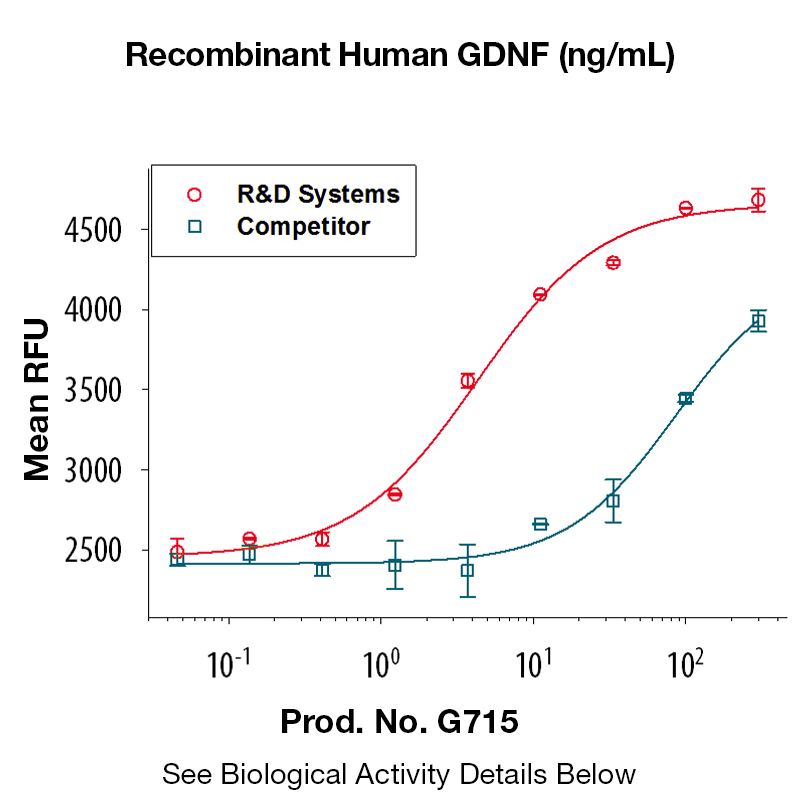
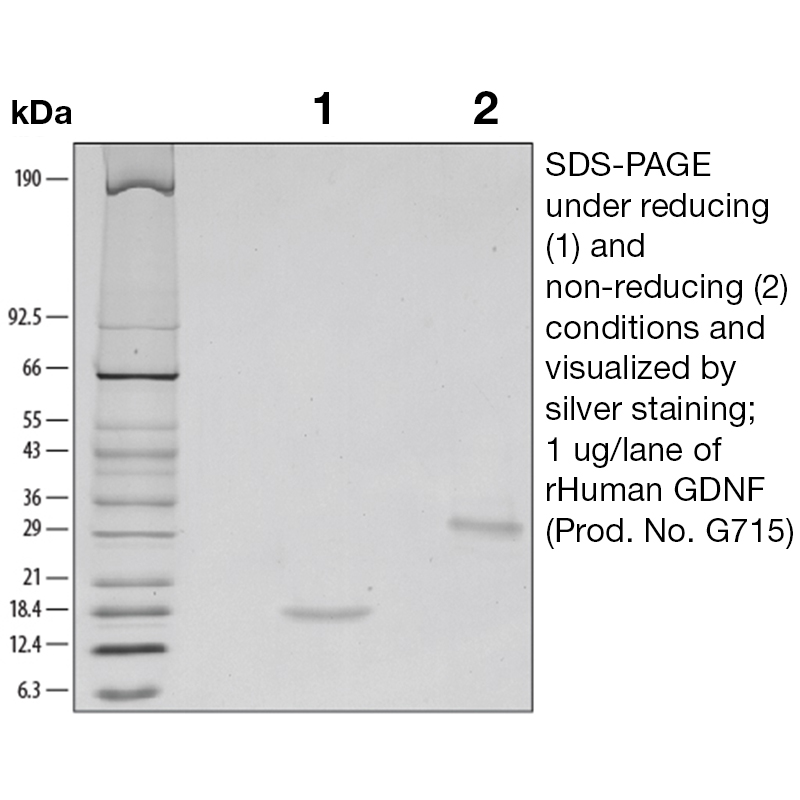
BackgroundGlial cell derived neurotrophic factor, also known as GDNF is a glycosylated, disulfide-bonded homodimer that is a distantly related member of the transforming growth factor-beta superfamily.1 GDNF potently promotes the survival of many types of neurons, most prominently, dopaminergic and motorneurons. GDNF regulates kidney development and spermatogenesis, and it affects alcohol consumption.2 Protein DetailsPurity >97% by SDS-PAGE and analyzed by silver stain. Endotoxin Level <1.0 EU/µg as determined by the LAL method Biological Activity The biological activity of Human GDNF was determined by its ability to support the survival and stimulate neurite outgrowth of cultured embryonic chick dorsal root ganglia neurons (Davies, A.M., 1989, Neurotrophic Factor Bioassay Using Dissociated Neurons, Nerve Growth Factor, Rush, R.A., ed., John Willey and Sons, Ltd., p.95). The expected ED<sub>50</sub> for this effect is typically 1 - 3 ng/ml. Protein Accession No. Amino Acid Sequence rg qrgknrgcvl taihlnvtdl glgyetkeel ifrycsgscd aaettydkil knlsrnrrlv sdkvgqaccr piafdddlsf lddnlvyhil rkhsakrcgc i N-terminal Sequence Analysis Arg109 State of Matter Lyophilized Predicted Molecular Mass The predicted molecular weight of Recombinant Human GDNF is Mr 11.6 kDa. Predicted Molecular Mass 11.6 Formulation This recombinant protein was 0.2 µm filtered and lyophilized from modified Dulbecco’s phosphate buffered saline (1X PBS) pH 7.2 – 7.3 with no calcium, magnesium, or preservatives. Storage and Stability This lyophilized protein is stable for six to twelve months when stored desiccated at -20°C to -70°C. After aseptic reconstitution, this protein may be stored at 2°C to 8°C for one month or at -20°C to -70°C in a manual defrost freezer. Avoid Repeated Freeze Thaw Cycles. See Product Insert for exact lot specific storage instructions. Country of Origin USA Shipping Next Day Ambient NCBI Gene Bank Applications and Recommended Usage ? (Quality Tested by Leinco) ELISA Sandwich: This antibody is useful as the capture antibody in a sandwich ELISA. The suggested coating concentration is 5 µg/ml (100 µl/well) µg/ml. Flow Cytometry: PN:A106 Flow Cytometry: It is recommended to use the indirect method for signal enhancement when enumerating cells expressing CXCR5. A suggested method would be to stain cells expressing CXCR5 with approximately 10 µl per test. A typical test sample constitutes approximately 50 µl of packed whole blood or 1 x 10⁵ continuous passage or activated cell cultures that have been centrifuged at 500 X g for five minutes. Labeling of the cells with the biotin conjugate should be followed by PN:A104, resuspended in 200-400 µl of 1X PBS. Leinco Protein AdvisorPowered by AI: AI is experimental and still learning how to provide the best assistance. It may occasionally generate incorrect or incomplete responses. Please do not rely solely on its recommendations when making purchasing decisions or designing experiments. Recombinant Human GDNF is widely used in research applications due to its potent neurotrophic effects, especially for promoting the survival, differentiation, and maintenance of various neuronal populations, most notably midbrain dopaminergic neurons. Key scientific reasons to use recombinant human GDNF include:
Typical research applications include:
Using recombinant human GDNF ensures reproducibility, defined activity, and compatibility with human cell systems, which are critical for translational research and therapeutic development. Yes, recombinant human GDNF can be used as a standard for quantification and calibration in ELISA assays, but the suitability depends on the specific formulation and your experimental requirements. Formulation ConsiderationsBSA-containing versus carrier-free formulations play a critical role in determining appropriate use. The BSA-formulated recombinant GDNF is specifically recommended for use as an ELISA standard. In contrast, carrier-free formulations are recommended for applications where the presence of BSA could interfere with your assay. ELISA Calibration StandardsRecombinant human GDNF serves as the calibration standard in commercial ELISA kits. These kits are calibrated against highly purified recombinant human GDNF produced through standard expression systems. The recombinant protein standards demonstrate excellent performance characteristics: they produce linear dose-response curves that parallel results obtained with naturally occurring human GDNF, indicating that the kits can accurately determine relative mass values for natural GDNF. Binding CharacteristicsThe recombinant GDNF exhibits strong binding affinity to its receptor. When immobilized at 1 µg/mL, recombinant human GDNF can bind with an apparent Kd<1 nM to the GFR alpha-1/GDNF receptor alpha-1 Fc chimera, demonstrating high-affinity interactions suitable for quantitative applications. Important LimitationHowever, there is a critical caveat: ELISA standard recombinant proteins are not recommended for bioassay usage, as they are not tested for these applications. If you intend to use the GDNF for functional bioassays rather than purely quantitative ELISA calibration, you should select a formulation specifically validated for bioassay applications. For straightforward ELISA quantification and calibration purposes, the BSA-formulated recombinant GDNF is an appropriate choice, provided you verify that the formulation is compatible with your specific assay protocol. Recombinant human GDNF has been validated for several key applications in published research: Primary Research ApplicationsBioassay and Functional Studies Recombinant human GDNF is extensively used in bioassay applications to assess biological activity and protein function. The protein demonstrates measurable biological activity, typically reported at 4 U/mg, enabling quantitative evaluation of its effects on target cells. Neuronal Cell Culture and Differentiation GDNF serves as a critical survival and differentiation factor in neuronal cell culture systems. It promotes growth and differentiation of neurons and synapses, making it particularly valuable for studies involving dopaminergic neuron development and maintenance. The protein has been specifically validated for use with induced pluripotent stem cell (iPSC)-derived neurons and other neuronal culture models. Disease Modeling and Neuroprotection Studies Published research has employed recombinant human GDNF in multiple neurodegenerative disease models, including studies on Parkinson's disease, amyotrophic lateral sclerosis (ALS), and frontotemporal dementia (FTD). The protein is used to model ferroptosis in dopaminergic neurons, investigate mitochondrial dysfunction in ALS, and evaluate neuroprotective mechanisms in various neurological conditions. Signaling Pathway Analysis GDNF has been validated for analyzing apoptosis and intracellular signaling pathways, allowing researchers to elucidate the molecular mechanisms underlying neuronal survival and death processes. Western Blot Control and Immunoassay The protein serves as a validated control for Western blot applications and functions as an immunoassay standard in quantitative protein detection assays. These applications collectively demonstrate GDNF's utility as a research tool for understanding neuronal biology, disease mechanisms, and potential therapeutic interventions in neurodegenerative disorders. To reconstitute and prepare Recombinant Human GDNF (Glial Cell Line-Derived Neurotrophic Factor) protein for cell culture experiments, follow these general best practices based on manufacturer guidelines and scientific protocols: 1. Reconstitution
2. Aliquoting and Storage
3. Dilution for Cell Culture
4. Additional Tips
Summary Protocol
Always refer to the specific product datasheet for any unique requirements or recommendations. References & Citations1. Collins, F. et al. (1993) Science 260: 1130 2. Ron, D. et al. (2008) Proc. Natl. Acad. Sci. U.S.A. 105: 8114 Technical Protocols  Certificate of AnalysisIMPORTANT Use lot specific datasheet for all technical information pertaining to this recombinant protein. |
Related Products
Prod No. | Description |
|---|---|
G663 | |
G116 | |
G639 | |
G715 | |
G141 |
 Products are for research use only. Not for use in diagnostic or therapeutic procedures.
