

Recombinant Mouse FGF-Basic


Recombinant Mouse FGF-Basic
Product No.: F1022
[product_table name="All Top" skus="F1022"]
| Alternate Names Fibroblast Growth Factor-Basic, B-FGF, FGF-2, FGF-β, FGFB, Prostatropin, NUDT6 Product Type Recombinant Protein Expression Host E. coli Cells Species Mouse |
| Select Product Size | Qty Max: Min: 1 Step: 1 $445.00 |
Data
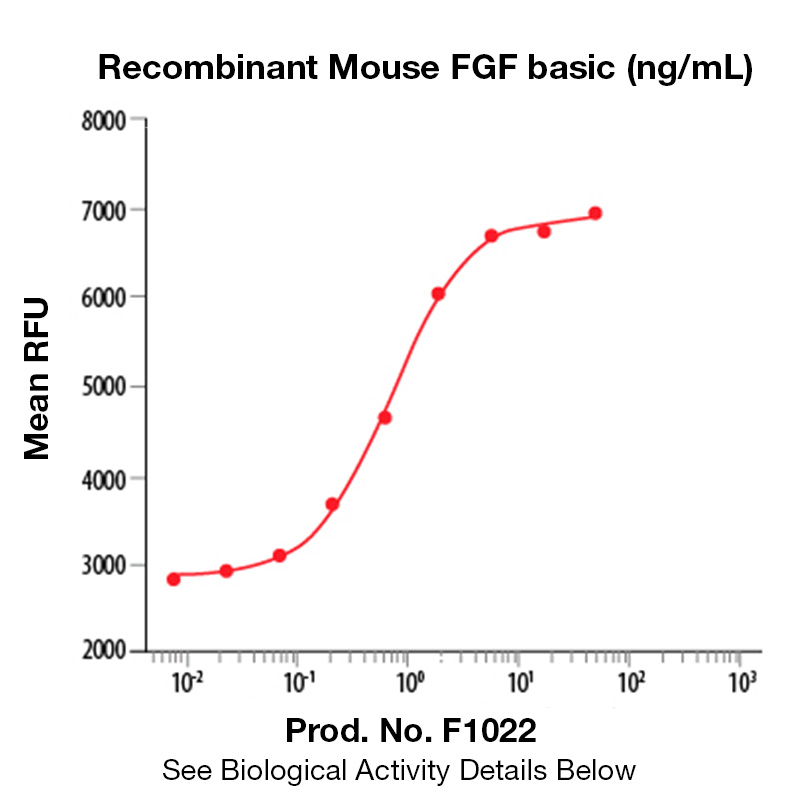
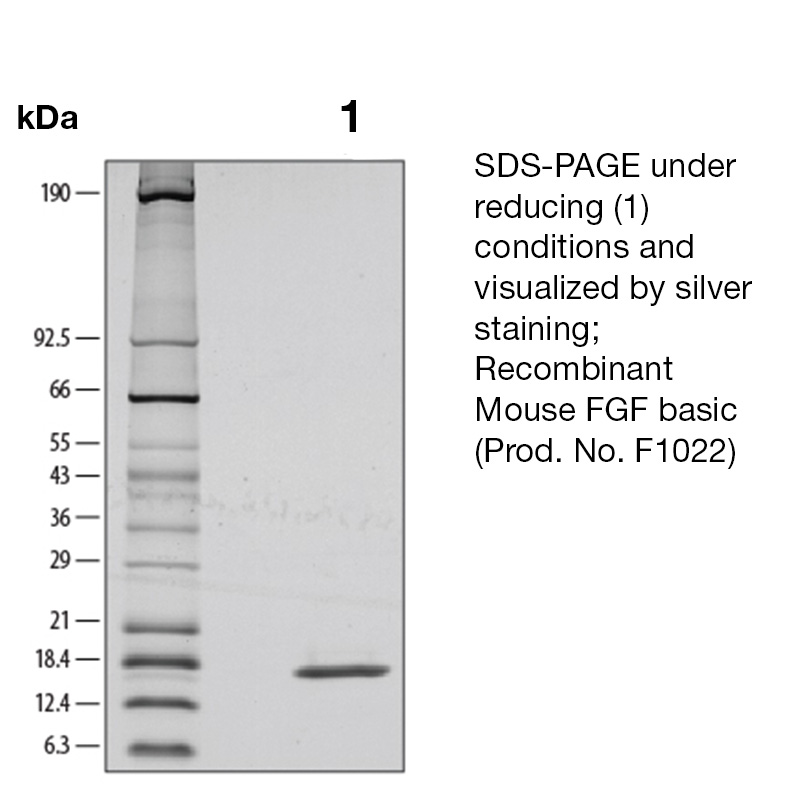
BackgroundAcidic and basic fibroblast growth factors (FGFs) are members of a family of proteins that exert pleiotropic effects in a range of cell types including skeletal myocytes.1 Fibroblast growth factor basic (FGF basic) significantly promote angiogenesis; a central event for the growth and metastasis of solid tumors.2 It is expressed in the brain, pituitary, kidney, retina, bone, testis, adrenal gland, liver, placenta, and monocytes, epithelial and endothelial cells. FGF-basic plays a central role during prenatal development and postnatal growth and regeneration of tissues, by promoting cellular proliferation and differentiation. FGF-basic is one of the angiogenesis factors and may promote wound healing.3 Protein DetailsPurity >97% by SDS-PAGE and analyzed by silver stain. Endotoxin Level <0.1 EU/µg as determined by the LAL method Protein Accession No. Amino Acid Sequence alpedggaaf ppghfkdpkr lycknggffl rihpdgrvdg vreksdphvk lqlqaeergv vsikgvcanr ylamkedgrl laskcvteec ffferlesnn yntyrsrkys swyvalkrtg qyklgsktgp gqkailflpm saks
N-terminal Sequence Analysis Ala11 State of Matter Lyophilized Predicted Molecular Mass The predicted molecular weight of Recombinant Mouse FGF-b is Mr 16.2 kDa. Predicted Molecular Mass 16.2 Formulation This recombinant protein was lyophilized from a sterile (0.2 micron) filtered aqueous solution containing 10 mM sodium phosphate, 50 mM sodium chloride, pH 7.5. Storage and Stability This lyophilized protein is stable for six to twelve months when stored desiccated at -20°C to -70°C. After aseptic reconstitution, this protein may be stored at 2°C to 8°C for one month or at -20°C to -70°C in a manual defrost freezer. Avoid Repeated Freeze Thaw Cycles. See Product Insert for exact lot specific storage instructions. Country of Origin USA Shipping Next Day Ambient NCBI Gene Bank Leinco Protein AdvisorPowered by AI: AI is experimental and still learning how to provide the best assistance. It may occasionally generate incorrect or incomplete responses. Please do not rely solely on its recommendations when making purchasing decisions or designing experiments. Recombinant Mouse FGF-Basic (FGF-2) is a highly valuable tool for a wide range of research applications due to its critical roles in regulating fundamental cellular processes. Here are several key reasons why you should consider using Recombinant Mouse FGF-Basic in your research: 1. Supports Stem Cell Culture and Maintenance
2. Promotes Cell Proliferation and Survival
3. Enhances Angiogenesis and Tissue Repair
4. Regulates Differentiation and Development
5. Facilitates Disease Modeling and Therapeutic Research
6. High Quality and Consistency
7. Versatile Applications
8. Well-Characterized and Widely Used
In summary, Recombinant Mouse FGF-Basic is a powerful and versatile tool that supports a broad spectrum of research applications, from stem cell biology and tissue engineering to disease modeling and therapeutic development. Its ability to regulate key cellular processes makes it an essential component for advancing scientific understanding and innovation. Yes, recombinant mouse FGF-basic can be used as a standard for quantification or calibration in ELISA assays, provided it is compatible with your assay system. Multiple sources confirm that recombinant mouse FGF-basic is suitable as an ELISA standard, and commercial ELISA kits often use recombinant FGF-basic as their calibration standard. Key considerations and supporting details:
Limitations:
Summary Table: Use of Recombinant Mouse FGF-Basic as ELISA Standard
In conclusion, recombinant mouse FGF-basic is appropriate for use as a standard in ELISA quantification and calibration, provided it is validated for your specific assay system and sample type. Research Applications of Recombinant Mouse FGF-BasicRecombinant mouse FGF-basic (FGF-2) has been validated across a diverse range of research applications in published literature, spanning developmental biology, regenerative medicine, and disease modeling. Cell Culture and Stem Cell MaintenanceFGF-basic serves as a critical component in human embryonic stem cell culture systems, where it is necessary for maintaining pluripotency and preventing differentiation. The protein is routinely used in serum-free culture media formulations designed for stem cell expansion and maintenance. Additionally, it has been applied in 3D culturing protocols for human pluripotent stem cell-derived endothelial cells intended for vascular regeneration applications. Developmental and Differentiation StudiesThe protein has been validated in research examining embryonic development and differentiation processes. Studies have utilized recombinant mouse FGF-basic in investigations of pluripotency factor regulation and Hox cluster activation in early embryos. It has also been employed in research on neocortical neurogenesis, including studies examining how maternal hyperglycemia affects neural development. Tissue Regeneration and RepairFGF-basic has demonstrated utility in research focused on direct cellular reprogramming and tissue regeneration. Studies have employed the protein in protocols for extracellular vesicle-guided direct reprogramming of fibroblasts into functional cardiomyocytes. Research on perivascular adipose-derived stem cell differentiation toward smooth muscle cells has also incorporated FGF-basic signaling pathways. Neurological ResearchThe protein has been validated in neural stem cell research, including studies investigating small extracellular vesicle-based delivery systems for reducing apoptosis and neuroinflammation following traumatic spinal cord injury. These applications leverage FGF-basic's role in neuronal function and survival pathways. Standard Laboratory ApplicationsBeyond specialized research, recombinant mouse FGF-basic has been validated for use as an ELISA standard, Western blot control, and in cell proliferation bioassays. The protein's bioactivity has been characterized through NR6R-3T3 mouse fibroblast cell proliferation assays, with typical ED₅₀ values of 2.5 ng/mL or less. To reconstitute and prepare Recombinant Mouse FGF-Basic (FGF2/bFGF) protein for cell culture experiments, dissolve the lyophilized protein in sterile buffer at a recommended concentration of 100 μg/mL (0.1 mg/mL), using either sterile water or sterile PBS, ideally containing at least 0.1% carrier protein such as bovine serum albumin (BSA). Step-by-step protocol:
Additional notes:
Summary Table:
This protocol ensures optimal solubility, stability, and biological activity of recombinant mouse FGF-Basic for cell culture applications. References & Citations1. Swain, JL. et al. (1991) Developement 111: 741 2. Grevers, G. et al. (1997) Laryngorhinootologie 76: 421 3. Bühring, HJ. et al. (2007) Differentiation. 75(4):279-91 Certificate of AnalysisIMPORTANT Use lot specific datasheet for all technical information pertaining to this recombinant protein. |
Related Products
Prod No. | Description |
|---|---|
| F149 | |
| F1105 | |
| F107 | |
| F110 | |
| F1022 | |
| F1027 |
 Products are for research use only. Not for use in diagnostic or therapeutic procedures.
