Galectin-3 is a beta-galactoside-binding protein that regulates many biologic processes, including cell adhesion, migration, cell growth, tumor progression, metastasis, and apoptosis.1 It is secreted from activated macrophages, basophils, and mast cells.2 Galectin-3 may play an important role in the acute phase of human atopic dermatitis.
Protein Details
Purity
>90% by SDS-PAGE and analyzed by silver stain.
Endotoxin Level
<0.01 EU/µg as determined bythe LAL method
Biological Activity
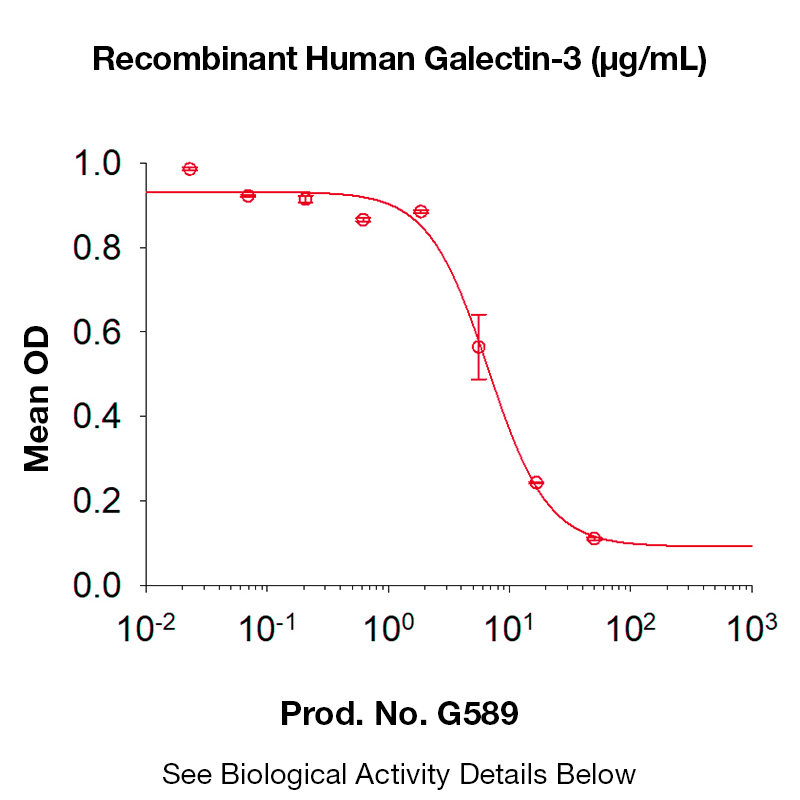
The biological activity of Human Gal-3 was determined by its ability to agglutinate human red blood cells.<sup>2</sup> ED<sub>50</sub> is 3 - 10 μg/ml.
Protein Accession No.
Q6IBA7
Amino Acid Sequence
Ala 2 - Ile 250 (Accession # Q6IBA7)
N-terminal Sequence Analysis
Ala2
State of Matter
Lyophilized
Predicted Molecular Mass
The predicted molecular weight of Recombinant Human Galectin-3 is Mr 26 kDa.
Predicted Molecular Mass
26
Formulation
This recombinant protein was 0.2 µm filtered and lyophilized from modified Dulbecco’s phosphate buffered saline (1X PBS), 4 mM β-mercaptoethanol (βME) containing 50 µg of BSA per 1 µg of cytokine.
Storage and Stability
This lyophilized protein is stable for six to twelve months when stored desiccated at -20°C to -70°C. After aseptic reconstitution, this protein may be stored at 2°C to 8°C for one month or at -20°C to -70°C in a manual defrost freezer. Avoid Repeated Freeze Thaw Cycles. See Product Insert for exact lot specific storage instructions.
Powered by AI: AI is experimental and still learning how to provide the best assistance. It may occasionally generate incorrect or incomplete responses. Please do not rely solely on its recommendations when making purchasing decisions or designing experiments.
Using Recombinant Human Galectin-3 in research applications enables precise investigation of this multifunctional protein’s roles in cell biology, immunology, cancer, fibrosis, and as a biomarker, due to its well-defined, consistent, and biologically active form.
Key reasons to use recombinant human Galectin-3 include:
Functional Studies: Recombinant Galectin-3 allows controlled studies of its effects on cell adhesion, migration, invasion, and apoptosis. For example, it has been shown to regulate cell–cell and cell–matrix interactions, modulate gene expression, and influence cell motility and angiogenesis.
Immunology and Inflammation: Galectin-3 is a key modulator of innate and adaptive immune responses. It participates in neutrophil activation, monocyte/macrophage chemoattraction, opsonization, and mast cell activation, and can amplify both acute and chronic inflammatory responses.
Cancer Research: Galectin-3 is implicated in tumor growth, progression, metastasis, and angiogenesis. It acts as a regulator of tumor metastasis and is associated with tumor progression in several carcinomas.
Fibrosis and Cardiovascular Disease: Galectin-3 contributes to chronic inflammation and fibrosis, including cardiac fibrosis and heart failure, making it a target for studies on fibrotic diseases and atherosclerosis.
Biomarker Development: Due to its involvement in various pathologies, Galectin-3 is studied as a diagnostic and prognostic biomarker for heart disease, kidney disease, and cancer.
Mechanistic Assays: Recombinant Galectin-3 is used in ELISA, bioassays, enzyme assays, cell adhesion, migration, and invasion assays, and surface plasmon resonance studies, providing reproducible and specific results.
Molecular Pathways: It enables dissection of intracellular and extracellular signaling pathways, such as Notch and VEGFR2 signaling in angiogenesis, and autophagy regulation in response to membrane damage.
Using the recombinant form ensures batch-to-batch consistency, eliminates variability from endogenous sources, and allows for dose-dependent and mechanistic studies in vitro and in vivo.
In summary, recombinant human Galectin-3 is a versatile tool for dissecting its diverse biological functions, disease mechanisms, and therapeutic potential in a controlled and reproducible manner.
Yes, recombinant human Galectin-3 can be used as a standard for quantification or calibration in ELISA assays, provided it is of high purity and its concentration is accurately determined. This practice is widely accepted in quantitative ELISA protocols for Galectin-3.
Supporting details:
ELISA calibration standards: Multiple validated ELISA kits for human Galectin-3 use recombinant human Galectin-3 as their calibration standard. For example, the Quantikine Human Galectin-3 Immunoassay is calibrated against a highly purified recombinant human Galectin-3 expressed in E. coli, and the calibrators are prepared from this recombinant protein.
Assay specificity: These ELISA kits are designed to recognize both natural and recombinant forms of human Galectin-3, ensuring that recombinant protein is suitable for generating standard curves and quantifying Galectin-3 in biological samples.
Protocol requirements: When using recombinant Galectin-3 as a standard, it is critical to:
Accurately determine its concentration, typically by spectrophotometric or protein assay methods.
Prepare serial dilutions in the same buffer or diluent as your samples to ensure consistency and minimize matrix effects.
Validate that your ELISA antibodies recognize the recombinant form equivalently to the native protein, which is standard for commercial kits but should be confirmed for custom assays.
Best practices: Use recombinant Galectin-3 that is highly purified and well-characterized, ideally with documentation of its source, expression system, and purity. Avoid repeated freeze-thaw cycles and follow recommended storage conditions to maintain protein integrity.
Additional considerations:
If your recombinant Galectin-3 is not from a commercial ELISA kit, ensure it is free from contaminants and its concentration is reliably measured.
Always run a standard curve with each assay to calibrate quantification and verify linearity and sensitivity within your assay’s dynamic range.
Summary: Recombinant human Galectin-3 is an appropriate and widely used standard for ELISA quantification and calibration, provided it is pure, accurately quantified, and recognized by the assay antibodies.
Recombinant Human Galectin-3 has been validated for a wide range of applications in published research, primarily in studies of cell adhesion, immune response, fibrosis, cancer biology, inflammation, and biomarker development.
Key validated applications include:
ELISA Standard: Used as a quantitative standard in enzyme-linked immunosorbent assays for measuring galectin-3 levels in serum and other biological samples.
Bioassays: Employed in functional assays to study cell adhesion, migration, apoptosis, and immune cell activation, including neutrophil activation, monocyte/macrophage chemoattraction, and mast cell activation.
Enzyme Assays: Utilized to assess proteolytic activity and interactions with other proteins, such as prostate-specific antigen (PSA).
Surface Plasmon Resonance (SPR): Applied in binding studies to characterize interactions with glycosylated ligands, pathogens, and cell surface molecules.
Cell Adhesion Assays: Immobilized recombinant galectin-3 supports adhesion of various cell types, including Jurkat T cells, in a dose-dependent manner.
Wound Healing Models: Topical application in hydrogels has been shown to promote diabetic wound healing in animal models.
Fibrosis and Inflammation Models: Used in vitro and in vivo to study mechanisms and therapeutic interventions for liver, lung, and cardiac fibrosis, as well as chronic and acute inflammatory responses.
Cancer Research: Investigated for its role in tumor growth, progression, metastasis, and as a drug target in KRAS-addicted cancers and other malignancies.
Neuroinflammation and Neurotrophic Factor Regulation: Studied for its impact on neurotrophic factor expression and neuroinflammatory disorders.
Biomarker Development: Validated as a diagnostic and prognostic biomarker for heart disease, kidney disease, and other conditions.
Cell Culture Bioactivity: Used to assess effects on cell growth, migration, and differentiation in various cell types.
Supporting details:
Recombinant human galectin-3 is commonly expressed in E. coli and purified to high levels (>90% purity), ensuring suitability for biochemical and cell-based assays.
It has been used to study interactions with pathogens (e.g., Candida albicans, Streptococcus pneumoniae, Toxoplasma gondii) and to elucidate mechanisms of innate immunity.
Its role in regulating integrin-dependent cell adhesion, apoptosis, and autophagy has been explored in multiple cell systems.
Clinical and preclinical studies have validated galectin-3 as a therapeutic target, with recombinant protein used for inhibitor screening and mechanistic studies.
Tumor progression, metastasis, drug target validation
Neurobiology
Neurotrophic factor regulation, neuroinflammation
Biomarker Development
Heart/kidney disease diagnostics
Cell Culture Bioactivity
Cell growth, migration, differentiation
These applications are supported by peer-reviewed studies and are widely used in both basic and translational research.
To reconstitute and prepare Recombinant Human Galectin-3 protein for cell culture experiments, follow these best-practice steps based on protocols from multiple sources:
1. Centrifuge the vial before opening:
Briefly spin the vial (e.g., 3000 rpm for 5 minutes) to ensure all lyophilized protein is at the bottom.
2. Reconstitution:
Add sterile water or sterile PBS to the vial.
Common reconstitution concentrations are 50–100 μg/mL for stock solutions.
If using PBS, some protocols recommend including 0.1% BSA to stabilize the protein and prevent adsorption to surfaces.
Gently mix by swirling or inverting; do not vortex, as vigorous agitation can denature the protein and reduce activity.
3. Incubation:
Allow the solution to sit at room temperature for at least 20 minutes to ensure complete dissolution.
If the protein appears as a film, ensure it is fully dissolved by gentle mixing.
4. Sterile Filtration (if required):
For cell culture, filter the reconstituted protein through a 0.2 μm sterile filter to ensure sterility, especially if not using sterile water or PBS for reconstitution.
5. Aliquot and Storage:
Aliquot the stock solution to avoid repeated freeze-thaw cycles, which can degrade the protein.
Store aliquots at –80°C for long-term storage or –20°C for short-term use.
Avoid multiple freeze-thaw cycles.
6. Working Solution Preparation:
Dilute the stock solution to the desired working concentration in cell culture medium or buffer just before use.
Typical working concentrations for functional assays (e.g., chemotaxis, cell activation) range from 2.5–25 μg/mL, but optimal concentrations should be determined empirically for your specific assay.
Summary Table: Key Steps for Galectin-3 Reconstitution
Step
Details
Centrifuge vial
3000 rpm, 5 min
Reconstitution solvent
Sterile H₂O or PBS (optionally with 0.1% BSA)
Stock concentration
50–100 μg/mL
Mixing
Gentle swirling/inversion; do not vortex
Incubation
Room temperature, ≥20 min
Sterile filtration
0.2 μm filter (if needed)
Aliquot & storage
–80°C (long-term), avoid freeze-thaw
Working concentration
2.5–25 μg/mL (optimize for your assay)
Additional Notes:
If using for sensitive cell culture applications, ensure the protein is endotoxin-free (low LPS), as endotoxin contamination can affect cell responses.
Always check the specific product datasheet for any unique instructions regarding buffer composition or additives.
These steps will help ensure that recombinant Galectin-3 is properly prepared for reliable and reproducible cell culture experiments.
References & Citations
1. Eisenthal, A. et al. (2009) Pathol Res Pract. 2. Dahlgren, C. et al. (1998) Blood91: 3430
2. Hadari, YR. et al. (2000) J. Cell Sci. 113:2385.




 Products are for research use only. Not for use in diagnostic or therapeutic procedures.
