GK1.5 and 2.43: The Science Behind Reliable In Vivo T-Cell Depletion
Reagent-level decisions, validation practices, and mechanism awareness determine whether your in vivo T-cell depletion data remains reproducible across your preclinical models.
Critical Reagent Decisions for Reproducible CD4 and CD8 Depletion
T-cell depletion with monoclonal antibodies remains the most direct way to test the necessity of a defined T-cell subset, but reproducibility failures remain common. Our latest whitepaper examines the mechanistic variables and quality parameters behind successful T-cell depletion in depth, providing guidance you can directly apply to your in vivo workflows.
Topics covered include:
The FcγR-Mediated Mechanism
The Same-Clone Validation Trap
Verifying depletion by flow cytometry using the same clone that was administered in vivo leads to false results because residual dosing antibody masks the target epitope. Utilizing non-competing detection clones—such as RM4-5 for CD4 and 53-6.7 for CD8α—is a mandatory practice to correctly identify surviving target cells.
Tissue Sanctuary Compartments and Experimental Design
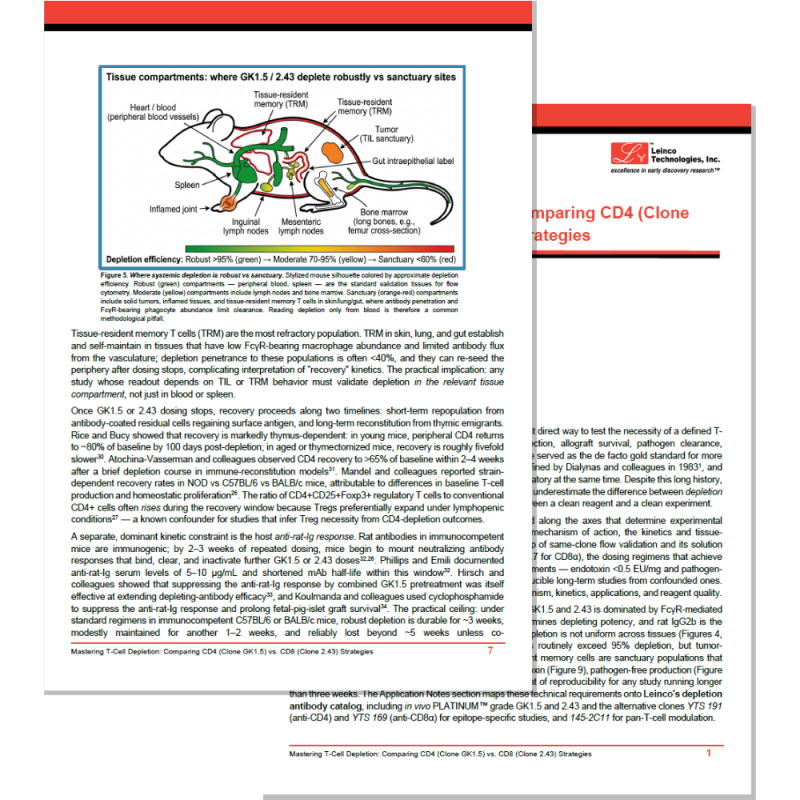
Depletion efficiency is highly heterogeneous across the body. While peripheral blood and spleen reliably achieve >95% depletion, solid tumors, inflamed tissues, and tissue-resident memory (TRM) populations act as “sanctuary sites” with limited antibody penetration, demanding rigorous, compartment-specific validation.
Endotoxin and Reagent Purity
Trace endotoxin (LPS) contamination triggers non-specific immune activation via the TLR4 pathway, overlaying any specific experimental intervention and skewing results. Applying strict in vivo-grade specifications (below 0.5 EU/mg) ensures LPS exposure remains below the threshold for macrophage and dendritic cell activation.
Application matrix — when to use CD4 vs CD8 depletion.
| Tumor Models | Transplant Rejection | Infection/Parasite | |
|---|---|---|---|
| GK1.5 (CD4 Depletion) |
![GK1.8 Tumor Models [MIXED] - Loss of help, impaired CD8 priming. Some models: paradoxical Treg-debulking benefit.](https://www.leinco.com/wp-content/uploads/2026/06/Figure-8-GK1_8-TumorModels.jpg) Loss of help, impaired CD8 priming. Some models: paradoxical Treg-debulking benefit. |
![GK1.8 [BENEFICIAL] - transplant rejection - Prolonged allograft survival; Tolerance protocols.](https://www.leinco.com/wp-content/uploads/2026/06/Figure-8-GK1_8-transplant-rejection.jpg) Prolonged allograft survival; Tolerance protocols. |
![GK1.8 [MIXED] - Infection Parasite - Variable: BALB/c Leishmania CURED (Th2 removal). Toxoplasma worsened.](https://www.leinco.com/wp-content/uploads/2026/06/Figure-8-GK1_8-InfectionParasite.jpg) Variable: BALB/c Leishmania CURED (Th2 removal). Toxoplasma worsened. |
| 2.43 (CD8 Depletion) |
![2.43 - Tumor Models [DETRIMENTAL]- Ablate ICI efficacy and tumor rejection. CD8 = effector necessity.](https://www.leinco.com/wp-content/uploads/2026/06/Figure-8-2.43-TumorModels.jpg) Ablates ICI efficacy and tumor rejection. CD8 = effector necessity. |
![2.43 - transplant rejection [BENEFICIAL] - Effective in MHC-I mismatched models; combine with CD4 for tolerance.](https://www.leinco.com/wp-content/uploads/2026/06/Figure-8-2.43-transplant-rejection.jpg) Effective in MHC-I mismatched models; combine with CD4 for tolerance. |
![2.43 - Infection Parasite [DETRIMENTAL]- Loss of viral clearance (LCMV, SIV); CD4-dependent infections preserved.](https://www.leinco.com/wp-content/uploads/2026/06/Figure-8-2.43-InfectionParasite.jpg) Loss of viral clearance (LCMV, SIV); CD4-dependent infections preserved. |