

Anti-FPR1/FPR2 [Clone NFPR1]


Anti-FPR1/FPR2 [Clone NFPR1]
Product No.: 30107
Data
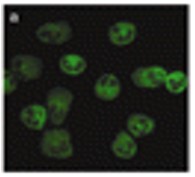 Immunofluorescence: use at 10ug/ml. Methanol-fixed human neutrophils stained with #30107. See Riesselman M. et al (below) for details.
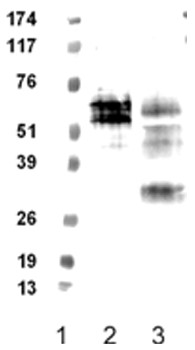 Immunoblotting: use at 1-5ug/ml. Alkali-stripped membranes from rFPR-expressing CHO cells (lane 2) and degranulated human neutrophils (lane 3) blotted with #30107. See Riesselman M. et al (below) for details.
 - -
- -
Antibody DetailsProduct DetailsReactive Species Human Host Species Mouse Immunogen His-tagged recombinant FPR1 (human neutrophil N-formyl peptide receptor 1) expressed in and purified from Sf9 cells. Product Concentration Lot Specific Formulation This monoclonal antibody is formulated in phosphate buffered saline (PBS) pH 7.2 - 7.4 with no carrier protein or preservatives added. State of Matter Liquid Product Preparation Antibodies are purified by a multi-step process including the use of protein A or G to assure extremely low levels of endotoxins, leachable protein A or aggregates. Storage and Handling This antibody is stable for at least one (1) year at -20°C to -70°C. Store product in appropriate aliquots to avoid multiple freeze-thaw cycles. Country of Origin USA Shipping Next Day 2-8°C Applications and Recommended Usage? Quality Tested by Leinco Immunoblotting: use at 1-5ug/mL.
Immunofluorescence: use at 10ug/mL. These are recommended concentrations. Enduser should determine optimal concentrations for their application. Each investigator should determine their own optimal working dilution for specific applications. See directions on lot specific datasheets, as information may periodically change. DescriptionDescriptionSpecificity This antibody recognizes human FPR1 at aa 305-GQDFRERLI-313 at the amino-terminal portion of the carboxyl-terminal tail. It also recognizes the same epitope in FPR2. Background Formyl peptide receptors (FPR) are G protein-coupled receptors that are activated by different agonists included N- formylated peptides originating from bacteria and mitochondria. In humans, the FPR family includes the high affinity FPR1, the low affinity FPR2/ALX (previously known as FPRL1 or ALX) and FPR3. Human FPR1 is important for phagocyte chemotaxis, superoxide production, and degranulation, and helps direct phagocytes to sites of infection. Functional FPR1expression has been demonstrated on fibroblasts, bone marrow mesenchymal stem cells, A549 lung cells, HEP-G2 hepatoma cells, and on several types of epithelial cells. Function High affinity receptor for N-formyl-methionyl peptides (fMLP), which are powerful neutrophil chemotactic factors (PubMed:2161213, PubMed:2176894, PubMed:10514456, PubMed:15153520). Binding of fMLP to the receptor stimulates intracellular calcium mobilization and superoxide anion release (PubMed:2161213, PubMed:1712023, PubMed:15153520, PubMed:15210802). This response is mediated via a G-protein that activates a phosphatidylinositol-calcium sPubMed:10514456, PubMed:15153520, PubMed:2161213, PubMed:2176894, PubMed:25109685, PubMed:10514456, PubMed:1712023, PubMed:2161213, PubMed:2176894}. NCBI Gene Bank ID UniProt.org Research Area Growth Factors, Cytokines, Receptors References & CitationsRiesselman M et al. 2007 J Immunol 179: 2520-2531. Maaty WS et al. 2013 J Biol Chem 288: 27042-27058. Technical ProtocolsIF  Certificate of Analysis |
Formats Available
 Products are for research use only. Not for use in diagnostic or therapeutic procedures.
