

Anti-GABARAP Antibody (56568)


Anti-GABARAP Antibody (56568)
Product No.: 56568
Data
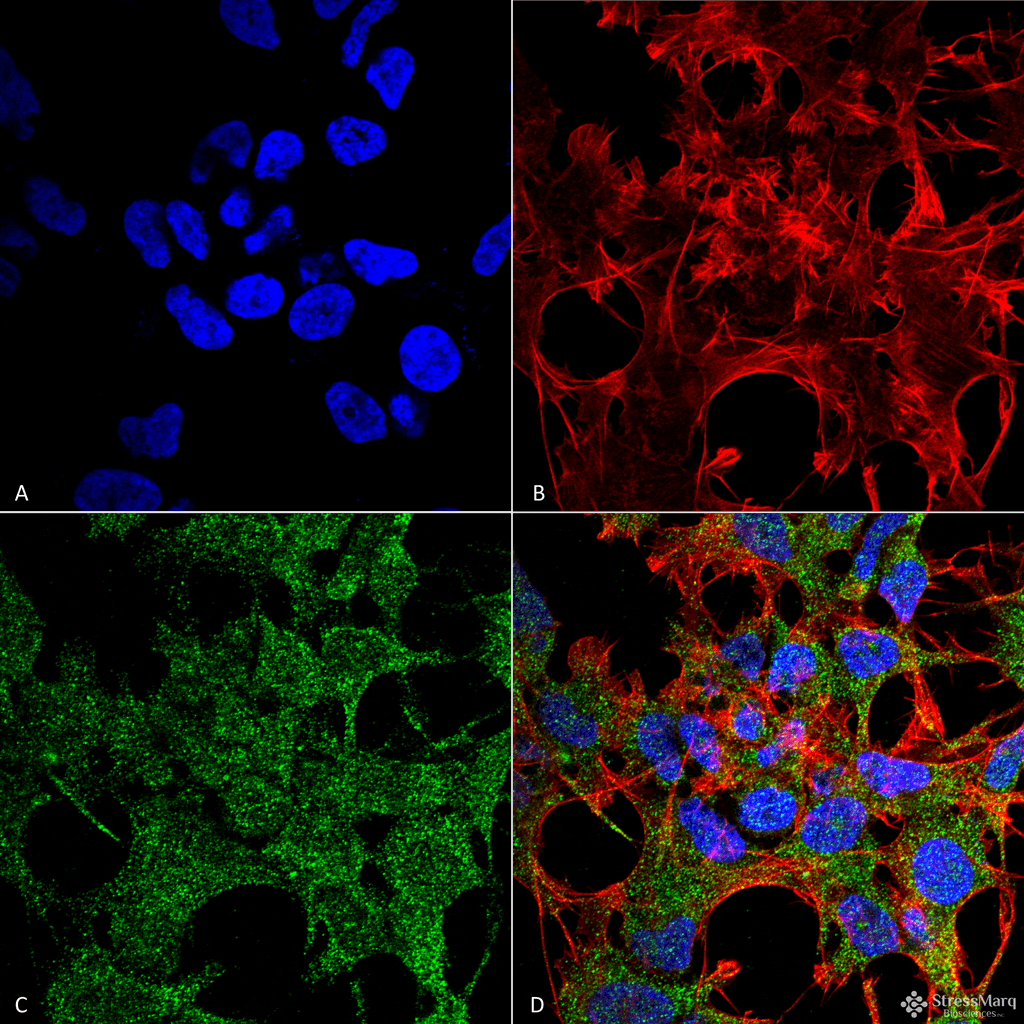 Immunocytochemistry/Immunofluorescence analysis using Rabbit Anti-GABARAP Polyclonal Antibody (56568). Tissue: Neuroblastoma cell line (SK-N-BE). Species: Human. Fixation: 4% Formaldehyde for 15 min at RT. Primary Antibody: Rabbit Anti-GABARAP Polyclonal Antibody (56568) at 1:100 for 60 min at RT. Secondary Antibody: Goat Anti-Rabbit ATTO 488 at 1:100 for 60 min at RT. Counterstain: Phalloidin Texas Red F-Actin stain; DAPI (blue) nuclear stain at 1:1000, 1:5000 for 60min RT, 5min RT. Localization: Endomembrane System, Cytoplasm, Golgi Apparatus Membrane, Cytoplasmic Vesicle. Magnification: 60X. (A) DAPI (blue) nuclear stain (B) Phalloidin Texas Red F-Actin stain (C) GABARAP Antibody (D) Composite.
 - -
- -
Antibody DetailsProduct DetailsReactive Species Human ⋅ Mouse Host Species Rabbit Immunogen Synthetic peptide corresponding to the N-terminus of human GABARAP Product Concentration 1.0 mg/ml Formulation PBS, pH 7.4, 50% glycerol, 0.09% sodium azide. State of Matter Liquid Product Preparation Purified by peptide immuno-affinity chromatography Storage and Handling This antibody is stable for at least one (1) year at -20°C. Regulatory Status For in vitro investigational use only. Not for
use in therapeutic or diagnostic procedures. Country of Origin USA Shipping Next Day 2-8°C Applications and Recommended Usage? Quality Tested by Leinco Immunoblotting: use at dilution of 1:1,000. A band of ~14-16kDa is detected.
Immunofluorescence: use at dilution of 1:100 These are recommended working dilutions. Endusers should determine optimal dilutions for their applications. Each investigator should determine their own optimal working dilution for specific applications. See directions on lot specific datasheets, as information may periodically change. DescriptionDescriptionSpecificity This antibody recognizes human and mouse GABARAP. Background Gamma-aminobutyric acid A receptors (GABA(A) receptors) are ligand-gated chloride channels that mediate inhibitory neurotransmission. This protein clusters neurotransmitter receptors by mediating interaction with the cytoskeleton. In addition, GABARAP has an important role in autophagy; it is crucial for autophagosome formation and sequestering cytosolic cargo into double-membrane vesicles which is then followed by degradation after fusion with lysosomes. Function Ubiquitin-like modifier that plays a role in intracellular transport of GABA(A) receptors and its interaction with the cytoskeleton (PubMed:9892355). Involved in autophagy: while LC3s are involved in elongation of the phagophore membrane, the GABARAP/GATE-16 subfamily is essential for a later stage in autophagosome maturation (PubMed:15169837, PubMed:20562859, PubMed:22948227). Through its interaction with the reticulophagy receptor TEX264, participates in the remodeling of subdomains of the endoplasmic reticulum into autophagosomes upon nutrient stress, which then fuse with lysosomes for endoplasmic reticulum turnover (PubMed:31006538). Also required for the local activation of the CUL3(KBTBD6/7) E3 ubiquitin ligase complex, regulating ubiquitination and degradation of TIAM1, a guanyl-nucleotide exchange factor (GEF) that activates RAC1 and downstream signal transduction (PubMed:25684205). Thereby, regulates different biological processes including the organization of the cytoskeleton, cell migration and proliferation (PubMed:25684205). Involved in apoptosis (PubMed:15977068). {PubMed:15169837, PubMed:15977068, PubMed:20562859, PubMed:22948227, PubMed:25684205, PubMed:31006538, PubMed:9892355}. NCBI Gene Bank ID UniProt.org Research Area Neuroscience References & CitationsTechnical ProtocolsICC IF  Certificate of Analysis |
 Products are for research use only. Not for use in diagnostic or therapeutic procedures.
