

Anti-Human RAD50 [Clone CPTC-RAD50-1] – Purified No Carrier Protein


Anti-Human RAD50 [Clone CPTC-RAD50-1] – Purified No Carrier Protein
Product No.: LTCC001
- -
- -
Clone SAIC-113-5-4 Target Rad50 Formats AvailableView All Product Type Monoclonal Antibody Alternate Names RAD50 Homolog, DNA Repair Protein RAD50, NBSLD, HRad50, HRAD50, RAD502 Isotype Rabbit IgG Applications IF , WB , immuno-MRM |
Data
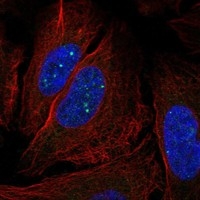 Immunofluorescent staining of human cell line U2OS
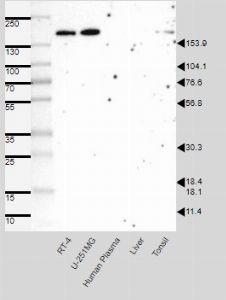 Western Blot Validation of Anti-RAD50 Monoclonal Antibody
 - -
- -
Antibody DetailsProduct DetailsReactive Species Human Immunogen Synthetic peptide mapping to the human RAD50 sequence containing the phosphorylated Serine 635 residue: LFDVC*G(pS)QDFESDLDR
Purity <95% by SDS Page Formulation This monoclonal antibody is aseptically packaged and formulated in 0.01 M phosphate buffered saline (150 mM NaCl) PBS pH 7.2 - 7.4 with no carrier protein, potassium, calcium or preservatives added. Due to inherent biochemical properties of antibodies, certain products may be prone to precipitation over time. Precipitation may be removed by aseptic centrifugation and/or filtration. Product Preparation Leinco's recombinant antibodies are manufactured in an animal free facility using only in vitro protein free cell culture techniques and are purified by a multi-step process including the use of protein A or G to assure extremely low levels of endotoxins, leachable protein A or aggregates. Derived from a rabbit host, this monoclonal antibody offers superior binding affinity, higher sensitivity, and lower background noise compared to traditional mouse monoclonals or polyclonals. This ensures clean, highly reproducible data across demanding quantitative multiplex assays, Western Blots, and immunofluorescence workflows. Country of Origin USA Applications and Recommended Usage? Quality Tested by Leinco Validated Applications and Performance Data This rabbit monoclonal IgG clone has been rigorously characterized and validated through international proteomic and cancer research initiatives (including CPTAC and the Human Protein Atlas): Western Blot (WB): Validated at a recommended dilution of 1:500. It demonstrates high specificity, displaying a clean, single band corresponding to the predicted molecular weight (+/-20%) in standard cell and tissue lysates. Immunofluorescence (IF): Validated at a 1:200 dilution in human cell lines (such as U2OS and THP-1 fixed with PFA). Confocal imaging reveals distinct localization to nuclear bodies, consistent with active DNA repair sites. Immuno-MRM (iMRM): Strongly positive validation for mass spectrometry-based assays. Highly optimized for multiplexed, targeted quantitative proteomics to measure real-time phosphosignaling fluctuations in the DDR pathway. Each investigator should determine their own optimal working dilution for specific applications. See directions on lot specific datasheets, as information may periodically change. DescriptionBackground Anti-Human Phospho-RAD50 (Ser635) Rabbit Monoclonal AntibodyOur premium Rabbit Monoclonal Antibody targets human RAD50 (RAD50 Double Strand Break Repair Protein), specifically recognizing the endogenous phosphorylated Serine 635 (pS635) site. RAD50 is a vital protein-coding gene essential for genomic stability, cell growth, and cellular viability. As a core component of the evolutionarily conserved MRN complex (comprising RAD50, MRE11, and NBS1), the RAD50 protein plays a central, upstream role in the DNA Damage Response (DDR) pathway. Upon DNA damage, phosphorylation at critical residues like Ser635 acts as a molecular switch for downstream signaling, making this phospho-specific antibody an indispensable tool for robustly quantifying phosphosignaling dynamics in cancer and molecular biology research. Key Functions of RAD50 in the MRN Complex The RAD50 protein cooperates closely with MRE11 and NBS1 to bind DNA ends and maintain structural integrity during repair. Its primary biological pathways include: * DNA Double-Strand Break (DSB) Repair:RAD50 acts as a molecular bridge, holding DNA ends in close proximity. This facilitates nonhomologous end joining (NHEJ) and homologous recombination by allowing the cell to search for sequence homology. * Regulation of Nuclease Activity: It stimulates DNA ligase activity while strictly regulating the 3'-5' exonuclease and endonuclease activities of MRE11, preventing excessive nucleolytic degradation. * DNA Damage Signaling & ATM Kinase Activation: The MRN complex is strictly required for triggering upstream activation of the ATM kinase, a critical regulator of cell cycle checkpoint activation. * Telomere Maintenance & Meiosis: Within telomeres, the MRN complex modulates t-loop formation to maintain telomere integrity. It is also essential for meiotic recombination and the resolution of D-loop structures via Synthesis-Dependent Strand Annealing (SDSA). Clinical Relevance: RAD50 in DiseaseBecause RAD50 is fundamental to DNA repair and cell cycle control, aberrations in its pathway are heavily implicated in oncology and genetic diseases: - Nijmegen Breakage Syndrome-Like Disorder (NBSLD): Mutations or disruptions in the RAD50 gene are a direct cause of this rare genomic instability disorder, characterized by microcephaly and immunodeficiency. - Tumor Biology: Dysregulation of the MRN complex and ATM-dependent checkpoint signaling is a hallmark of various cancers, making the tracking of RAD50 phosphorylation critical for oncology therapeutics and DNA repair inhibitor studies. Function RAD50 is a core component of the MRN complex, acting as a critical structural scaffold and sensor that tethers broken DNA ends together to initiate double-strand break repair. Through this mechanical bridging, it coordinates essential genomic stability pathways, including homologous recombination, DNA damage checkpoint signaling, and telomere maintenance. Research Area Immuno-Oncology . Immunology . DNA/RNA Damage . Epigenetics References & Citations1. Product Specific Citation (Clone CPTC-RAD50-1): Kennedy, J. J., et al. (2018). A Multiplexed Mass Spectrometry-Based Assay for Robust Quantification of Phosphosignaling in Response to DNA Damage. Molecular & Cellular Proteomics, 17(5), 1018–1029. PMID: 29474155 | PMCID: PMC5939939 2. Discovery of the Ser635 Phosphorylation Site: Gatei, M., et al. (2011). ATM Protein-dependent Phosphorylation of Rad50 Protein Regulates DNA Repair and Cell Cycle Control. Journal of Biological Chemistry, 286(36), 31542-31556. PMID: 21730974 Technical ProtocolsIF  immuno-MRM Certificate of Analysis |
Formats Available
- -
- -
Prod No. | Description |
|---|---|
LTCC001 |
 Products are for research use only. Not for use in diagnostic or therapeutic procedures.
