

Anti-Mouse CD11α (LFA-1a) [Clone M17/4] — Purified in vivo GOLD™ Functional Grade
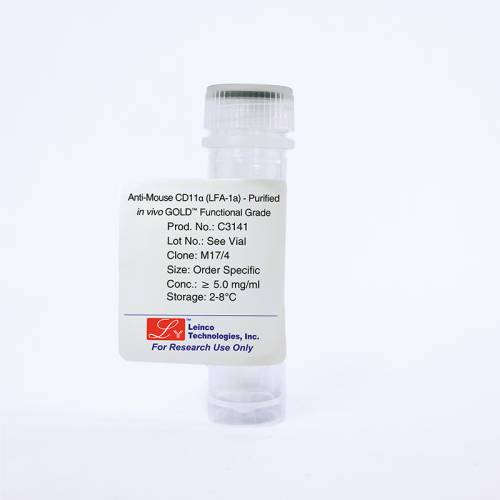

Anti-Mouse CD11α (LFA-1a) [Clone M17/4] — Purified in vivo GOLD™ Functional Grade
Product No.: C3141
- -
- -
Clone M17/4 Target CD11a Formats AvailableView All Product Type Hybridoma Monoclonal Antibody Alternate Names LFA-1 alpha, Ly-15, Integrin alpha L, Itgal Isotype Rat IgG2a κ Applications FC , IP , Blockade (in vitro/in vivo) , IHC-F |
- -
- -
Antibody DetailsProduct DetailsReactive Species Mouse Host Species Rat Recommended Dilution Buffer Immunogen C57BL/6 mouse cytotoxic T-cell line T8000 Product Concentration ≥ 5.0 mg/ml Endotoxin Level < 1.0 EU/mg as determined by the LAL method Purity ≥95% monomer by analytical SEC ⋅ >95% by SDS Page Formulation This monoclonal antibody is aseptically packaged and formulated in 0.01 M phosphate buffered saline (150 mM NaCl) PBS pH 7.2 - 7.4 with no carrier protein, potassium, calcium or preservatives added. Due to inherent biochemical properties of antibodies, certain products may be prone to precipitation over time. Precipitation may be removed by aseptic centrifugation and/or filtration. State of Matter Liquid Product Preparation Functional grade preclinical antibodies are manufactured in an animal free facility using only in vitro protein free cell culture techniques and are purified by a multi-step process including the use of protein A or G to assure extremely low levels of endotoxins, leachable protein A or aggregates. Storage and Handling Functional grade preclinical antibodies may be stored sterile as received at 2-8°C for up to one month. For longer term storage, aseptically aliquot in working volumes without diluting and store at ≤ -70°C. Avoid Repeated Freeze Thaw Cycles. Regulatory Status Research Use Only Country of Origin USA Shipping 2 – 8° C Wet Ice Applications and Recommended Usage? Quality Tested by Leinco Blockade (in vitro/in vivo), IHC-F, IP, FC Each investigator should determine their own optimal working dilution for specific applications. See directions on lot specific datasheets, as information may periodically change. DescriptionDescriptionSpecificity Activity is directed against mouse CD11a, a 180 kDa type I transmembrane glycoprotein also known as the integrin alpha L chain1,3. Clone M17/4 specifically recognizes an epitope on the extracellular domain of the CD11a subunit1. This subunit non-covalently associates with the CD18 (integrin beta 2) chain to form the heterodimeric Lymphocyte Function-associated Antigen-1 (LFA-1)2,3.
Background LFA-1 (CD11a/CD18) is a critical adhesion molecule belonging to the beta 2 integrin family3,4. It plays a fundamental role in leukocyte adhesion, trafficking, and the formation of the immunological synapse5,6. LFA-1 mediates firm adhesion of leukocytes to the vascular endothelium by binding to its primary ligands: Intercellular Adhesion Molecule-1 (ICAM-1/CD54), ICAM-2 (CD102), and ICAM-3 (CD50)5,6. This interaction is essential for the extravasation of immune cells into peripheral tissues during inflammatory responses5. Additionally, LFA-1 provides crucial co-stimulatory signals during T cell activation by stabilizing the interaction between the T cell receptor (TCR) and the peptide-MHC complex on antigen-presenting cells6. Clone M17/4 is widely recognized for its potent neutralizing and blocking capabilities1. It is a standard tool in functional bioassays to inhibit LFA-1-mediated cellular adhesion and to study the recruitment of leukocytes in models of infection, autoimmunity, and allograft rejection. Because it targets a monomorphic epitope, M17/4 is highly effective across various mouse strains1,3. Antigen Distribution CD11a is expressed on the surface of all leukocytes, including T and B lymphocytes, monocytes, macrophages, neutrophils, and natural killer (NK) cells2,3,5. Its expression levels can vary significantly depending on the activation state of the cell5,6. Ligand/Receptor ICAM-1 (CD54), ICAM-2 (CD102), ICAM-3 (CD50) NCBI Gene Bank ID UniProt.org Research Area Cell Adhesion . Immunology . Inflammation References & Citations1. Sanchez-Madrid F, et al. Antigens Involved in Mouse Cytolytic T-Lymphocyte (CTL)-Mediated Killing: Functional Screening and Topographic Relationship. Cellular Immunology. 73:1-11. 1982. 2. Davignon D, et al. Monoclonal antibody to a novel lymphocyte function-associated antigen (LFA-1): mechanism of blocking of T lymphocyte-mediated killing and effects on other T and B lymphocyte functions. Journal of Immunology. 127(2):590-595. 1981. 3. Springer TA, et al. LFA-1 and Lyt-2,3, molecules associated with T lymphocyte-mediated killing; and Mac-1, an LFA-1 homologue associated with complement receptor function. Immunological Reviews. 68:171-195. 1982. 4. Hynes RO. Integrins: versatility, modulation, and signaling in cell adhesion. Cell. 69(1):11-25. 1992. 5. Springer TA. Adhesion receptors of the immune system. Nature. 346(6283):425-434. 1990. 6. Dustin ML, Springer TA. T-cell receptor cross-linking transiently stimulates antigen-specific adherence measured by LFA-1-ICAM-1 interaction. Nature. 341(6243):619-624. 1989. Technical Protocols  Blockade (in vitro/in vivo) IHC-F Certificate of Analysis |
Formats Available
- -
- -
Prod No. | Description |
|---|---|
C3143 | |
C3146 | |
C3147 | |
C3151 | |
C3152 | |
C3154 | |
C3141 | |
C3153 | |
C3142 | |
C3144 |
 Products are for research use only. Not for use in diagnostic or therapeutic procedures.
