

Recombinant Mouse GM-CSF


Recombinant Mouse GM-CSF
Product No.: G128
[product_table name="All Top" skus="G128"]
| Alternate Names Granulocyte Macrophage Colony Stimulating Factor, CSF-2, MGI-1GM, Pluripoietin-Alpha Product Type Recombinant Protein Expression Host E. coli Cells Species Mouse |
| Select Product Size | Qty Max: Min: 1 Step: 1 Select A Size |
Data
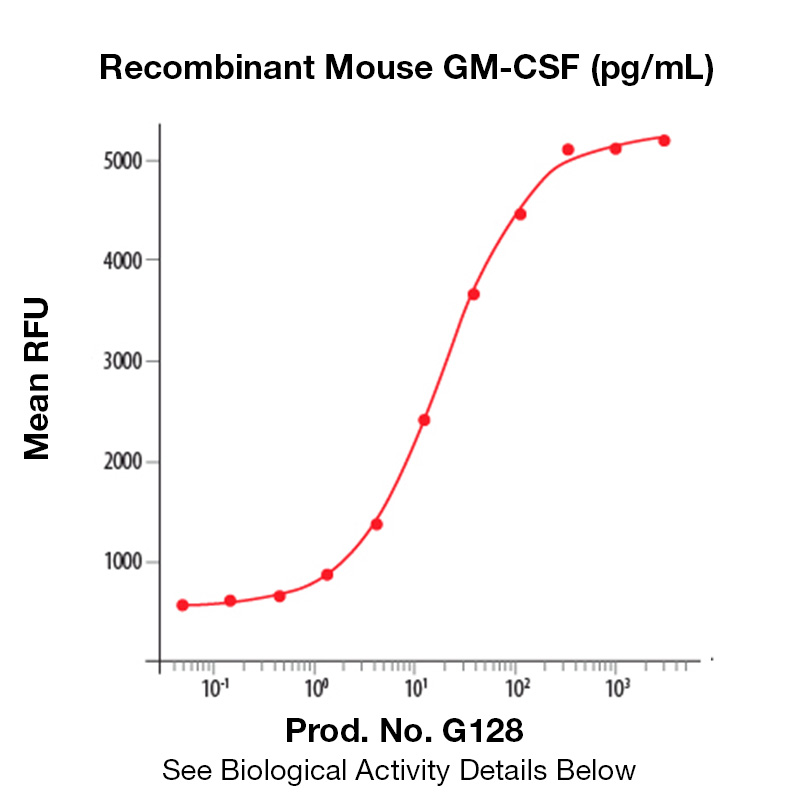
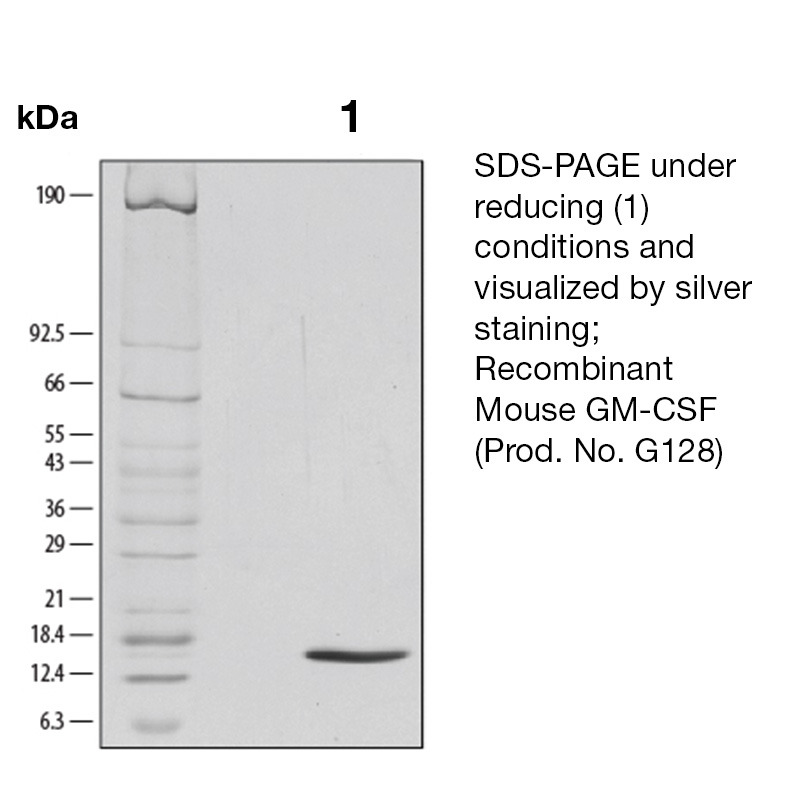
BackgroundGranulocyte-Macrophage Colony Stimulating Factor is a 22 kD, pleiotropic cytokine that is a white blood cell growth factor. It controls the production and function of blood cells by stimulating stem cells to produce granulocytes and monocytes. GM-CSF differs from G-CSF in that it affects more cell types including macrophages and eosinophils. Moreover, GM-CSF is part of the immune/inflammatory cascade, a process crucial for fighting infection. Interestingly, GM-CSF expression may have pathological implications. Autocrine expression of GM-CSF in myeloid leukemia cells is suspected to play a role in neoplasia, the formation of a new and abnormal growth of tissue. Additionally, GM-CSF expression has also been documented in certain solid tumors. There have also been reports of GM-CSF in synovial fluid from patients with arthritis suggesting that GM-CSF may play a role in tissue damage associated with the inflammatory process. Blocking GM-CSF is thought to have therapeutic potential by reducing inflammation. Some drugs are currently being developed to block GM-CSF. Protein DetailsPurity >97% by SDS-PAGE and analyzed by silver stain. Endotoxin Level <1.0 EU/µg as determined by the LAL method Biological Activity The biological activity of Mouse GM-CSF was determined by proliferation of the factor-dependent murine cell line, DA-3 (Ihle, J.N. et al., 1984, Advances in Viral Oncology, G. Klein, ed. Raven Press, New York, NY. 4:95 - 137). The expected ED<sub>50</sub> is 10 - 60 pg/ml. Protein Accession No. Amino Acid Sequence ptrspitvtr pwkhveaike alnllddmpv tlneevevvs nefsfkkltc vqtrlkifeq glrgnftklk galnmtasyy qtycpptpet dcetqvttya dfidslktfl tdipfeckkp vqk
N-terminal Sequence Analysis Met State of Matter Lyophilized Predicted Molecular Mass The predicted molecular weight of Recombinant Mouse GM-CSF is Mr 14.3 kDa. However, the actual molecular weight as observed by migration on SDS-PAGE is 14 kDa (reducing conditions). Predicted Molecular Mass 14.3 Formulation This recombinant protein was 0.2 µm filtered and lyophilized from modified Dulbecco’s phosphate buffered saline (1X PBS) pH 7.2 – 7.4 with no calcium, magnesium, or preservatives. Storage and Stability This lyophilized protein is stable for six to twelve months when stored desiccated at -20°C to -70°C. After aseptic reconstitution, this protein may be stored at 2°C to 8°C for one month or at -20°C to -70°C in a manual defrost freezer. Avoid Repeated Freeze Thaw Cycles. See Product Insert for exact lot specific storage instructions. Country of Origin USA Shipping Next Day Ambient NCBI Gene Bank Leinco Protein AdvisorPowered by AI: AI is experimental and still learning how to provide the best assistance. It may occasionally generate incorrect or incomplete responses. Please do not rely solely on its recommendations when making purchasing decisions or designing experiments. Recombinant Mouse GM-CSF (Granulocyte-Macrophage Colony-Stimulating Factor) is a valuable tool for a wide range of research applications due to its critical roles in hematopoiesis, immune modulation, and inflammation. Here are key reasons why you should consider using recombinant mouse GM-CSF in your research: 1. Regulation of Myeloid Cell Development
2. Immune System Activation and Modulation
3. Therapeutic and Disease Modeling Applications
4. Adjuvant and Vaccine Studies
5. High Biological Activity and Reliability
6. Versatile Experimental Use
7. Relevance to Human Disease
In summary, recombinant mouse GM-CSF is a powerful cytokine for studying immune cell biology, host defense, and therapeutic interventions, offering both versatility and biological relevance in research settings. Yes, recombinant mouse GM-CSF is widely used as a standard for quantification or calibration in ELISA assays. Recombinant mouse GM-CSF is specifically formulated and validated for use as an ELISA standard, allowing for accurate quantification of GM-CSF in biological samples. ELISA kits and protocols routinely use recombinant GM-CSF to generate standard curves, which are essential for determining the concentration of GM-CSF in unknown samples. The recombinant protein is typically reconstituted in phosphate-buffered saline (PBS) containing a carrier protein such as bovine serum albumin (BSA) at a concentration of at least 0.1% to ensure stability and reproducibility. Key considerations for using recombinant mouse GM-CSF as an ELISA standard:
Limitations and Best Practices:
In summary, recombinant mouse GM-CSF is an established and reliable standard for ELISA quantification, provided it is handled and prepared according to best laboratory practices. Recombinant Mouse GM-CSF has been validated for a wide range of applications in published research, primarily in immunology, cell biology, and disease modeling. The most common validated applications include:
Additional validated uses:
Summary Table of Key Applications
These applications are supported by hundreds of peer-reviewed publications, demonstrating the versatility and reliability of recombinant mouse GM-CSF in both basic and translational research contexts. Reconstitution ProtocolReconstitute the lyophilized recombinant mouse GM-CSF protein by adding sterile, distilled water or sterile phosphate-buffered saline (PBS) to achieve a concentration of 0.1–1.0 mg/mL, with 100 μg/mL being a standard working concentration. Before opening the vial, centrifuge it briefly to bring the contents to the bottom. When reconstituting, gently pipette the solution down the sides of the vial rather than vortexing, as vigorous mixing can denature the protein. Carrier Protein AdditionFor enhanced stability, particularly during storage and dilution, add a carrier protein to your reconstitution solution. Bovine Serum Albumin (BSA) or human serum albumin (HSA) are the standard choices, with a minimum concentration of 0.1% in the final solution. If your experiments involve bovine-derived materials, consider using an alternative carrier protein such as equine serum albumin to avoid cross-reactivity. Alternatively, you can reconstitute the protein directly in complete cell culture medium containing serum, which provides both carrier protein and appropriate osmolarity for cell culture applications. Storage and StabilityStore the lyophilized protein at ≤ –20°C, where it remains stable for 6–12 months when kept desiccated. Once reconstituted, follow these storage guidelines:
To prevent loss of potency, aliquot the reconstituted protein into working portions and avoid repeated freeze-thaw cycles by using a manual defrost freezer. Preparation for Cell CultureWhen preparing the protein for direct cell culture stimulation, you can reconstitute it in your complete cell culture medium rather than in PBS/BSA solution. This approach simplifies handling and ensures the protein is in the appropriate osmotic environment for your cells. Stock solutions can be prepared at 50–100 μg/mL in sterile buffer with 0.2–1% carrier protein, then further diluted as needed for your specific experimental requirements. The recombinant mouse GM-CSF protein has a molecular weight of approximately 14 kDa and demonstrates high purity (>95%) with bioactivity typically showing an ED₅₀ of 5–30 pg/mL for stimulating myeloid cell proliferation. References & Citations1. Parker, MW. et al. (2008) Cell 134: 496 2. Whitsett, JA. et al. (2002) Annual Review of Physiology 64: 775 Certificate of AnalysisIMPORTANT Use lot specific datasheet for all technical information pertaining to this recombinant protein. |
Related Products
Prod No. | Description |
|---|---|
| G665 | |
| G675 | |
| G596 | |
| G128 | |
| G117 | |
| G672 | |
| G681 | |
| G119 | |
| G124 | |
| G142 | |
| G143 | |
| G691 |
 Products are for research use only. Not for use in diagnostic or therapeutic procedures.
