

Anti-Lassa Virus, Nucleoprotein [Clone 1LV15] — Purified No Carrier Protein


Anti-Lassa Virus, Nucleoprotein [Clone 1LV15] — Purified No Carrier Protein
Product No.: L350
- -
- -
Clone 1LV15 Target Lassa Virus Formats AvailableView All Product Type Hybridoma Monoclonal Antibody Alternate Names Lassa, LASV, Lassa hemorrhagic fever, Lassa fever virus Isotype Mouse IgG1 κ Applications ELISA , Lateral Flow , WB |
Data
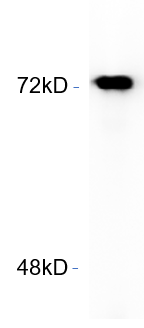 Western Blot:
1LV15 against gamma-irradiated Lassa virus.
- -
- -
Antibody DetailsProduct DetailsReactive Species Lassa Virus Host Species Mouse Product Concentration ≥1.0 mg/ml Purity ≥90% Formulation This monoclonal antibody is aseptically packaged and formulated in 0.01 M phosphate buffered saline (150 mM NaCl) PBS pH 7.2 - 7.4 with no carrier protein, potassium, calcium or preservatives added. State of Matter Liquid Product Preparation Purified antibodies are manufactured in an animal free facility using only in vitro protein free cell culture techniques and are purified by a multi-step process including the use of protein A or G to assure extremely low levels of endotoxins, leachable protein A or aggregates. Storage and Handling This antibody may be stored sterile as received at 2-8°C for up to one month. For longer term storage, aseptically aliquot in working volumes without diluting and store at ≤ -70°C. Avoid Repeated Freeze Thaw Cycles. Regulatory Status Research Use Only Country of Origin USA Shipping 2-8°C Wet Ice Applications and Recommended Usage? Quality Tested by Leinco ELISA, WB Additional Applications Reported In Literature ? Lateral Flow Each investigator should determine their own optimal working dilution for specific applications. See directions on lot specific datasheets, as information may periodically change. DescriptionDescriptionSpecificity Anti-Lassa Virus (Clone 1LV15) is specific for the Nucleoprotein of Lassa Virus (Josiah) and whole virions. The Lassa virus nucleoprotein (NP) is a highly conserved structural protein that encapsidates the viral RNA genome and is essential for replication, transcription, and assembly of the virus, making it a prime target for diagnostic assays and antiviral research. As a result, monoclonal antibodies specific for Lassa NP are widely used as raw materials in ELISA, lateral flow, and other immunoassay formats for sensitive detection of Lassa virus antigens in clinical and environmental samples. Background Lassa fever and public health impact Lassa virus is an arenavirus that causes Lassa fever, an acute viral hemorrhagic disease endemic to West Africa, with the highest burden reported in Nigeria, Sierra Leone, Liberia, and parts of Guinea. Millions of infections and thousands of deaths are estimated to occur annually, with overall infection fatality around 1–2%, but case fatality rates in hospitalized patients often ranging from 15% to over 20%, and even higher in high‑risk groups such as pregnant women. Human infection typically occurs through exposure to excreta of infected Mastomys rodents or via contaminated food and household environments, with increasing recognition of transmission in peri‑urban as well as rural settings. Person‑to‑person spread can occur through contact with blood or bodily fluids, leading to healthcare‑associated outbreaks and underscoring the need for rapid, reliable laboratory diagnosis. Clinical presentation and need for early diagnosis Early Lassa fever often presents as a nonspecific febrile illness with symptoms that overlap malaria, typhoid, and other endemic infections, which complicates clinical diagnosis in resource‑limited settings. As disease progresses, patients can develop bleeding, shock, multi‑organ failure, and neurological complications, and outcomes improve significantly when antiviral therapy such as ribavirin is initiated early in the course of illness. Because of this narrow therapeutic window, frontline laboratories rely heavily on antigen‑detection ELISAs, lateral flow assays, and RT‑PCR to confirm Lassa virus infection during the acute phase, when viral load and NP antigenemia are highest. High‑quality monoclonal antibodies to NP are therefore critical components of these assays, enabling sensitive detection of circulating virus before a robust antibody response has developed. Role and properties of Lassa virus nucleoprotein The Lassa virus NP encapsidates the viral negative‑sense RNA and, together with the L polymerase, forms the ribonucleoprotein complex that is the minimal unit required for genome replication and transcription. Structural studies show that NP contains an N‑terminal domain that binds capped RNA, supporting “cap‑snatching” mechanisms for viral mRNA synthesis, and a C‑terminal 3′–5′ exoribonuclease domain that degrades immunostimulatory RNA species. This exoribonuclease activity allows NP to antagonize innate immune sensing pathways such as RIG‑I, dampening interferon production and contributing to viral immune evasion and pathogenesis. Because NP is abundantly expressed, relatively conserved across diverse Lassa virus lineages, and essential for both replication and immune modulation, it is a preferred antigen for diagnostic assay development and a focus of ongoing antiviral and vaccine research. NP as a diagnostic and research antigen NP‑based antigen‑capture ELISAs and immunochromatographic assays have been shown to detect Lassa virus across genetically diverse strains, reducing strain‑related variability compared with some nucleic acid–based methods. Recombinant NP and NP‑specific monoclonal antibodies are also widely used for detection of anti‑Lassa antibodies in serosurveys, for basic virology studies, and as critical raw materials in IVD assay development for Category A viral hemorrhagic fever agents. By targeting a conserved, high‑copy viral protein that appears early in infection, NP‑specific reagents help enable earlier case identification, improved patient management, and better surveillance of Lassa fever in endemic and emerging regions. Research Area Category A Pathogens . Infectious Disease . Matched Pair . Viral . IVD Raw Material References & Citations1. Centers for Disease Control and Prevention, National Center for Emerging and Zoonotic Infectious Diseases (NCEZID), Division of High-Consequence Pathogens and Pathology (DHCPP), Viral Special Pathogens Branch (VSPB). Link 2.) Qi X, Lan S, Wang W, Schelde LM, Dong H, Wallat GD, Ly H, Liang Y, Dong C. Cap binding and immune evasion revealed by Lassa nucleoprotein structure. Nature. 2010 Dec 9;468(7325):779-83. doi: 10.1038/nature09605. Epub 2010 Nov 17. PMID: 21085117; PMCID: PMC3057469. Technical Protocols Lateral Flow  Certificate of Analysis |
Formats Available
 Products are for research use only. Not for use in diagnostic or therapeutic procedures.
