

Anti-Mouse/Human/Rat Osteopontin [Clone 103D6] — Purified in vivo PLATINUM™ Functional Grade
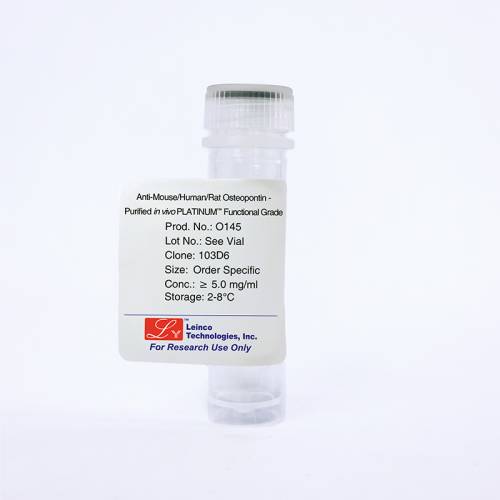

Anti-Mouse/Human/Rat Osteopontin [Clone 103D6] — Purified in vivo PLATINUM™ Functional Grade
Product No.: O145
- -
- -
Antibody DetailsProduct DetailsReactive Species Human ⋅ Mouse ⋅ Rat Host Species Mouse Recommended Dilution Buffer Immunogen Recombinant mouse OPN protein Product Concentration ≥ 5.0 mg/ml Endotoxin Level <0.5 EU/mg as determined by the LAL method Purity ≥98% monomer by analytical SEC ⋅ >95% by SDS Page Formulation This monoclonal antibody is aseptically packaged and formulated in 0.01 M phosphate buffered saline (150 mM NaCl) PBS pH 7.2 - 7.4 with no carrier protein, potassium, calcium or preservatives added. Due to inherent biochemical properties of antibodies, certain products may be prone to precipitation over time. Precipitation may be removed by aseptic centrifugation and/or filtration. State of Matter Liquid Product Preparation Functional grade preclinical antibodies are manufactured in an animal free facility using in vitro cell culture techniques and are purified by a multi-step process including the use of protein A or G to assure extremely low levels of endotoxins, leachable protein A or aggregates. Pathogen Testing To protect mouse colonies from infection by pathogens and to assure that experimental preclinical data is not affected by such pathogens, all of Leinco’s Purified Functional PLATINUM™ antibodies are tested and guaranteed to be negative for all pathogens in the IDEXX IMPACT I Mouse Profile. Storage and Handling Functional grade preclinical antibodies may be stored sterile as received at 2-8°C for up to one month. For longer term storage, aseptically aliquot in working volumes without diluting and store at ≤ -70°C. Avoid Repeated Freeze Thaw Cycles. Regulatory Status Research Use Only Country of Origin USA Shipping 2 – 8° C Wet Ice Applications and Recommended Usage? Quality Tested by Leinco ELISA Additional Applications Reported In Literature ? in vivo OPN neutralization, in vitro OPN Neutralization Each investigator should determine their own optimal working dilution for specific applications. See directions on lot specific datasheets, as information may periodically change. DescriptionDescriptionSpecificity 103D6 activity is directed against mouse, human, and rat osteopontin, also known as
secreted phosphoprotein 1 (SPP1). Background Osteopontin is a phosphorylated glycoprotein1 that regulates bone formation, bone tissue
remodeling, and promotes osteogenic differentiation of mesenchymal stem cells2. Osteopontin
also inhibits adipogenic differentiation, can induce angiogenesis, and promotes leukocyte
adhesion. Osteopontin performs its regulatory roles by interacting with integrins to activate
downstream signaling pathways. In cancer, increased levels of osteopontin are associated with
migration, invasion, and poor prognosis. Osteopontin promotes tumor development by activating
the PI3K/pAkt/NF-κB pathway when interacting with the αvβ3 integrin and can promote cancer
invasion when interacting with CD44. Osteopontin is thus a target for the development of cancer
treatments, including transcription and translation inhibitors as well as blockade by
immunotherapy. 103D6 was generated by immunizing C57BL/6 mice with recombinant osteopontin protein1. Mice with the highest osteopontin antibody titer, as determined by ELISA, were selected for spleen cell electro-fusion with SP2/0 myeloma cells. Fused cells were screened by ELISA with osteopontin protein and then by T cell proliferation rescue assay in anti-CD3/CD28/osteopontin- coated plates. 103D6 is a neutralizing antibody that inhibits colonic tumor growth in vivo and increases tumor- specific cytotoxic T lymphocyte effector function1. Antigen Distribution Osteopontin is a secreted protein found in bone that is also expressed
intracellularly in other tissues, including cardiac fibroblasts, dendritic cells, macrophages,
smooth muscle, endothelial cells, kidney, and brain. In cancer, osteopontin can also be expressed
in tumor cells, myeloid cells, and innate lymphoid cells. Additionally, osteopontin is elevated in
human cancer patient peripheral blood. Ligand/Receptor CD44 integrins (αVβ3) NCBI Gene Bank ID UniProt.org Research Area Cell Biology . Cell Motility/Cytoskeleton/Structure . Immunology . Signal Transduction . Apoptosis/Tumor Suppressors/Cell Death . Cancer Biomarker . Stem Cells References & Citations1 Klement JD, Poschel DB, Lu C, et al. Cancers (Basel). 13(5):1006. 2021. 2 Xu W, Bi Z, Lu L, et al. Oncol Rep. 54(5):136. 2025. Technical Protocols In Vitro and In Vivo Neutralization Certificate of Analysis |
Formats Available
 Products are for research use only. Not for use in diagnostic or therapeutic procedures.
