



Data
![BRCA1 antibody [17F8] - ChIP grade detects BRCA1 protein by western blot analysis. Various whole cell extracts (30 ug) were separated by 5% SDS-PAGE, and blotted with BRCA1 antibody [17F8] - ChIP grade (3301) diluted by 1:500. The HRP-conjugated anti-mouse IgG antibody was used to detect the primary antibody.](https://www.leinco.com/wp-content/uploads/2025/01/qed-bioscience-anti-brca1-antibody-3301-1.jpg) BRCA1 antibody [17F8] – ChIP grade detects BRCA1 protein by western blot analysis. Various whole cell extracts (30 ug) were separated by 5% SDS-PAGE, and blotted with BRCA1 antibody [17F8] – ChIP grade (3301) diluted by 1:500. The HRP-conjugated anti-mouse IgG antibody was used to detect the primary antibody.
BRCA1 antibody [17F8] – ChIP grade detects BRCA1 protein by western blot analysis. Various whole cell extracts (30 ug) were separated by 5% SDS-PAGE, and blotted with BRCA1 antibody [17F8] – ChIP grade (3301) diluted by 1:500. The HRP-conjugated anti-mouse IgG antibody was used to detect the primary antibody.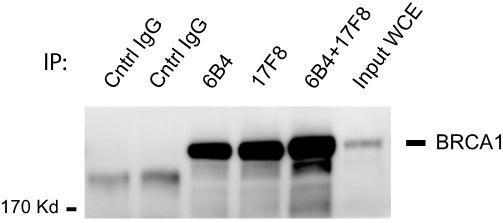 BRCA1 antibody 17F8 (3301) was used for IP-WB assay.
6B4 alone (4 microgram), 17F8 alone (4 microgram), 6B4 plus 17F8 (2 microgram each), and mouse control normal IgG were used in an immunoprecipitation assay with MCF7 cell extract.
Immunoprecipitated BRCA1 was detected in WB using BRCA1 antibody 6B4 at 1:1000 dilution.
BRCA1 antibody 17F8 (3301) was used for IP-WB assay.
6B4 alone (4 microgram), 17F8 alone (4 microgram), 6B4 plus 17F8 (2 microgram each), and mouse control normal IgG were used in an immunoprecipitation assay with MCF7 cell extract.
Immunoprecipitated BRCA1 was detected in WB using BRCA1 antibody 6B4 at 1:1000 dilution.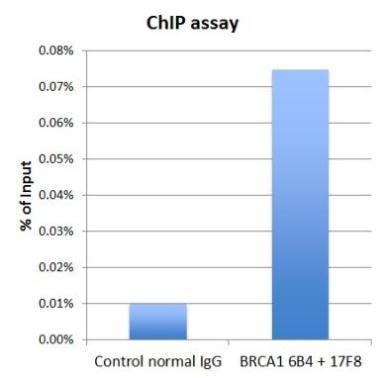 BRCA1 antibody 17F8 (3301) were used for ChIP assay.
The 6B4 and 17F8 mixture (3 microgram each), or normal mouse IgG (6 microgram) were incubated with HeLa chromatin extract (100 umicrogram each) in the ChIP assay.
Enrichment of genomic DNA on a BRCA1 target gene promoter (HMGA2) was validated by a Q-PCR assay.
BRCA1 antibody 17F8 (3301) were used for ChIP assay.
The 6B4 and 17F8 mixture (3 microgram each), or normal mouse IgG (6 microgram) were incubated with HeLa chromatin extract (100 umicrogram each) in the ChIP assay.
Enrichment of genomic DNA on a BRCA1 target gene promoter (HMGA2) was validated by a Q-PCR assay. - -
- -
Antibody DetailsProduct DetailsReactive Species Human Host Species Mouse Immunogen GST fusion protein expressed in E. coli corresponding to aa 341-748 of full-length BRCA1. Product Concentration Lot Specific Formulation PBS, pH 7.4 State of Matter Liquid Product Preparation Purified by Protein G affinity chromatography Storage and Handling This antibody is stable for at least one (1) year at -70°C. Avoid multiple freeze- thaw cycles. Regulatory Status Research Use Only Country of Origin USA Shipping Next Day 2-8°C Applications and Recommended Usage? Quality Tested by Leinco Immunoblotting: use at 1-10 ug/mL.
Immunoprecipitation: use at 1-10 ug/mL. Positive controls: Any normal human tissue, especially those containing rapidly proliferating cells, such as lymphoid germinal centers. Each investigator should determine their own optimal working dilution for specific applications. See directions on lot specific datasheets, as information may periodically change. DescriptionSpecificity This antibody recognizes full-length BRCA1, a 220 kD nuclear phosphoprotein. In a high proportion of breast and ovarian cancer cell lines, BRCA1 aberrantly mislocates to the cytoplasm. Its usefulness to monitor functional inactivation of BRCA1 in sporadic breast cancers is under active investigation. Function E3 ubiquitin-protein ligase that specifically mediates the formation of 'Lys-6'-linked polyubiquitin chains and plays a central role in DNA repair by facilitating cellular responses to DNA damage (PubMed:12890688, PubMed:14976165, PubMed:16818604, PubMed:17525340, PubMed:12887909, PubMed:10500182, PubMed:19261748). It is unclear whether it also mediates the formation of other types of polyubiquitin chains (PubMed:12890688). The BRCA1-BARD1 heterodimer coordinates a diverse range of cellular pathways such as DNA damage repair, ubiquitination and transcriptional regulation to maintain genomic stability (PubMed:12890688, PubMed:14976165, PubMed:20351172). Regulates centrosomal microtubule nucleation (PubMed:18056443). Required for appropriate cell cycle arrests after ionizing irradiation in both the S-phase and the G2 phase of the cell cycle (PubMed:10724175, PubMed:12183412, PubMed:11836499, PubMed:19261748). Required for FANCD2 targeting to sites of DNA damage (PubMed:12887909). Inhibits lipid synthesis by binding to inactive phosphorylated ACACA and preventing its dephosphorylation (PubMed:16326698). Contributes to homologous rPubMed:10500182, PubMed:10724175, PubMed:11836499, PubMed:12183412, PubMed:12887909, PubMed:12890688, PubMed:14976165, PubMed:16326698, PubMed:16818604, PubMed:17525340, PubMed:18056443, PubMed:19261748, PubMed:19369211, PubMed:20160719, PubMed:20351172}. NCBI Gene Bank ID UniProt.org Research Area Cancer Research References & CitationsChen, Y et al. (1995) Science 270: 789- 791 Chen, C-F et al. (1995) J Biol Chem 271: 32863-32868 Chen, Y et al. (1996) Cancer Res 56: 3168-3172. Technical Protocols ICC IF    Chromatin IP (ChIP) IHC-P Certificate of Analysis |
Formats Available
 Products are for research use only. Not for use in diagnostic or therapeutic procedures.
