



Data
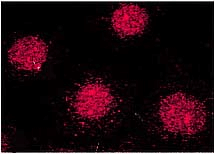 Immunocytochemistry/Immunofluorescence analysis using Mouse Anti-FKBP52 Monoclonal Antibody, Clone Hi52C (11103). Tissue: MCF-7 cells (metastatic mammary gland/breast cell line). Species: Human. Primary Antibody: Mouse Anti-FKBP52 Monoclonal Antibody (11103) at 1:1000. Secondary Antibody: APC Goat Anti-Mouse (red). Courtesy of: Tom Ratajczak, Univ. of W. Australia.
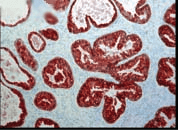 Immunohistochemistry analysis using Mouse Anti-FKBP52 Monoclonal Antibody, Clone Hi52C (11103). Tissue: prostate tissue (ductal epithelial cells). Species: Human. Primary Antibody: Mouse Anti-FKBP52 Monoclonal Antibody (11103) at 1:1000. Courtesy of: David F. Smith, Mayo Clinic, USA.
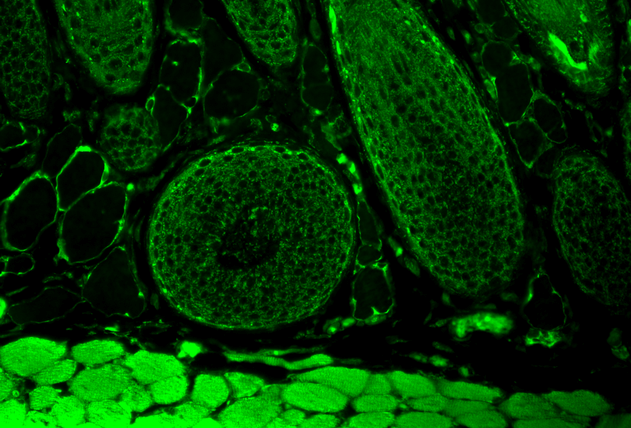 Immunohistochemistry analysis using Mouse Anti-FKBP52 Monoclonal Antibody, Clone Hi52C (11103). Tissue: backskin. Species: Mouse. Fixation: Bouin’s Fixative and paraffin-embedded. Primary Antibody: Mouse Anti-FKBP52 Monoclonal Antibody (11103) at 1:100 for 1 hour at RT. Secondary Antibody: FITC Goat Anti-Mouse (green) at 1:50 for 1 hour at RT. Localization: Epidermis.
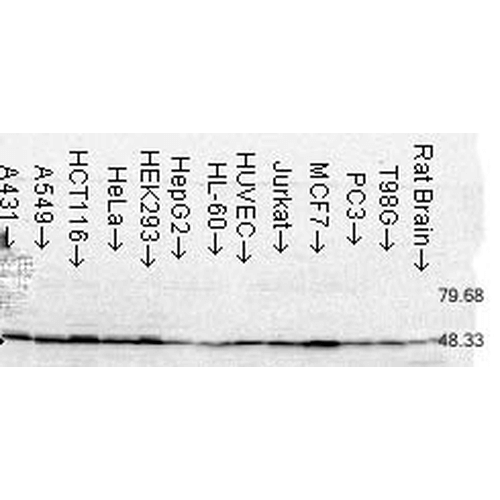 Western Blot analysis of Human Cell lysates showing detection of FKBP52 protein using Mouse Anti-FKBP52 Monoclonal Antibody, Clone Hi52C (11103). Load: 15 µg. Block: 1.5% BSA for 30 minutes at RT. Primary Antibody: Mouse Anti-FKBP52 Monoclonal Antibody (11103) at 1.5 µg/mL for 2 hours at RT. Secondary Antibody: Sheep Anti-Mouse IgG: HRP for 1 hour at RT.
- -
- -
Antibody DetailsProduct DetailsReactivity Species Canine ⋅ Hamster ⋅ Human ⋅ Mouse ⋅ Rat Host Species Mouse Immunogen Recombinant full-length FKBP52 with an N-terminal polyhistidine tag. Product Concentration Lot Specific Formulation PBS, pH 7.4. State of Matter Liquid Product Preparation Purified by Protein G affinity chromatography Storage and Handling This antibody is stable for at least one (1) year at -20°C. Avoid repeated freezing and
thawing. Regulatory Status For in vitro investigational use only. Not for
use in therapeutic or diagnostic procedures. Country of Origin USA Shipping Next Day 2-8°C Applications and Recommended Usage? Quality Tested by Leinco Immunoblotting: use at 0.5-1ug/mL. A band of ~52 kDa is detected.
Immunohistochemistry: use at 4-5ug/mL Immunoprecipitation: 5ug on 10-20ul Protein A-Sepharose + 100ul sample. These are recommended concentrations. User should determine optimal concentrations for their application. Positive control: HeLa cell lysate, rat kidney and rat/mouse testes tissue extracts. Each investigator should determine their own optimal working dilution for specific applications. See directions on lot specific datasheets, as information may periodically change. DescriptionSpecificity This antibody recognizes human, mouse, rat, dog, and hamster FKBP52. Background FK506-binding proteins, FKBP51 and FKBP52, are high molecular weight immunophilins that are part of the mature glucocorticoid receptor heterocomplex. The N-terminal domains of these proteins bind FK506 and have peptidyl-prolyl isomerase activity that converts prolyl peptide bonds within target proteins from cis- to trans- proline. The C-terminal domains contain the tetratricopeptide repeats that are involved in protein-protein interactions with Hsp90. Although FKBP52 and FKBP51 share ~75% sequence similarity, they affect hormone binding by glucocorticoid receptors differently and have different Hsp90-binding characteristics. In addition, FKBP51 is linked to the progesterone receptor while FKBP52 is linked to progesterone, androgen, and glucocorticoid receptors. Antigen DetailsFunction Immunophilin protein with PPIase and co-chaperone activities. Component of steroid receptors heterocomplexes through interaction with heat-shock protein 90 (HSP90). May play a role in the intracellular trafficking of heterooligomeric forms of steroid hormone receptors between cytoplasm and nuclear compartments. The isomerase activity controls neuronal growth cones via regulation of TRPC1 channel opening. Acts also as a regulator of microtubule dynamics by inhibiting MAPT/TAU ability to promote microtubule assembly. May have a protective role against oxidative stress in mitochondria. {PubMed:1279700, PubMed:1376003, PubMed:19945390, PubMed:21730050, PubMed:2378870}. NCBI Gene Bank ID UniProt.org Research Area Heat Shock & Stress Proteins References & CitationsNair, SC et al. 1997 Mol Cell Biol 17: 594- 603 Technical ProtocolsICC IF    |
Formats Available
 Products are for research use only. Not for use in diagnostic or therapeutic procedures.