

Anti-K+/Cl- Cotransporter (KCC2) [Clone S1-12]


Anti-K+/Cl- Cotransporter (KCC2) [Clone S1-12]
Product No.: 11564
- -
- -
Clone S1-12 Target K+/Cl- Cotransporter (KCC2) Formats AvailableView All Product Type Monoclonal Alternate Names Electroneutral potassium-chloride cotransporter 2, Furosemide-sensitive K-Cl cotransporter, K-Cl cotransporter 2, rKCC2, Neuronal K-Cl cotransporter Isotype Mouse IgG2a Applications ICC , IF , IHC , IP , WB |
Data
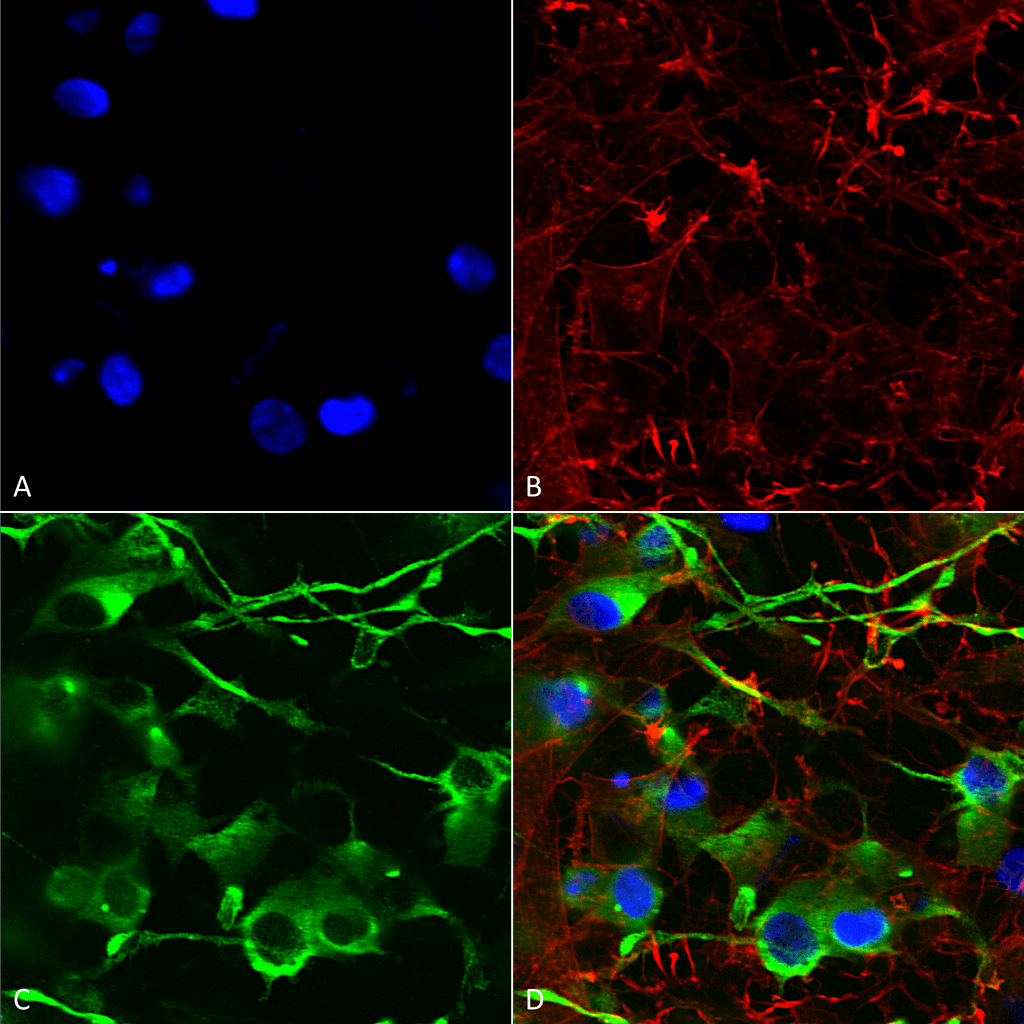 Immunocytochemistry/Immunofluorescence analysis using Mouse Anti-KCC2 Monoclonal Antibody, Clone S1-12 (11564). Tissue: Neuroblastoma cells (SH-SY5Y). Species: Human. Fixation: 4% PFA for 15 min. Primary Antibody: Mouse Anti-KCC2 Monoclonal Antibody (11564) at 1:200 for overnight at 4°C with slow rocking. Secondary Antibody: AlexaFluor 488 at 1:1000 for 1 hour at RT. Counterstain: Phalloidin-iFluor 647 (red) F-Actin stain; Hoechst (blue) nuclear stain at 1:800, 1.6mM for 20 min at RT. (A) Hoechst (blue) nuclear stain. (B) Phalloidin-iFluor 647 (red) F-Actin stain. (C) KCC2 Antibody (D) Composite.
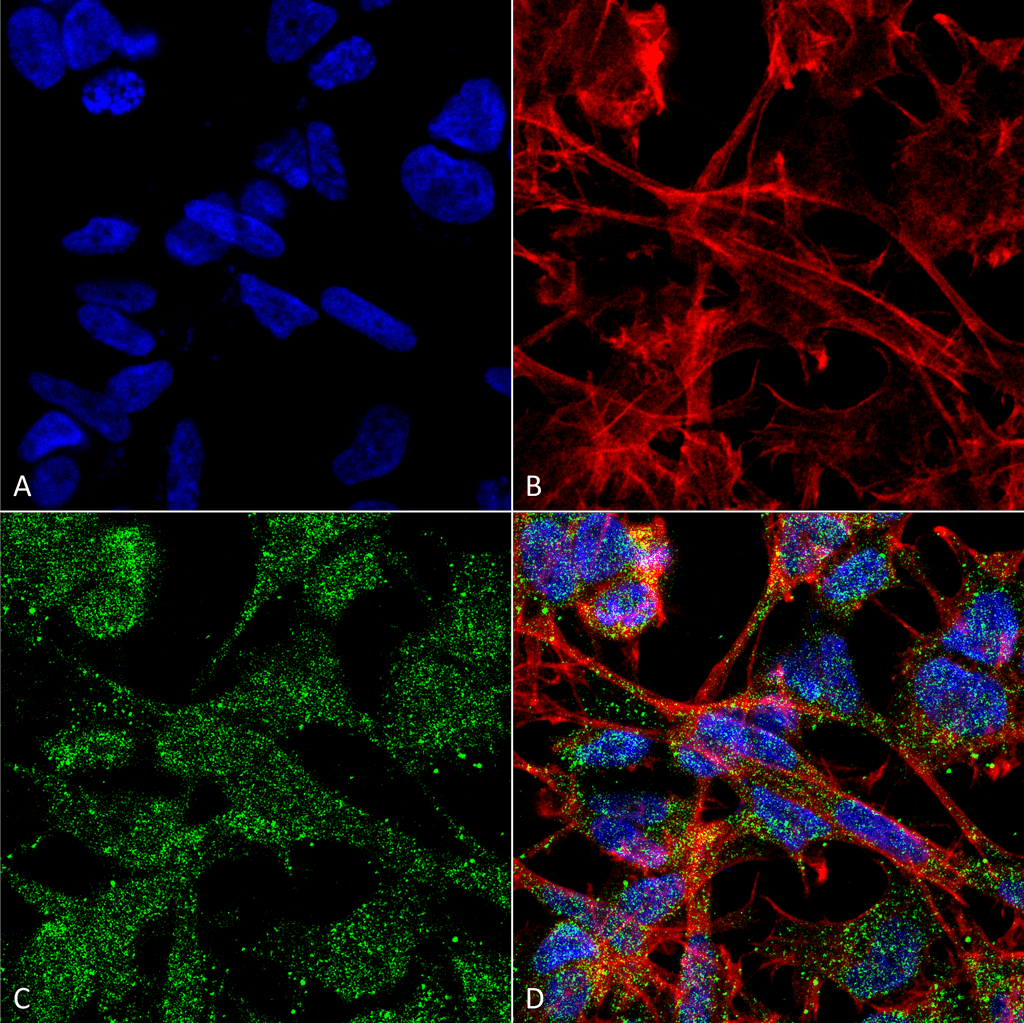 Immunocytochemistry/Immunofluorescence analysis using Mouse Anti-KCC2 Monoclonal Antibody, Clone S1-12 (11564). Tissue: Neuroblastoma cell line (SK-N-BE). Species: Human. Fixation: 4% Formaldehyde for 15 min at RT. Primary Antibody: Mouse Anti-KCC2 Monoclonal Antibody (11564) at 1:100 for 60 min at RT. Secondary Antibody: Goat Anti-Mouse ATTO 488 at 1:200 for 60 min at RT. Counterstain: Phalloidin Texas Red F-Actin stain; DAPI (blue) nuclear stain at 1:1000, 1:5000 for 60 min at RT, 5 min at RT. Localization: Membrane. Magnification: 60X. (A) DAPI (blue) nuclear stain. (B) Phalloidin Texas Red F-Actin stain. (C) KCC2 Antibody. (D) Composite.
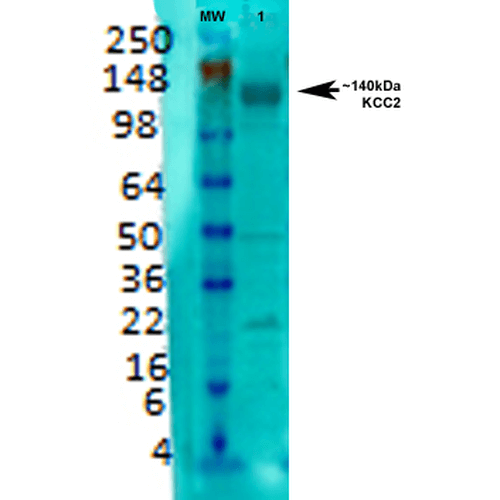 Western Blot analysis of Rat brain membrane lysate showing detection of KCC2 protein using Mouse Anti-KCC2 Monoclonal Antibody, Clone S1-12 (11564). Primary Antibody: Mouse Anti-KCC2 Monoclonal Antibody (11564) at 1:1000.
 - -
- -
Antibody DetailsProduct DetailsReactivity Species Human ⋅ Mouse ⋅ Rat Host Species Mouse Immunogen Fusion protein consisting of aa 932-1043 of rat KCC2 (accession no. NP_599190). Product Concentration 1.0 mg/ml Formulation PBS, pH 7.4, 50% glycerol, 0.09% sodium azide. State of Matter Liquid Product Preparation Purified by Protein G affinity chromatography Storage and Handling This antibody is stable for at least one (1) year at -20°C. Avoid repeated freeze-thaw cycles. Regulatory Status For in vitro investigational use only. Not for use in therapeutic or diagnostic procedures. Country of Origin USA Shipping Next Day 2-8°C Applications and Recommended Usage? Quality Tested by Leinco Immunoblotting: use at 3ug/mL. A band of ~140kDa is detected.
Immunohistochemistry: use at 1-5ug/mL. Positive control: Adult rat brain These are recommended concentrations; Enduser should determine optimal concentrations for their applications. Each investigator should determine their own optimal working dilution for specific applications. See directions on lot specific datasheets, as information may periodically change. DescriptionSpecificity This antibody recognizes human, mouse and rat KCC2. Background KCC2 is a member of the cation-chloride cotransporter gene family. KCCs lower intracellular chloride concentrations below the electrochemical equilibrium potential. Depending on the concentration gradients of potassium and chloride, KCC2 can operate as a net efflux or influx pathway. KCC2 is expressed at high levels in neurons throughout the nervous system and is localized at inhibitory synapses of the spinal cord. Studies in mice have shown that KCC2 reduces GABA's inhibitory signaling resulting in motor defects, epilepsy, and anxiety-like behavior. Antigen DetailsFunction Mediates electroneutral potassium-chloride cotransport in mature neurons and is required for neuronal Cl(-) homeostasis. As major extruder of intracellular chloride, it establishes the low neuronal Cl(-) levels required for chloride influx after binding of GABA-A and glycine to their receptors, with subsequent hyperpolarization and neuronal inhibition (PubMed:9930699). Involved in the regulation of dendritic spine formation and maturation (PubMed:22345354). {PubMed:22345354, PubMed:9930699}. NCBI Gene Bank ID UniProt.org Research Area Ion Channels References & CitationsTechnical ProtocolsICC IF    |
Formats Available
 Products are for research use only. Not for use in diagnostic or therapeutic procedures.
