

Anti-Prekallikrein Heavy Chain [Clone 13G11]


Anti-Prekallikrein Heavy Chain [Clone 13G11]
Product No.: 19901
Data
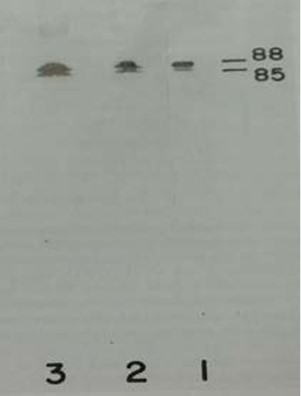 Immunoblotting:
use at 1-5ug/ml. Bands of 85kDa and 88kDa are detected. Detection of prekallikrein in normal human plasma (Lanes 2 and 3). For comparison, purified human prekallikrein is included in Lane 1.
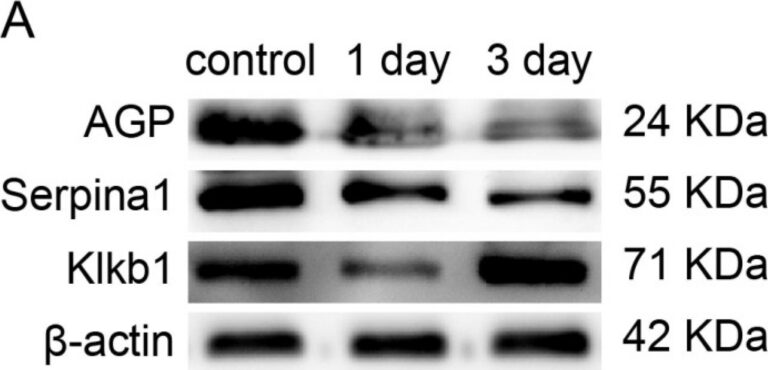 Western blot validation of the three differentially expressed proteins identified by the iTRAQ-based proteomics approach were performed using the remaining five plasma samples from each of the groups. Significant differences among multiple groups were calculated by one-way analysis of variance (ANOVA) followed by Tukey’s Honest Significant Difference test. * means p < 0.05 between the control group and 1 day or 3 day group.
- -
- -
Antibody DetailsProduct DetailsReactive Species Human Host Species Mouse Immunogen Purified human prekallikrein. Product Concentration Lot Specific Formulation This monoclonal antibody is aseptically packaged and formulated in 0.01 M phosphate buffered saline (150 mM NaCl) PBS pH 7.2 - 7.4 with no carrier protein, potassium, calcium or preservatives added. State of Matter Liquid Product Preparation Purified by Protein G affinity chromatography Storage and Handling This antibody is stable for at least one (1) year at -20°C. Avoid multiple freeze-thaw cycles. Country of Origin USA Shipping Next Day 2-8°C Applications and Recommended Usage? Quality Tested by Leinco Immunoblotting: use at 1-5ug/mL. Bands of 85kDa and 88kDa are detected
ELISA: use at 5-10ug/mL with prekallikrein sample bound to ELISA plates. These are recommended concentrations. Endusers should determine optimal concentrations for their applications. Each investigator should determine their own optimal working dilution for specific applications. See directions on lot specific datasheets, as information may periodically change. DescriptionDescriptionSpecificity This antibody recognizes two variants of prekallikrein in human plasma, 88kDa and
85kDa, and its activation products kallikrein, the complexes formed by kallikrein with its
endogenous inhibitors C1 inhibitor, alpha-2-macroglobulin and antithrombin III, and 45kDa
prekallikrein/kallikrein fragments. It also recognizes prekallikrein and its activation products in
chimpanzee, rhesus, and baboon plasmas. The epitope for this antibody is located on the
prekallikrein/kallikrein hevy chain and is involved in the interaction between prekallikrein and
factor XIIa. This antibody inhibits prekallikrein activation in human and rhesus plasmas by ~60-
80% and 55%, respectively. This antibody does not cross-react with tissue kallikrein. Background Human prekallikrein, a serine protease zymogen, is present in plasma as two variants, 88kDa and 85kDa, probably due to different carbohydrate content. Approximately 75% of the total prekallikrein in plasma is noncovalently associated with high molecular weight kininogen (HMWK). HMWK mediates binding of prekallikrein to a negatively-charged surface which is required for its optimal activation to kallikrein by activated factor XII. Although kallikrein light and heavy chains can behave as functionally independent domains, the interaction between these two chains is essential for full biologic activity. Function The enzyme cleaves Lys-Arg and Arg-Ser bonds. It activates, in a reciprocal reaction, factor XII after its binding to a negatively charged surface. It also releases bradykinin from HMW kininogen and may also play a role in the renin-angiotensin system by converting prorenin into renin. NCBI Gene Bank ID UniProt.org Research Area Coagulation factors References & CitationsDas A et al. Biochim Biophys Acta 1571: 225-38 (2002). Campbell DJ et al. Am J Physiol Integrative Comp Physiol 281: R1059-70 (2001). Veloso D. Immunopharmacology 33: 374-6 (1996). Veloso D et al. Thrombosis and Haemostatis 68: 526-533 (1992). Veloso D and Colman RW. Thrombosis and Haemostatis 65: 382-8°C8 (1991). Veloso D et al. Adv Exp Med Biol 247: 499-505 (1989). Veloso D et al. Blood 70: 1053-62 (1987). Technical Protocols  Certificate of Analysis |
Formats Available
 Products are for research use only. Not for use in diagnostic or therapeutic procedures.