

Recombinant Mouse Flt-3 Ligand


Data
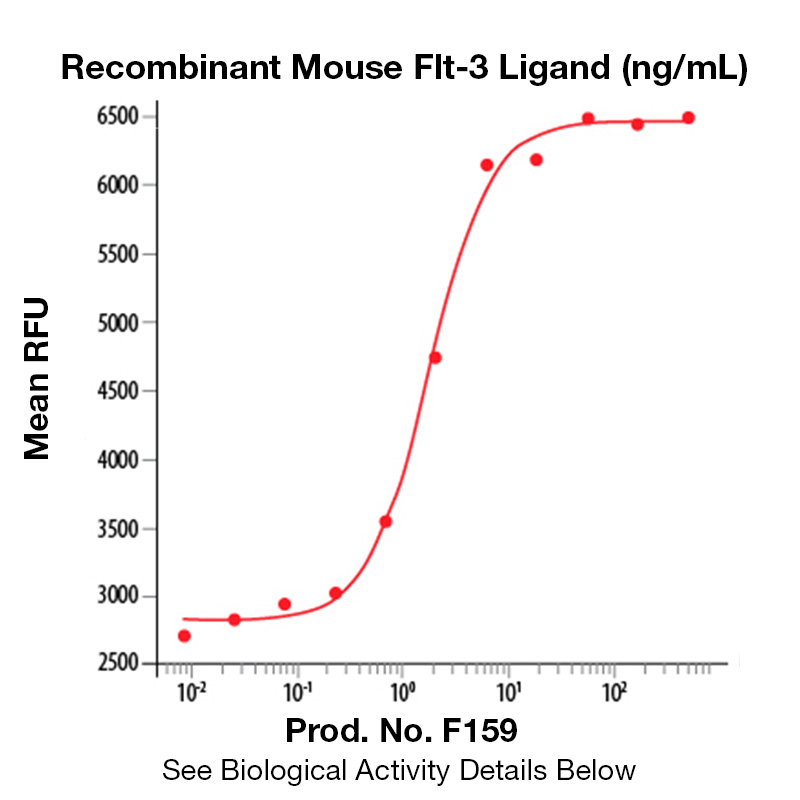
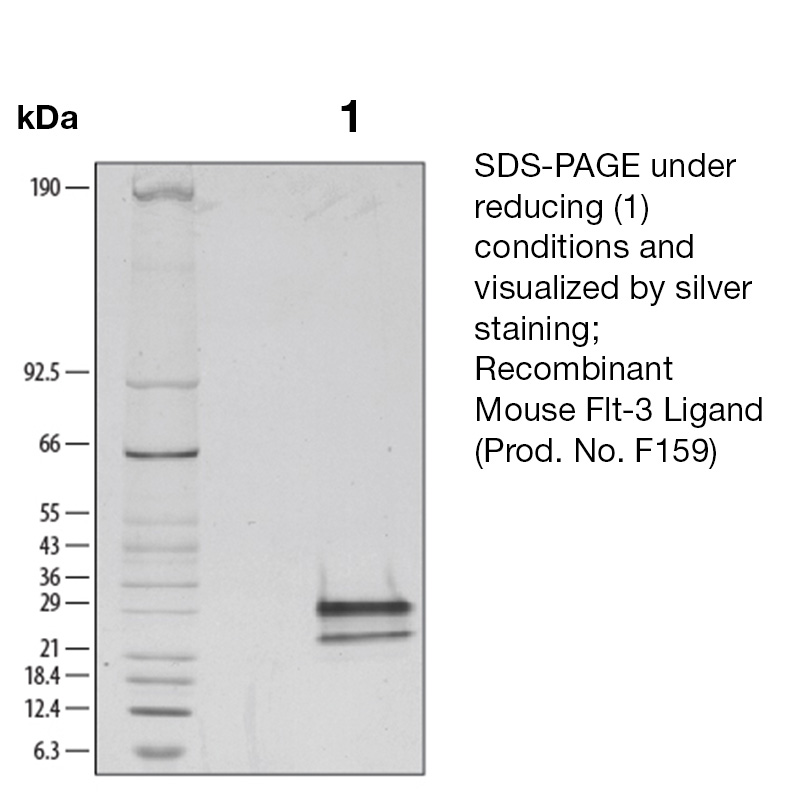
BackgroundFms-related tyrosine kinase 3 ligand (FLT3LG) is a hematopoietic four helical bundle cytokine. It is structurally homologous to stem cell factor (SCF) and colony stimulating factor 1 (CSF-1). In synergy with other growth factors, such as IL-7 and IL-3, Flt-3 ligand promotes long-term expansion and differentiation of human pro-B-cells.1,2 Flt3 ligand is a cytokine capable of inducing large numbers of dendritic cells that dramatically enhances the sensitivity of antigen-specific B and T cell responses to systemic injection of a soluble protein. Through a CD40-CD40 ligand-dependent mechanism Flt-3 Ligand influences the class of antibody produced and enables productive immune responses.3 Protein DetailsPurity >97% by SDS-PAGE and analyzed by silver stain. Endotoxin Level <0.1 EU/µg as determined by the LAL method Biological Activity The biological activity of Mouse FLT3LG was determined in a cell proliferation assay. The expected ED<sub>50</sub>=1-4ng/ml Protein Accession No. Amino Acid Sequence gtpd cyfshspiss nfkvkfrelt dhllkdypvt vavnlqdekh ckalwslfla qrwieqlktv agskmqtlle dvnteihfvt sctfqplpec lrfvqtnish llkdtctqll alkpcigkac qnfsrclevq cqpdsstllp prspialeat elpeprpr N-terminal Sequence Analysis Gly27 State of Matter Lyophilized Predicted Molecular Mass The predicted molecular weight of Recombinant Mouse Flt-3 Ligand is Mr 18 kDa. However, the actual molecular weight as observed by migration on SDS-PAGE is Mr 18-32 kDa. Predicted Molecular Mass 18 Formulation This recombinant protein was lyophilized from a 0.2 μm filtered solution in 45% acetonitrile (CH3CN) and 0.1% trifluoroacetic acid (TFA). Storage and Stability This lyophilized protein is stable for six to twelve months when stored desiccated at -20°C to -70°C. After aseptic reconstitution, this protein may be stored at 2°C to 8°C for one month or at -20°C to -70°C in a manual defrost freezer. Avoid Repeated Freeze Thaw Cycles. See Product Insert for exact lot specific storage instructions. Country of Origin USA Shipping Next Day Ambient NCBI Gene Bank Leinco Protein AdvisorPowered by AI: AI is experimental and still learning how to provide the best assistance. It may occasionally generate incorrect or incomplete responses. Please do not rely solely on its recommendations when making purchasing decisions or designing experiments. Recombinant Mouse Flt-3 Ligand (FLT3L) is widely used in research to promote the expansion, differentiation, and functional study of hematopoietic and immune cell populations, particularly dendritic cells, early progenitors, and lymphoid lineages. Key scientific applications and rationale include:
In summary, using recombinant mouse FLT3L enables precise control over hematopoietic and immune cell development in experimental systems, making it indispensable for basic and translational research in immunology, hematopoiesis, infection, and disease modeling. Yes, you can use Recombinant Mouse Flt-3 Ligand (Flt3L) as a standard for quantification or calibration in your ELISA assays, provided that your ELISA is designed to detect mouse Flt3L and the recombinant protein is compatible with the assay format. Key Points Supporting Its Use as an ELISA Standard:
Recommendations:
In summary, Recombinant Mouse Flt-3 Ligand is a suitable and widely used standard for quantification in ELISA assays targeting mouse Flt3L. Applications of Recombinant Mouse Flt-3 Ligand in Published ResearchRecombinant mouse Flt-3 ligand (FLT3L) has been validated across a diverse range of applications in published research, spanning immunology, hematology, and therapeutic development. Hematopoietic Cell Development and ExpansionFLT3L functions as a potent stimulator of hematopoietic cell proliferation and differentiation. The protein stimulates cell proliferation in the BaF3 mouse pro-B cell line transfected with mouse Flt-3, with an ED₅₀ of 0.4-2.4 ng/mL. Additionally, FLT3L synergizes with multiple cytokines including IL-3, GM-CSF, and stem cell factor to promote mobilization and myeloid differentiation of hematopoietic stem cells. When combined with stem cell factor and thrombopoietin, FLT3L is commonly used to promote expansion of primitive hematopoietic cells in culture. Dendritic Cell Generation and MaturationOne of the most well-established applications involves dendritic cell (DC) development. FLT3L controls the development of dendritic cells and is particularly important for plasmacytoid DCs and CD8-positive classical DCs and their CD103-positive tissue-resident counterparts. The protein induces maturation and expansion of dendritic cells both in vivo and for in vitro generation of bone marrow-derived DCs. Research has demonstrated that FLT3L therapy increases all classical dendritic cell subsets in orthotopic breast cancer and lung cancer models. B and T Cell DevelopmentFLT3L cooperates with IL-2, IL-6, IL-7, and IL-15 to induce natural killer cell development. The protein also works with IL-3, IL-7, and IL-11 to induce terminal B cell maturation. Furthermore, FLT3L facilitates formation of regulatory T cells (Tregs), which has been shown to reduce the severity of antigen-induced arthritis in mice. Eosinophil GenerationFLT3L enables the generation of eosinophils from bone marrow progenitor cells, expanding its utility in studying myeloid lineage differentiation. Inflammatory and Immunological StudiesThe protein has been applied to studies on allergic airway inflammation in mouse models. Additionally, animal studies demonstrate that FLT3L reduces the severity of experimentally induced allergic inflammation. Published research shows that FLT3L treatment reduces enterovirus A71 lethality in mice with enhanced B cell responses, and acutely malnourished weanling mice administered FLT3L can support cell-mediated inflammatory responses. Therapeutic and Bioassay ApplicationsFLT3L has been validated for functional assays, ELISA, Western blot, and immunohistochemistry applications. The protein has been successfully expressed in recombinant form and used as a specific vehicle to deliver cytotoxic drugs to FLT3-expressing acute myeloid leukemia cells, demonstrating its utility in targeted therapeutic development. Skeletal MyogenesisEmerging research has identified FLT3L signaling as a novel regulator of skeletal myogenesis, with studies demonstrating that FLT3L depletion impairs differentiation of mouse primary myoblasts. To reconstitute and prepare Recombinant Mouse Flt-3 Ligand (FLT3L) protein for cell culture experiments, dissolve the lyophilized protein in sterile water or PBS at a concentration between 50–100 µg/mL. For optimal stability and activity, further dilute in cell culture medium or buffer containing at least 0.1% BSA to prevent adsorption and loss of bioactivity. Step-by-step protocol:
Summary Table:
Key points:
These steps ensure maximal recovery, stability, and bioactivity of recombinant mouse Flt-3 Ligand for cell culture applications. References & Citations1. Mattson, J. et al. (1994) Nature 368: 643 2. Cleveland, LS. et al. (1995) Oncogene 10: 149 3. Maliszewski, CR. et al. (1998) J. Exp. Med. 188: 2075 Certificate of AnalysisIMPORTANT Use lot specific datasheet for all technical information pertaining to this recombinant protein. |
Related Products
Prod No. | Description |
|---|---|
F1071 | |
F1076 | |
F159 | |
F1029 | |
F1062 | |
F135 | |
F1096 | |
F114 |
 Products are for research use only. Not for use in diagnostic or therapeutic procedures.
