



Data
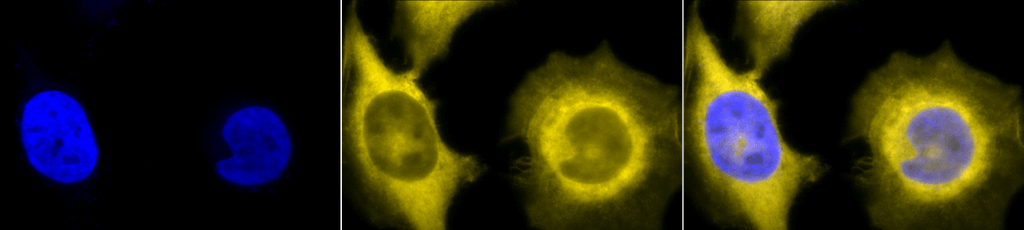 Immunocytochemistry/Immunofluorescence analysis using Rat Anti-GRP94 Monoclonal Antibody, Clone 9G10 (11097). Tissue: Heat Shocked cervical cancer cells (HeLa). Species: Human. Fixation: 2% Formaldehyde for 20 min at RT. Primary Antibody: Rat Anti-GRP94 Monoclonal Antibody (11097) at 1:100 for 12 hours at 4°C. Secondary Antibody: R-PE Goat Anti-Rat (yellow) at 1:200 for 2 hours at RT. Counterstain: DAPI (blue) nuclear stain at 1:40000 for 2 hours at RT. Localization: Endoplasmic reticulum lumen. Melanosome. Magnification: 100x. (A) DAPI (blue) nuclear stain. (B) Anti-GRP94 Antibody. (C) Composite. Heat Shocked at 42°C for 1h.
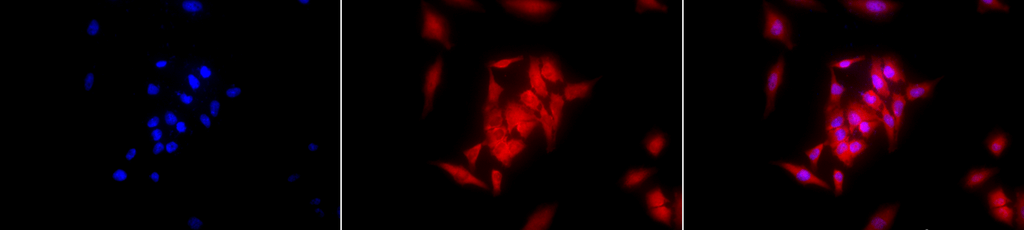 Immunocytochemistry/Immunofluorescence analysis using Rat Anti-GRP94 Monoclonal Antibody, Clone 9G10 (11097). Tissue: Heat Shocked cervical cancer cells (HeLa). Species: Human. Fixation: 2% Formaldehyde for 20 min at RT. Primary Antibody: Rat Anti-GRP94 Monoclonal Antibody (11097) at 1:100 for 12 hours at 4°C. Secondary Antibody: APC Goat Anti-Rat (red) at 1:200 for 2 hours at RT. Counterstain: DAPI (blue) nuclear stain at 1:40000 for 2 hours at RT. Localization: Endoplasmic reticulum lumen. Melanosome. Magnification: 20x. (A) DAPI (blue) nuclear stain. (B) Anti-GRP94 Antibody. (C) Composite. Heat Shocked at 42°C for 1h.
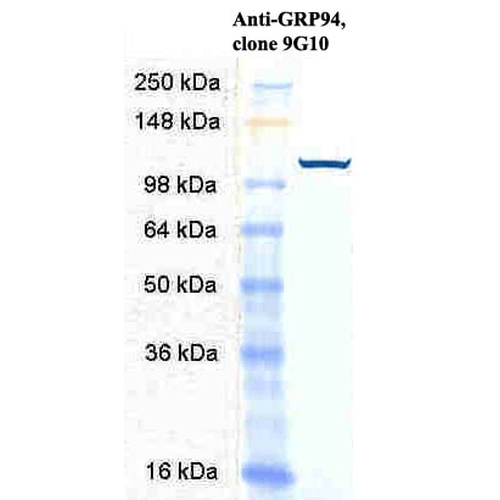 Western Blot analysis of Human Cervical cancer cell line (HeLa) lysate showing detection of GRP94 protein using Rat Anti-GRP94 Monoclonal Antibody, Clone 9G10 (11097). Primary Antibody: Rat Anti-GRP94 Monoclonal Antibody (11097) at 1:1000. Secondary Antibody: HRP Goat Anti-Rat.
- -
- -
Antibody DetailsProduct DetailsReactivity Species Bovine ⋅ Canine ⋅ Chicken ⋅ Guinea Pig ⋅ Hamster ⋅ Human ⋅ Monkey ⋅ Mouse ⋅ Pig ⋅ Rabbit ⋅ Rat ⋅ Sheep ⋅ Xenopus Host Species Rat Immunogen Purified Grp94 isolated from chicken oviducts. Product Concentration Lot Specific Formulation PBS, pH 7.4. State of Matter Liquid Product Preparation Purified by Protein G affinity chromatography Storage and Handling This antibody is stable for at least one (1) year at -20°C. Regulatory Status For in vitro investigational use only. Not for
use in therapeutic or diagnostic procedures. Country of Origin USA Shipping Next Day 2-8°C Applications and Recommended Usage? Quality Tested by Leinco Immunoblotting: use at 0.5-1ug/mL. A band of ~98 kDa is detected.
Immunohistochemistry: use at 2-30ug/mL. Immunoprecipitation: 10ug/mL. These are recommended concentrations. User should determine optimal concentrations for their application. Positive control: HeLa cell lysate. Each investigator should determine their own optimal working dilution for specific applications. See directions on lot specific datasheets, as information may periodically change. DescriptionSpecificity This antibody recognizes an ~98 kDa protein corresponding to the predicted molecular mass of Grp94 on SDS-PAGE immunoblots in human, mouse, rat, rabbit, monkey, hamster, guinea pig, dog, bovine, sheep, pig, chicken and Xenopus. Background Glucose-regulated protein 94 (Grp94) is an endoplasmic reticulum luminal stress protein which belongs to the Hsp90 family of molecular chaperones. The sequence of Grp94 includes the COOH-terminal tetrapeptide Lys-Asp-Glu-Leu (KDEL) which is a signal sequence that causes proteins to be retained in the pre-Golgi compartments. Expression of Grp94 is up-regulated by stress conditions such as glucose starvation and heat shock, and it functions in intracellular trafficking of peptides from the extracellular space to the MHC class I antigen processing pathway of antigen- presenting cells. Antigen DetailsFunction Molecular chaperone that functions in the processing and transport of secreted proteins (By similarity). When associated with CNPY3, required for proper folding of Toll-like receptors (By similarity). Functions in endoplasmic reticulum associated degradation (ERAD) (PubMed:18264092). Has ATPase activity (By similarity). May participate in the unfolding of cytosolic leaderless cargos (lacking the secretion signal sequence) such as the interleukin 1/IL-1 to facilitate their translocation into the ERGIC (endoplasmic reticulum-Golgi intermediate compartment) and secretion; the translocation process is mediated by the cargo receptor TMED10 (PubMed:32272059). {UniProtKB:P08113, PubMed:18264092, PubMed:32272059}. NCBI Gene Bank ID UniProt.org Research Area Heat Shock & Stress Proteins References & CitationsTechnical ProtocolsICC IF   FCM |
Formats Available
 Products are for research use only. Not for use in diagnostic or therapeutic procedures.