

Anti-HSP70 (HSC70) [Clone N27F3-4]


Anti-HSP70 (HSC70) [Clone N27F3-4]
Product No.: 11095
Data
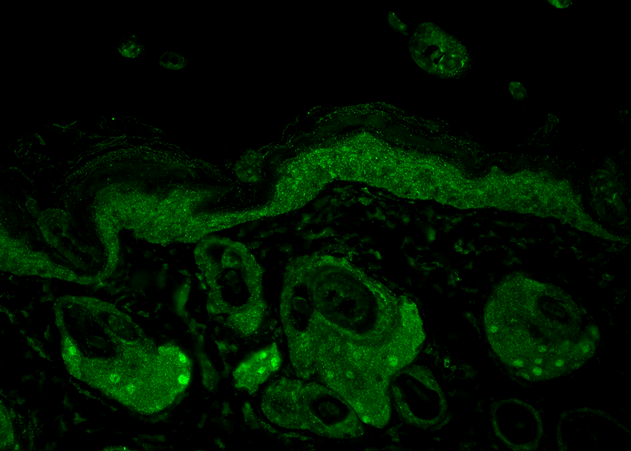 Immunohistochemistry analysis using Mouse Anti-Hsp70 Monoclonal Antibody, Clone N27F3-4 (11095). Tissue: backskin. Species: Mouse. Fixation: Bouin’s Fixative and paraffin-embedded. Primary Antibody: Mouse Anti-Hsp70 Monoclonal Antibody (11095) at 1:100 for 1 hour at RT. Secondary Antibody: FITC Goat Anti-Mouse (green) at 1:50 for 1 hour at RT. Localization: Epidermis.
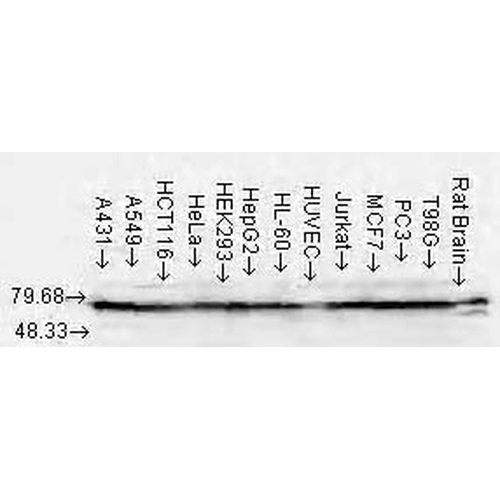 Western Blot analysis of Human Cell lysates showing detection of Hsp70 protein using Mouse Anti-Hsp70 Monoclonal Antibody, Clone N27F3-4 (11095). Load: 15 µg. Block: 1.5% BSA for 30 minutes at RT. Primary Antibody: Mouse Anti-Hsp70 Monoclonal Antibody (11095) at 1:1000 for 2 hours at RT. Secondary Antibody: Sheep Anti-Mouse IgG: HRP for 1 hour at RT.
- -
- -
Antibody DetailsProduct DetailsReactivity Species Bovine ⋅ C. elegans ⋅ Canine ⋅ Chicken ⋅ Drosophila ⋅ Fish ⋅ Guinea Pig ⋅ Hamster ⋅ Human ⋅ Monkey ⋅ Mouse ⋅ Ovine ⋅ Plant ⋅ Porcine ⋅ Rabbit ⋅ Rat ⋅ Xenopus Host Species Mouse Immunogen Recombinant Hsp70/Hsc70 Product Concentration Lot Specific Formulation PBS containing 0.1% sodium azide State of Matter Liquid Product Preparation Purified by Protein G affinity chromatography Storage and Handling This antibody is stable for at least one (1) year at 4°C. Precipitation may occur upon freezing and thawing. Regulatory Status For in vitro investigational use only. Not for
use in therapeutic or diagnostic procedures. Country of Origin USA Shipping Next Day 2-8°C Applications and Recommended Usage? Quality Tested by Leinco Immunoblotting: use at 1ug/mL. A band of 72-73kDa is detected.
Immunohistochemistry: use at 1-10ug/mL. Immunoprecipitation: 1-10ug/mL. Flow cytometry: use at 10ug/mL. These are recommended concentrations. User should determine optimal concentrations for their application. Positive control: HeLa cell lysate. Each investigator should determine their own optimal working dilution for specific applications. See directions on lot specific datasheets, as information may periodically change. DescriptionSpecificity This antibody recognizes inducible and
constitutive Hsp70/Hsc70 of human, mouse,
rat, rabbit, monkey, guinea pig, hamster,
chicken, bovine, canine, ovine, porcine, fish,
Xenopus, Drosophila, C. elegans, and
plants. The epitope is in the region of amino
acids 503-640 of human Hsp70. Background Hsp70 genes, members of a multigene family, encode heat-inducible 70kDa heat- shock proteins that function as molecular chaperones. They have been identified in most organelles of eukaryotic cells as well as in bacteria. The N-terminus of Hsp70 binds ATP with high affinity and the C- terminus binds proteins and polypeptides. Hsp70s bind nascent polypeptides as well as partially folded intermediates of proteins, thus preventing their aggregation and/or misfolding. Binding of ATP triggers a conformational change that results in the release of bound protein. Hsp70s function in protein synthesis, protein folding and oligomerization, and protein transport. Antigen DetailsNCBI Gene Bank ID UniProt.org Research Area Heat Shock & Stress Proteins References & CitationsTechnical ProtocolsICC IF    FCM IEM |
Formats Available
 Products are for research use only. Not for use in diagnostic or therapeutic procedures.