

Anti-Influenza B Neuraminidase [Clone B3]


Anti-Influenza B Neuraminidase [Clone B3]
Product No.: 19601
- -
- -
Clone B3 Target Influenza B Neuraminidase Formats AvailableView All Product Type Monoclonal Alternate Names EC 3.2.1.18 Isotype Mouse IgG2a Applications ELISA , N |
Data
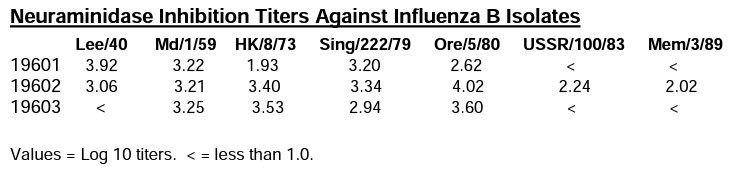 Neuraminidase Inhibition Titers Against Influenza B Isolates.
- -
- -
Antibody DetailsProduct DetailsReactive Species Influenza B Neuraminidase Host Species Mouse Immunogen Influenza B Lee/40 Product Concentration Lot Specific Formulation PBS, pH 7.4. State of Matter Liquid Product Preparation Purified by Protein G affinity chromatography Storage and Handling This antibody is stable for at least one (1) year at -20°C to -70°C. Store product in appropriate aliquots to avoid multiple freeze-thaw cycles. Country of Origin USA Shipping Next Day 2-8°C Applications and Recommended Usage? Quality Tested by Leinco These antibodies may be used in immunoassays to detect and quantitate Influenza B neuraminidase and in neuraminidase inhibition assays. Each investigator should determine their own optimal working dilution for specific applications. See directions on lot specific datasheets, as information may periodically change. DescriptionDescriptionSpecificity Mouse Monoclonal Antibody specific to Influenza B Neuraminidase Background Mechanism of Action: Influenza Neuraminidase
Neuraminidases are critical surface enzymes responsible for cleaving sialic acid groups from glycoproteins. In the context of the Influenza B virus, viral neuraminidase (NA) plays a pivotal role in the lifecycle of the pathogen. Structurally, Influenza neuraminidase is composed of four identical subunits arranged in a square tetramer, anchored to the virus surface by a long protein stalk. The enzyme’s active sites are located in deep depressions on the upper surface, where they bind to polysaccharide chains and clip off terminal sugars. Neuraminidase vs. Hemagglutinin in Viral Infection -Neuraminidase (NA) and Hemagglutinin (HA) are the two major membrane glycoproteins found on the surface of the influenza virus. They function in concert but with opposing roles: - Hemagglutinin (HA): Initiates infection by binding to sialic acid-containing receptors on the surface of host cells. - Neuraminidase (NA): Facilitates viral release. It acts as a receptor-destroying enzyme by cleaving the HA-sialic acid bond between newly formed virions and host cell receptors during budding. Research Applications for Anti-Influenza B Neuraminidase Antibodies Because of its essential role in viral spread, neuraminidase is a primary target for anti-influenza virus therapy development (such as neuraminidase inhibitors) and vaccine research. High-quality Influenza antibodies are indispensable tools for these studies. This Anti-Influenza B Neuraminidase Antibody (Cat. No. 19601) is specifically designed to aid researchers in: - Influenza Diagnosis: Detecting the presence of the Influenza B virus in biological samples. - Vaccine Development: Characterizing viral strains and assessing the potency of neuraminidase antigens. -Therapeutic Research: Screening and validating potential antiviral compounds that inhibit neuraminidase activity. Function Influenza B Neuraminidase (NA) is a receptor-destroying enzyme essential for the viral life cycle. It functions as a sialidase, cleaving terminal sialic acid residues from glycoproteins on the host cell surface and on newly formed virions. This enzymatic activity prevents the aggregation of progeny viruses and detaches them from the host cell receptors (hemagglutinin-sialic acid tethering), thereby facilitating the efficient release and spread of the virus to uninfected cells. NCBI Gene Bank ID UniProt.org Research Area Infectious Disease . Seasonal and Respiratory Infections . IVD Raw Material References & Citations1.) G.M. Air et al. (1990) Virology 177: 578. (Catalog no. 19601 = MAb B3, 19602 = MAb B14, 19603 = MAb B19). 2.) Matrosovich MN, Matrosovich TY, Gray T, Roberts NA, Klenk HD. Neuraminidase is important for the initiation of influenza virus infection in human airway epithelium. J Virol. 2004 Nov;78(22):12665-7. doi: 10.1128/JVI.78.22.12665-12667.2004. PMID: 15507653; PMCID: PMC525087. 3.)Creytens S, Pascha MN, Ballegeer M, Saelens X, de Haan CAM. Influenza Neuraminidase Characteristics and Potential as a Vaccine Target. Front Immunol. 2021 Nov 16;12:786617. doi: 10.3389/fimmu.2021.786617. PMID: 34868073; PMCID: PMC8635103. Technical Protocols N Certificate of Analysis |
Related Products
- -
- -
Formats Available
 Products are for research use only. Not for use in diagnostic or therapeutic procedures.
