

Anti-Mouse CD4 [Clone GK1.5] — Alexa Fluor® 647


Anti-Mouse CD4 [Clone GK1.5] — Alexa Fluor® 647
Product No.: C1640AF
Data
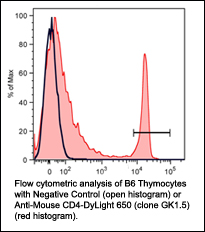
- -
- -
Antibody DetailsProduct DetailsReactive Species Mouse Host Species Rat Product Concentration 0.5 mg/ml Formulation This Alexa Fluor® 647 conjugate is formulated in 0.01 M phosphate buffered saline (150 mM NaCl) PBS pH 7.4, 1% BSA and 0.09% sodium azide as a preservative. Alexa Fluor® is a trademark of Life Technologies Corporation. State of Matter Liquid Storage and Handling This Alexa Fluor® 647 conjugate is stable when stored at 2-8°C. Do not freeze. Regulatory Status Research Use Only Country of Origin USA Shipping 2-8°C Wet Ice Excitation Laser Red Laser (633 nm) Alexa Fluor® 647 has a maximum emission of 668 nm when it is excited at 633 nm / 635 nm. Applications and Recommended Usage? Quality Tested by Leinco FC For flow cytometric staining, the suggested use of this reagent is 5 µl per million cells in 100 µl staining volume or 5 µl per 100 µl of whole blood. Titration of the reagent is recommended for optimal performance for each application. Additional Applications Reported In Literature ? IHC-FF ICC Each investigator should determine their own optimal working dilution for specific applications. See directions on lot specific datasheets, as information may periodically change. DescriptionDescriptionSpecificity Rat Anti-Mouse CD4 (CD4) (Clone GK1.5) recognizes an epitope on Mouse CD4. This monoclonal antibody was purified using multi-step affinity chromatography methods such as Protein A or G depending on the species and isotype. Background CD4 (cluster of differentiation 4) is a glycoprotein expressed on the surface of T helper cells, regulatory T cells, monocytes, macrophages, and dendritic cells. CD4 interacts with class II molecules of the major histocompatibility complex (MHC) enhancing the signal for T-cell activation.1 Antigen Distribution The L3T4 antigen is expressed by the helper/inducer subset of mouse T-cells. The antigen is present on approximately 80% of thymocytes, 20% of spleen cells and 60% of lymph node cells. The expression of L3T4 correlates with class II MHC antigen reactivity on cloned T-cell lines.
Ligand/Receptor MHC class II molecule PubMed NCBI Gene Bank ID UniProt.org References & Citations1. Hendrickson WA et al. (1994) Structure 2: 59 Technical Protocols ICC IHC FF Certificate of Analysis |
Related Products
Formats Available
 Products are for research use only. Not for use in diagnostic or therapeutic procedures.
