This monoclonal antibody is aseptically packaged and formulated in 20 mM L-histidine and 150 mM NaCl buffer, pH 5.9-6.1 with no carrier protein, potassium, calcium or preservatives added. Due to inherent biochemical properties of antibodies, certain products may be prone to precipitation over time. Precipitation may be removed by aseptic centrifugation and/or filtration.
Product Preparation
Functional grade preclinical antibodies are manufactured in an animal free facility using in vitro cell culture techniques and are purified by a multi-step process including the use of protein A or G to assure extremely low levels of endotoxins, leachable protein A or aggregates.
Pathogen Testing
To protect mouse colonies from infection by pathogens and to assure that experimental preclinical data is not affected by such pathogens, all of Leinco’s Purified Functional PLATINUM™ antibodies are tested and guaranteed to be negative for all pathogens in the IDEXX IMPACT I Mouse Profile.
Storage and Handling
Functional grade preclinical antibodies may be stored sterile as received at 2-8°C for up to one month. For longer term storage, aseptically aliquot in working volumes without diluting and store at ≤ -70°C. Avoid Repeated Freeze Thaw Cycles.
Applications and Recommended Usage? Quality Tested by Leinco
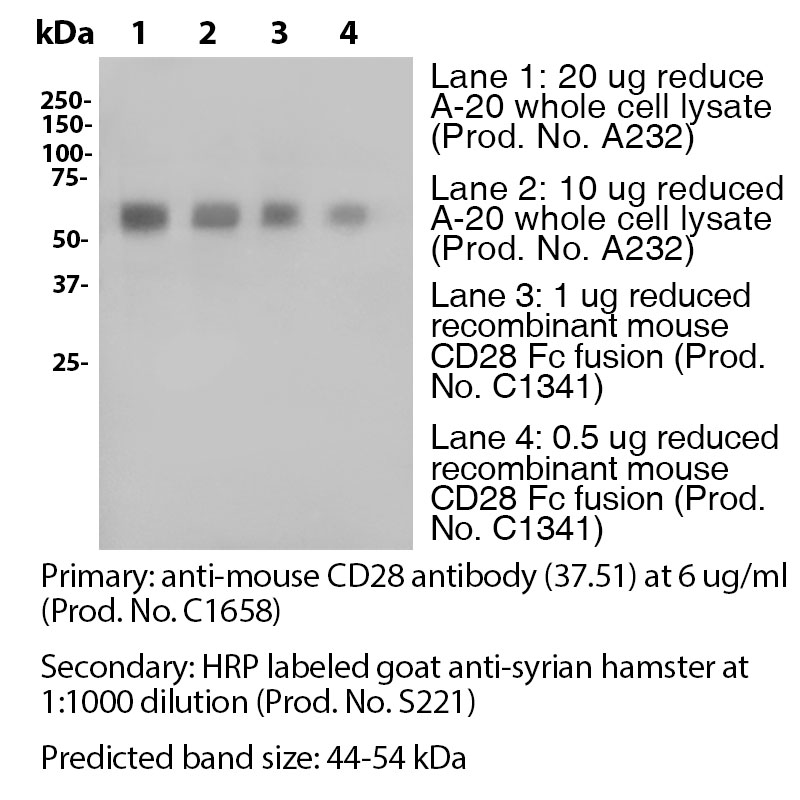
FC The suggested concentration for this 37.51 antibody for staining cells in flow cytometry is ≤ 1.0 μg per 106 cells in a volume of 100 μl. Titration of the reagent is recommended for optimal performance for each application. WB The suggested concentration for this 37.51 antibody for use in western blotting is 1-10 μg/ml.
Each investigator should determine their own optimal working dilution for specific applications. See directions on lot specific datasheets, as information may periodically change.
Description
Description
Specificity
Clone 37.51 recognizes an epitope on mouse CD28.
Background
CD28 is a 44 kD glycoprotein and a member of the Ig superfamily. In its capacity as a costimulatory receptor, CD28 produces co-stimulatory signals necessary for T cell activation and survival. CD28 is the only B7 receptor constitutively expressed on naive T cells. Without having this CD28/B7 interaction, T cells will fail to respond to their specific antigen when coming in contact with an MHC/antigen complex and thus, are said to be anergic.
Antigen Distribution
CD28 is expressed on thymocytes, CD4+, CD8+ peripheral T cells, NK cells.
Powered by AI: AI is experimental and still learning how to provide the best assistance. It may occasionally generate incorrect or incomplete responses. Please do not rely solely on its recommendations when making purchasing decisions or designing experiments.
Clone 37.51 is a monoclonal antibody targeting mouse CD28, commonly used in vivo to modulate T cell responses in mice. Its primary applications are:
T Cell Costimulation and Activation: Clone 37.51 is widely used to stimulate T cell activation and proliferation in vivo by engaging the CD28 costimulatory receptor, which augments IL-2 production, cytotoxicity, and overall immune responses.
Functional Immunological Assays: It provides a costimulatory signal in experimental models to study T cell-mediated immunity, often in the context of infectious disease models, cancer immunology, or vaccination studies.
CTL (Cytotoxic T Lymphocyte) Induction: It helps in the induction and analysis of CTL responses for studying cell-mediated immunity.
Cytokine Production Enhancement: The antibody increases cytokine output (e.g., IL-2) from activated T and NK cells, making it useful to model enhanced immune activation.
Flow Cytometry and Expression Analysis: Clone 37.51 can be used to identify and quantify CD28-expressing cells in tissues and blood by flow cytometry.
Bioanalytical/Pharmacokinetic Assays: It is utilized for neutralization studies, pathway analysis, and in bioanalytical assays when assessing activity or blockade of CD28-mediated signaling.
In Vivo Blockade of CD28: Some studies use the antibody for blocking CD28 to study effects of costimulation inhibition, although most frequently it is used as an agonist to enhance signaling.
Key cell populations targeted:
Most thymocytes
Peripheral CD4+ and CD8+ T cells
NK cells (to a lesser extent)
In summary, clone 37.51 is most commonly employed in mice for in vivo costimulatory activation of T cells—either to boost immune responses or dissect CD28-mediated signaling pathways in immunological research.
Commonly Used Companion Antibodies and Proteins
The 37.51 monoclonal antibody targets mouse CD28, a critical costimulatory receptor essential for optimal T cell activation and function. In the literature, clone 37.51 is most commonly used in conjunction with other antibodies and proteins to study T cell activation, costimulation, and immune response modulation.
Antibody Combinations
Anti-CD3: The most frequent partner is an anti-CD3 antibody, which provides the primary activation signal (Signal 1) to T cells. When combined with 37.51 (anti-CD28), this mimics the natural two-signal model of T cell activation—CD3 provides antigen recognition, while CD28 delivers the costimulatory signal (Signal 2).
Other T cell surface markers: Antibodies against CD4, CD8, CD25 (IL-2Rα), and CD69 (early activation marker) are often included in multicolor flow cytometry panels to phenotype and assess activation status of T cell subsets.
Regulatory markers: Antibodies to CTLA-4 (CD152), PD-1 (CD279), and other checkpoint molecules may be used alongside 37.51 to investigate costimulation in the context of immune regulation and exhaustion.
Protein and Cytokine Combinations
CD80 (B7-1) and CD86 (B7-2): These are the natural ligands for CD28 and are sometimes used in functional assays to compare antibody-mediated versus physiological CD28 engagement.
Cytokines: IL-2 is frequently measured as a readout of T cell activation induced by 37.51 anti-CD28 stimulation, and exogenous IL-2 may be added to cultures to enhance proliferation or survival.
Blocking antibodies: Anti-CTLA-4 or anti-PD-L1/PD-1 antibodies may be used to study the interplay between co-stimulation and co-inhibition pathways.
Experimental Applications
In vitro stimulation assays: 37.51 anti-CD28 is combined with anti-CD3 for polyclonal T cell activation, proliferation, and cytokine production assays.
Flow cytometry: Multicolor panels with 37.51 anti-CD28 allow identification of activated T cell subsets, often including markers like CD4, CD8, CD25, and CD69.
Costimulation studies: Researchers may combine 37.51 with other costimulatory or coinhibitory antibodies (e.g., anti-OX40, anti-4-1BB) to dissect pathways of T cell activation and regulation.
Summary Table
Category
Example Antibodies/Proteins
Role/Application
Primary Activation
Anti-CD3
Provides Signal 1 for T cell activation
Costimulation
37.51 (anti-CD28)
Provides Signal 2 (costimulation)
Phenotyping
Anti-CD4, Anti-CD8, Anti-CD25, Anti-CD69
Identifies T cell subsets and activation status
Checkpoints
Anti-CTLA-4, Anti-PD-1
Studies immune regulation and exhaustion
Ligands
CD80 (B7-1), CD86 (B7-2)
Compares antibody vs. physiological CD28 engagement
Cytokines
IL-2
Readout and enhancer of T cell responses
Blocking/Modulation
Anti-OX40, Anti-4-1BB
Investigates additional costimulatory pathways
Key Points
Anti-CD3 is the most common partner for 37.51, recapitulating the two-signal model of T cell activation.
CD4, CD8, CD25, CD69 are typical markers used alongside 37.51 in flow cytometry panels to phenotype and assess T cell activation.
CD80/CD86 are the natural ligands of CD28 and may be used in comparative functional assays.
Cytokines (especially IL-2) are both readouts and potential additives in such experiments.
Checkpoint antibodies (anti-CTLA-4, anti-PD-1) are used to model immune regulation in combination with 37.51.
These combinations are standard in mouse immunology studies for examining T cell biology, activation mechanisms, and immune modulation.
Clone 37.51 is a Syrian hamster monoclonal antibody targeting mouse CD28, a co-stimulatory receptor expressed on thymocytes, mature T cells, and NK cells; its key findings in scientific literature center on its ability to modulate T cell activation, proliferation, cytokine production, and immune responses in murine models.
Functional Insights:
Costimulation of T cells: Clone 37.51 binds CD28 and delivers a potent co-stimulatory signal, which, when combined with TCR/CD3 activation, significantly enhances T cell proliferation and upregulates IL-2 and IL-2 receptor expression.
Cytokine production: Studies document increased cytokine release (notably IL-2) and development of cytotoxic T lymphocytes (CTL) following CD28 stimulation by clone 37.51.
In vivo and in vitro utility: Widely used to probe immune cell activation and function in mouse models through costimulatory assays, flow cytometric phenotyping, and immune modulation experiments.
Application Context:
Flow cytometry: Used for surface staining to detect and characterize CD28 expression on mouse T cells; typically included in multicolor panels to analyze both CD4+ and CD8+ populations.
Functional assays: Extensively cited in protocols for in vitro T cell stimulation, in vivo immune response modulation, and inhibition/blocking experiments.
Expression profile: CD28 is expressed at varying densities across thymocyte maturation stages and peripheral T cell subsets; clone 37.51 is reported to clearly resolve these populations.
Publication Record:
Clone 37.51 is highly cited in the literature, most notably for functional assays (79 publications), flow cytometry (64), and in vitro assays (13).
Key references frequently cited include foundational immunology studies (e.g., Gallimore et al. 2005; Gross et al. 1992), validating its central role in mouse T cell biology.
Mechanistic Findings:
Engagement of CD28 by clone 37.51 promotes T cell proliferation and survival, counters T cell anergy (unresponsiveness), and can enhance cytotoxic function when paired with CD3 activation.
It has also been useful in studies examining co-stimulatory blockade, immune tolerance, and in vivo manipulation of T cell responses.
In summary, clone 37.51 is a cornerstone reagent in mouse immunology, leveraged to dissect costimulatory pathways, optimize T cell-based assays, and elucidate immune mechanisms in experimental systems; its citation record reflects widespread adoption for both phenotyping and functional modulation of CD28 in murine studies.
Dosing Regimens of Clone 37.51 Across Different Mouse Models
Clone 37.51 is a monoclonal antibody targeting the mouse CD28 costimulatory receptor, widely used in mouse immunology studies. While specific dosing regimens can vary significantly across different mouse models and experimental designs, general trends and applications of this antibody are outlined below:
General Use: Clone 37.51 is often used to study T cell activation, costimulation, and immune response modulation. It can enhance T cell proliferation and cytokine production, making it useful for both in vitro and in vivo experiments.
Dose Range: The dosing of clone 37.51 can vary based on the specific experimental requirements. For flow cytometry, it is typically used at concentrations less than or equal to 0.5 µg per test. However, in vivo studies often require larger doses, which can vary depending on the mouse model and the specific application.
Mouse Strains and Models: The dosing regimens may differ based on the mouse strain used and the specific model being studied. For example, in some studies involving graft-versus-host disease (GVHD), clone 37.51 is used to inhibit donor T cell expansion, but the exact dosing is not universally standardized.
Experimental Design: The route of administration (e.g., intravenous, intraperitoneal) and frequency of dosing can also influence the chosen regimen. These factors are typically optimized based on the experimental design and the goals of the study.
Unfortunately, specific detailed dosing regimens for clone 37.51 across different mouse models are not comprehensively summarized in the provided sources. However, it is crucial to consult the literature and experimental protocols specific to each model for precise dosing recommendations. Additionally, consulting guides on in vivo antibody dosing can provide more generalized advice on optimal dosing strategies for mouse models.
References & Citations
1. Gallimore, A. et al. (2005) J Immunol. 175(11):7098-102. PubMed
2. Gross, J. A. et al. (1992) J. Immunol.149:380






 Products are for research use only. Not for use in diagnostic or therapeutic procedures.
